

It's Thursday. You've trained four days in a row. Your legs feel heavy but your brain says you're being lazy. You open your app, glance at your numbers, and still can't decide whether to push through or back off.
This is one of the most common mental loops in training -- and it happens because most athletes think about rest in binary terms. Train or don't train. Go hard or do nothing.
The reality is more useful than that. The question isn't whether to rest. It's what kind of recovery your body actually needs today. And the answer is sitting in your data right now.
How to tell the difference between needing rest and just not feeling like it
This is the real question and it deserves an honest answer before anything else.
Motivation fluctuates. Mood fluctuates. Some mornings a workout feels hard before it starts and turns out to be your best session of the week. That's not a recovery signal -- that's normal human psychology.
The difference shows up in the data and in how your body actually responds once you start moving.
If you feel flat before a session but your HRV is normal, your RHR is stable, your sleep was solid, and your training load is manageable -- warm up slowly and give yourself 10 minutes before deciding. Most of the time the feeling shifts once you're moving. If it doesn't, and the effort feels disproportionately hard relative to the pace or weight, stop. That's a real signal.
If your data is clearly flagging fatigue and your body feels heavy and unmotivated -- that's alignment, not coincidence. Take the recovery day.
The goal is not to use rest as an escape from hard training. The goal is to use rest strategically so that your hard sessions are actually hard -- and actually productive -- when they happen.
Why rest days exist in the first place
When you train, you create controlled damage. Muscle fibers develop micro-tears. Glycogen stores deplete. Your nervous system accumulates fatigue. Your connective tissue absorbs stress. None of this is bad -- it's the entire point. The training session is the stimulus. The rest period is where your body responds to that stimulus by rebuilding stronger than before.
Skip the rest and you skip the adaptation. You're applying stress without allowing the response. Over time that compounds into a deficit your body will eventually force you to address -- through injury, illness, or a performance plateau that no amount of extra training will fix.
The athletes who make the most consistent progress are not the ones who train the most. They're the ones who recover most effectively between sessions.
Active recovery vs. full rest -- and why the distinction matters
Not all rest days are the same. There are two distinct types and knowing which one you need on a given day is what separates smart training from guesswork.
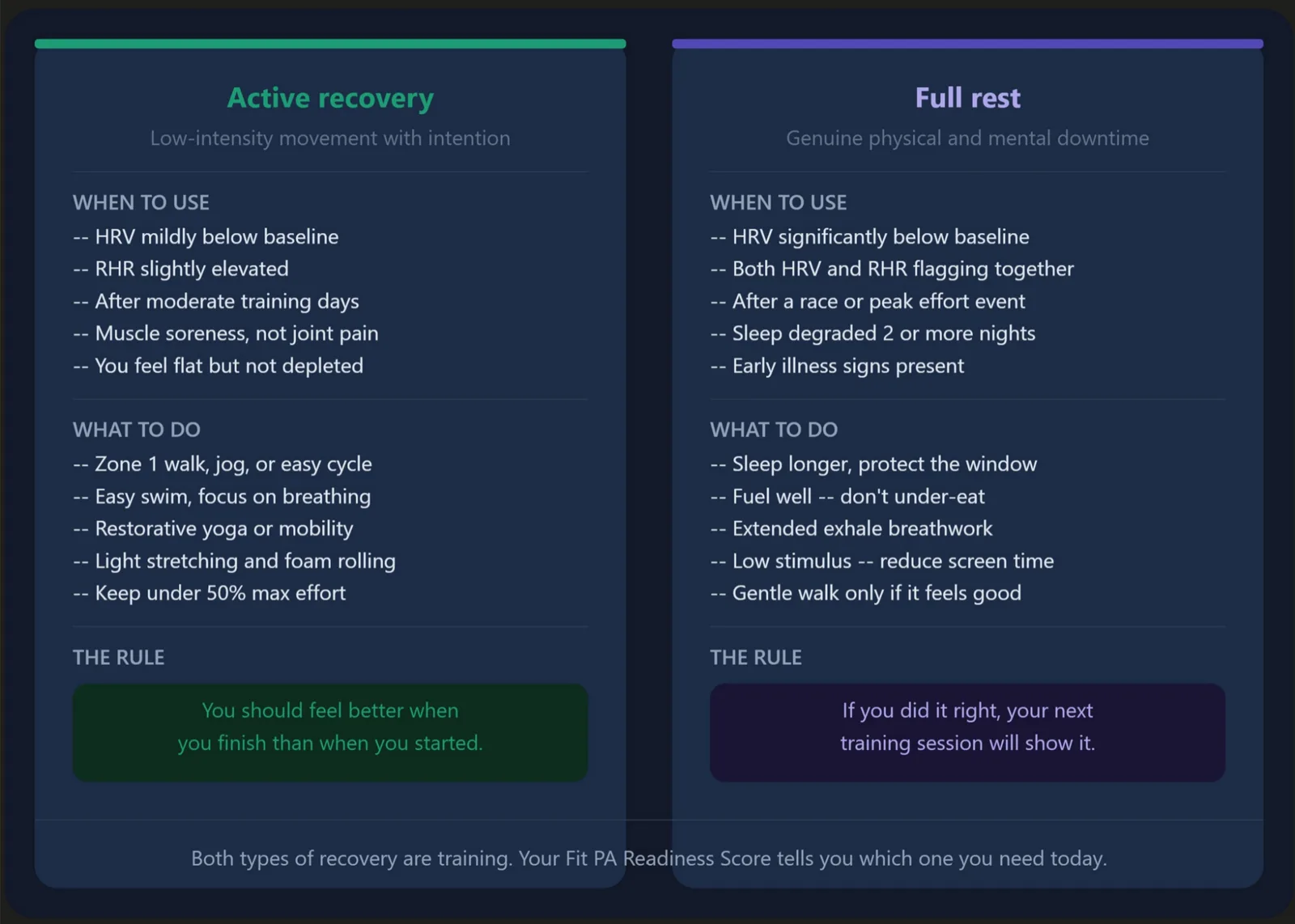
Full rest means genuine physical downtime. No structured training, no pushing pace, no chasing metrics. Walking to the coffee shop counts. A 30-minute Zone 1 stroll with your dog counts. What doesn't count is telling yourself you're resting while secretly doing a moderate effort because you felt guilty.
Full rest is most appropriate after your highest-load sessions, after a race or long event, when your biometrics show deep systemic fatigue across multiple markers, when you're showing early signs of illness, or when your sleep has been severely degraded for several consecutive nights.
Active recovery is deliberate low-intensity movement designed to accelerate the recovery process rather than pause it. Think Zone 1 running or cycling, an easy swim, a yoga session, light mobility work, or a slow walk with intention. The defining rule: the session should leave you feeling better than when you started. If it doesn't, you went too hard.
Active recovery works because gentle movement increases blood flow to damaged tissue, helps clear metabolic byproducts like lactate, keeps your parasympathetic nervous system engaged, and reduces delayed onset muscle soreness without adding meaningful training load. It keeps your routine intact and your habits consistent -- which matters more than most people realize over the course of a long training block.
The key distinction between active recovery and a real workout is intensity. Active recovery operates below 50 percent of maximum effort. If your heart rate is climbing into Zone 2 or your breathing becomes deliberate, you've crossed the line from recovery into training -- and you've just extended the debt you were trying to repay.
What the signals actually tell you
Here's the practical framework. Your Fit PA dashboard gives you four data points every morning. Here's how to read them specifically through the lens of a recovery decision.
HRV trending down for 3 or more days This is the clearest signal that your nervous system is carrying a load it hasn't been able to clear. The source doesn't matter -- training, life stress, sleep disruption -- the signal is the same. Active recovery or full rest depending on how far below your baseline the trend sits. A mild dip suggests active recovery. A significant sustained drop suggests full rest and a genuine look at what's driving it.
Resting Heart Rate elevated above your baseline Especially meaningful when it appears alongside a low HRV. A persistently elevated RHR of 3 to 5 beats above your normal tells you your sympathetic nervous system is still dominant. Your body is not in recovery mode yet regardless of how the previous session felt. Active recovery at most. Full rest if both signals are presenting together.
Sleep score degraded One bad night is recoverable and not necessarily a reason to change your training plan. Two or three consecutive nights of disrupted or insufficient sleep is a different situation. The adaptation window your training depends on -- growth hormone release, tissue remodeling, nervous system reset -- happens almost exclusively during deep sleep. If that window has been compressed for several nights running, your body hasn't finished processing your last hard session yet, let alone prepared for the next one.
Training load ratio elevated If your acute load (last 7 days) has spiked relative to your chronic baseline (last 28 days), your tissue and nervous system are handling more than they've been conditioned for. A recovery day here isn't optional -- it's the mechanism that prevents the ratio from pushing into injury territory.
The self-check your data can't replace
Before you act on any of those signals, do a ten-second honest check with yourself. Not a perfunctory "I'm fine" -- a real one.
How do your legs feel right now? Is there genuine heaviness or soreness that wasn't there two days ago? How is your mood -- flat, irritable, or motivated? Does the idea of moving feel energizing or like an obligation you're dreading?
When your subjective sense and your data agree, act with confidence. Both pointing toward fatigue -- take the recovery day without guilt. Both pointing toward readiness -- train hard and trust it.
When they disagree, pay attention to both. Your data says low readiness but you feel genuinely good and light -- proceed, but stay honest mid-session and be willing to back off if the effort doesn't match the feeling. Your sleep score looks fine but you feel exhausted and flat -- your body may be signaling something the sensors didn't catch. Cumulative emotional stress, nutritional depletion, or early illness often shows up in how you feel before it shows up in your numbers.
Neither the data nor your gut wins by default. Used together they're remarkably accurate.
What to actually do on a recovery day
This is where most people either overcomplicate it or completely check out. Here's a simple menu by recovery need.
Active recovery options (choose one, keep it easy)
- 20 to 40 minute Zone 1 walk, jog, or cycle -- conversational pace, no pushing
- Easy swim -- focus on breathing and movement quality, not distance
- Yoga or mobility session -- restorative or yin style, not power yoga
- Light stretching and foam rolling -- 15 to 20 minutes focused on the areas that took the most load
Full rest support (what to do when you're genuinely not training)
- Prioritize sleep -- go to bed earlier if possible, protect the sleep environment
- Fuel the recovery, not the deficit -- this is one of the most common mistakes athletes make, especially on days that feel unproductive. Your body is actively repairing tissue and restoring glycogen whether you trained or not. Under-fueling on rest days directly undermines the recovery the day is supposed to provide. Protein and carbohydrates both matter here, not just after workouts.
- Breathwork -- 5 to 10 minutes of extended exhale breathing (inhale 4 counts, exhale 6 to 8 counts) directly activates the parasympathetic nervous system and can measurably shift your HRV within a single session
- Low-stimulus environment -- screen time, noise, and decision fatigue all add to your allostatic load. A genuinely restful day includes mental recovery, not just physical downtime
A note for athletes whose recovery data fluctuates week to week
If you notice your HRV, sleep quality, or perceived recovery shifting significantly from week to week without an obvious training reason -- you're not imagining it, and it's not a data glitch.
For female athletes, hormonal cycle phases have a measurable impact on recovery metrics, energy availability, sleep architecture, and the body's ability to handle training load. What looks like inconsistent recovery data may actually be highly consistent data that reflects a pattern your current analysis isn't accounting for yet.
This is one of the most underleveraged areas in training science and one we'll be covering in depth in an upcoming article. For now, the practical note is this: if your recovery signals are lower than expected in the week before your period, that's physiologically normal -- and the same recovery principles in this article apply, with extra weight given to sleep, fueling, and load management during that window.
The guilt is the problem, not the rest
Here's the mindset reframe that changes everything: a recovery day is not time away from progress. It is the mechanism through which progress happens.
Every hard session you complete is an investment. The rest day is when the return is paid. Skip it and the investment sits unclaimed -- worse, it starts working against you as accumulated load compounds without resolution.
The athletes who last -- who make consistent progress across years rather than burning bright for one season -- are the ones who learned to take recovery as seriously as training. Not as a reward for hard work. As part of the work itself.
Your Fit PA Readiness Score exists precisely for this. When it signals a recovery day, it's not telling you to stop. It's telling you where the actual training is happening today.
Your Fit PA Readiness Score tells you every morning whether today calls for full intensity, a precision pivot, or genuine recovery. Check your dashboard and train with the data, not against it.