
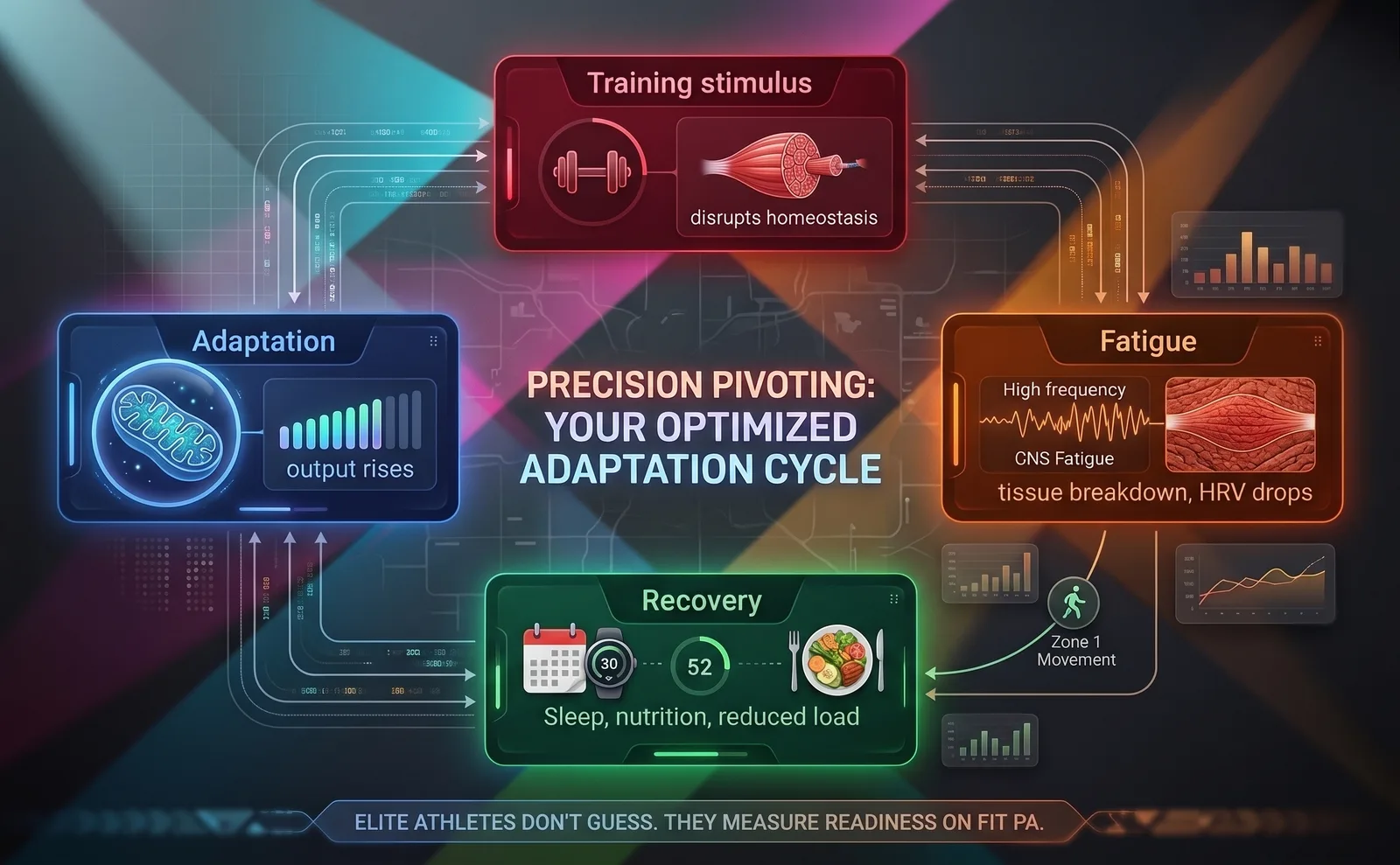
There's a version of athlete culture that treats rest as weakness. Log more miles. Add another session. Push through the tired. But that approach misunderstands how adaptation actually works.
Endurance gains happen during recovery, not during the workout itself. The training session creates a physiological disruption. Sleep, nutrition, and downtime are what allow your body to rebuild stronger. Compress that recovery window and you skip the adaptation phase entirely, accumulating systemic inflammation instead of improved performance.
The Gray Zone Problem
Most athletes don't overtrain by going too hard. They overtrain by going moderately hard, all the time.
This is the gray zone: an intensity level where you're working hard enough to accumulate fatigue but not hard enough to trigger a meaningful aerobic or anaerobic adaptation. You're spending energy without earning a specific physiological return.
Over time, this creates a compounding allostatic load problem. Your central nervous system doesn't distinguish between training stress, work stress, poor sleep, or emotional strain. It processes them as a single cumulative burden. When that total load exceeds your recovery threshold, your body shifts from an anabolic (building) state to a catabolic (breaking down) state. Progress stalls, or reverses.
Mitochondrial health is one of the earliest casualties. Aerobic development depends on healthy, well-functioning mitochondria, but without adequate downtime, your body deprioritizes long-term tissue repair in favor of immediate systemic demands.
Three Markers Worth Tracking
Elite athletes don't guess their readiness. They measure it. These three indicators give you an honest picture of where your body actually is.
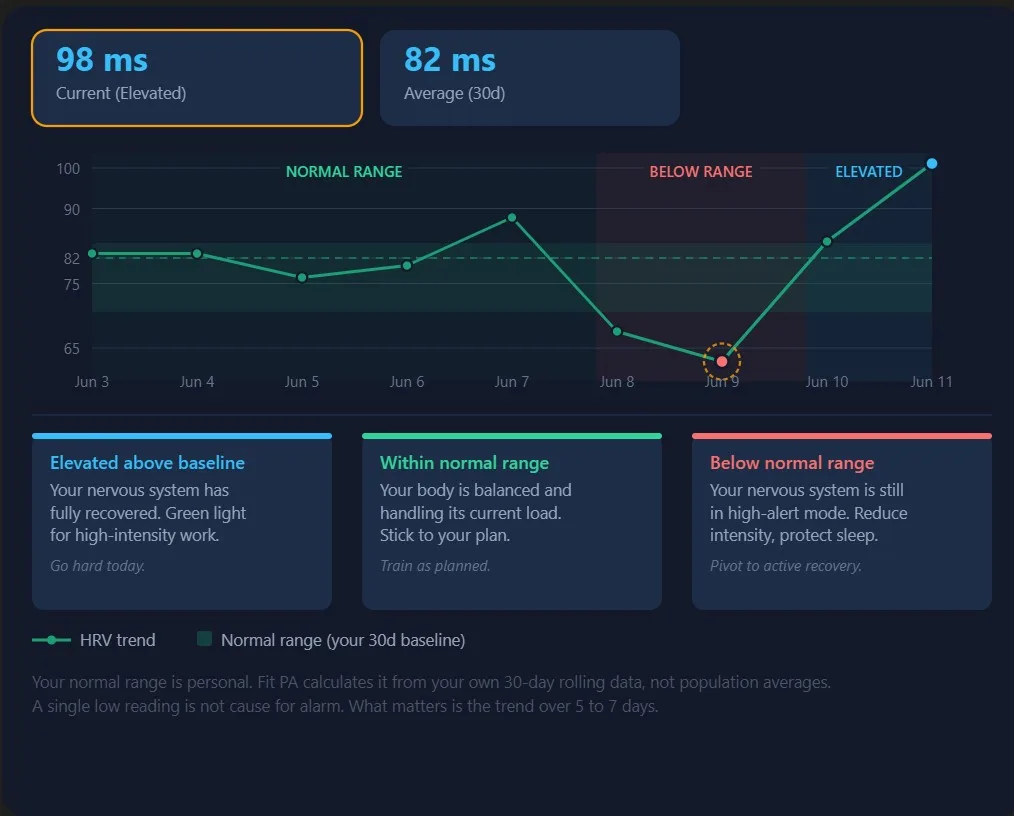
Heart Rate Variability (HRV) HRV measures the variation in time between your heartbeats. A higher, stable HRV generally signals that your autonomic nervous system (ANS) -- the system that governs heart rate, stress response, and recovery -- is operating in a recovered, balanced state. A sustained downward trend signals the opposite: your body is still processing stress and high-intensity work is likely to add to the burden rather than build fitness.
One important caveat: HRV is a sensitive metric. It reacts to almost everything -- a hard workout, a stressful day, poor sleep, dehydration, alcohol, even the early onset of illness before you feel sick. That sensitivity is exactly what makes it useful, but it also means a single low reading isn't cause for alarm. What matters is the trend over 5 to 7 days, not today's number in isolation.
The chart below explains what each HRV zone means for your training. You can find your own HRV trend on your Fit PA dashboard -- pulled directly from your connected device -- so you can apply this to your actual data, not a generic example.
Resting Heart Rate (RHR) RHR is highly individual, but a persistent elevation of even a few beats per minute is a reliable clinical marker of sympathetic nervous system dominance. It's your body signaling that it hasn't fully reset.
Sleep Architecture Deep sleep is the primary window for human growth hormone release and tissue remodeling. Disrupted or insufficient sleep doesn't just leave you tired. It removes the endocrine environment your body needs to adapt to your training stimulus.
What Your HRV Data Is Actually Telling You
Knowing your HRV is trending down is only useful if you know what to do about it. The right response depends on where the stress is coming from.
During a planned high-intensity build
A declining HRV trend during a hard training block is normal and expected. It's confirmation that the training stimulus is real and your body is working to process it. This is called productive overreaching, and it's part of how fitness is built.
The signal to watch for is a trend that keeps declining through your easier days and doesn't rebound. That's the difference between planned stress and accumulating debt. If your HRV hasn't recovered within 48 to 72 hours of your last hard effort, your body is telling you the load is outpacing your recovery capacity.
When life stress is the driver
A brutal work week, a difficult personal situation, or chronic poor sleep will suppress HRV just as reliably as a hard training block -- because your central nervous system doesn't separate the sources. It processes everything as a single load.
If your HRV is low and your training has been manageable, look at the rest of your life. The fix isn't just skipping a workout. It's addressing the actual source.
How to get back to baseline
Regardless of the stress source, the levers are the same -- but their priority shifts depending on what's driving the dip.
- Sleep first. It's the single most effective recovery tool available, for both training stress and life stress. Nothing else compensates for consistently poor sleep.
- Reduce intensity before volume. Cut effort level, not necessarily mileage.
- Fuel the recovery window. Carbohydrates and protein within 60 minutes of hard efforts accelerate glycogen replenishment and muscle repair.
- Use Zone 1 movement. Easy walking, a light spin, or a slow swim increases blood flow to damaged tissue and keeps your parasympathetic nervous system engaged without adding load.
- Try slow breathing. Extended exhale breathing (inhale for 4 counts, exhale for 6 to 8) directly activates the parasympathetic nervous system and can shift HRV measurably within minutes.
- Be honest about alcohol. Even moderate consumption suppresses deep sleep architecture and will show up in your HRV within hours.
Give it 2 to 3 days of reduced intensity, prioritized sleep, and solid fueling before reassessing the trend. If HRV is still depressed after that window, extend the recovery block rather than pushing through.
Precision Pivoting
Training isn't binary. It's not "go hard" or "do nothing." It's about adjusting intensity based on what your body can actually absorb on a given day.
When your biometrics point to high systemic fatigue, the goal is to maintain training continuity while removing intensity. A scheduled threshold session becomes a Zone 1 movement or mobility session. You're keeping your routine intact, staying in the habit, and giving your nervous system what it needs to return to homeostasis.
This isn't a rest day. It's a deliberate physiological investment.
Use your Readiness Score in Fit PA to calibrate daily training intensity. When the data signals high fatigue, your plan should shift to active recovery -- not because you're taking a step back, but because you're actively managing your hormonal and nervous system health so your next high-intensity block actually lands.
Ready to Train Smarter?
Your body is generating data every day. Fit PA helps you read it and train accordingly.