
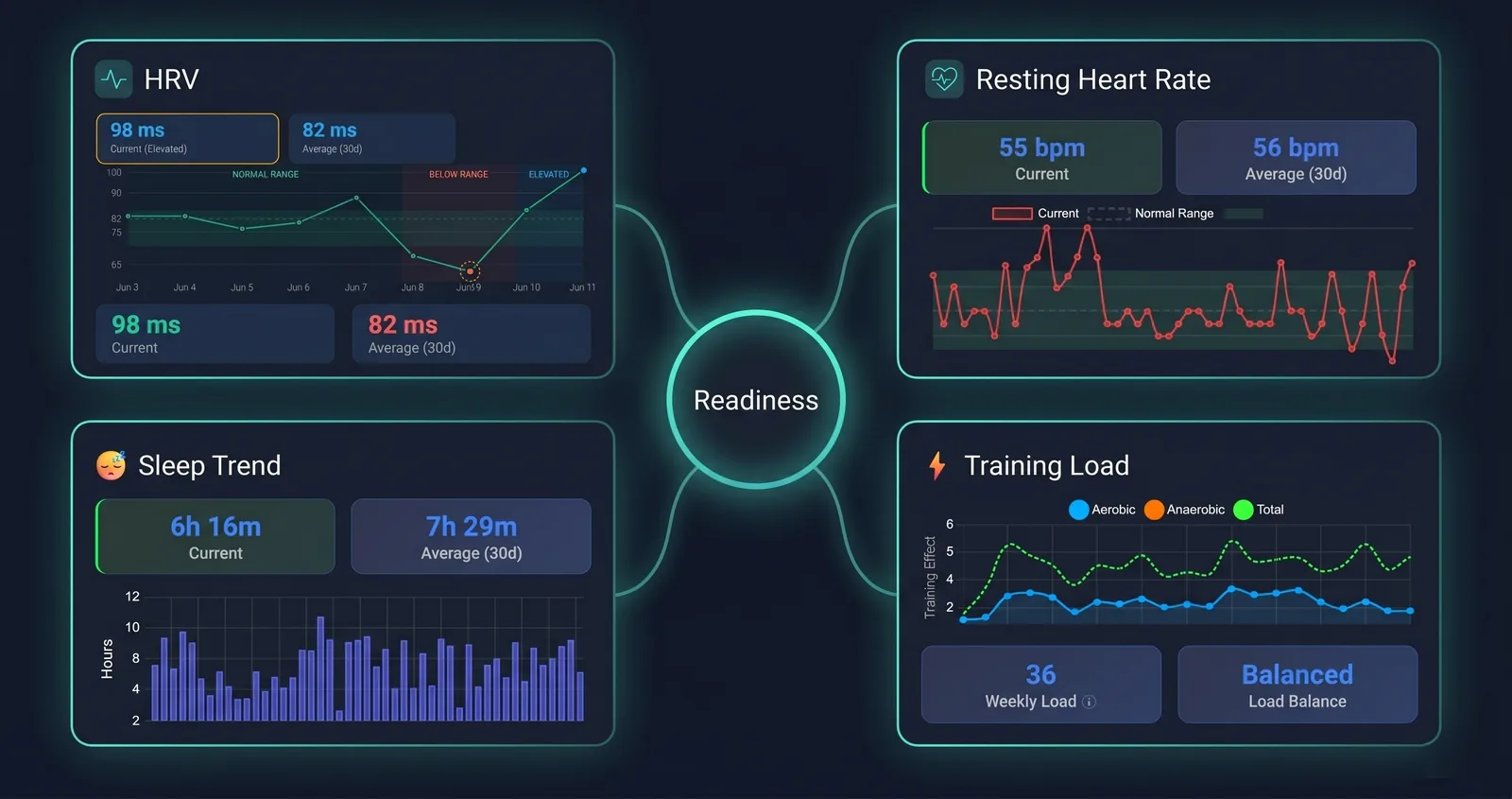
You've been wearing the device for months. Every morning it hands you a stack of numbers -- HRV, sleep score, training load, resting heart rate. You glance at them. Maybe you feel vaguely reassured, or vaguely concerned. Then you lace up and do whatever you were going to do anyway.
If that sounds familiar, you're not alone. Most wearable users collect data consistently but apply it rarely. Not because they're not motivated -- but because nobody taught them how to read it.
This article fixes that.
Four numbers. One picture.
Your device tracks a lot of things. But four metrics carry almost all of the useful signal about how your body is responding to training and life stress. Everything else is context.
The four are: Heart Rate Variability (HRV), Resting Heart Rate (RHR), sleep quality, and training load. They each tell you something different. Together, they tell you what your body actually needs today -- which is exactly what your Fit PA Readiness Score synthesizes every morning when you open the app.
Here's what each one means and why it matters.
Heart Rate Variability (HRV)
HRV measures the variation in time between your heartbeats. If your heart beats 60 times per minute, those beats are not perfectly spaced one second apart. The gaps between them fluctuate slightly -- and the size of that fluctuation is your HRV.
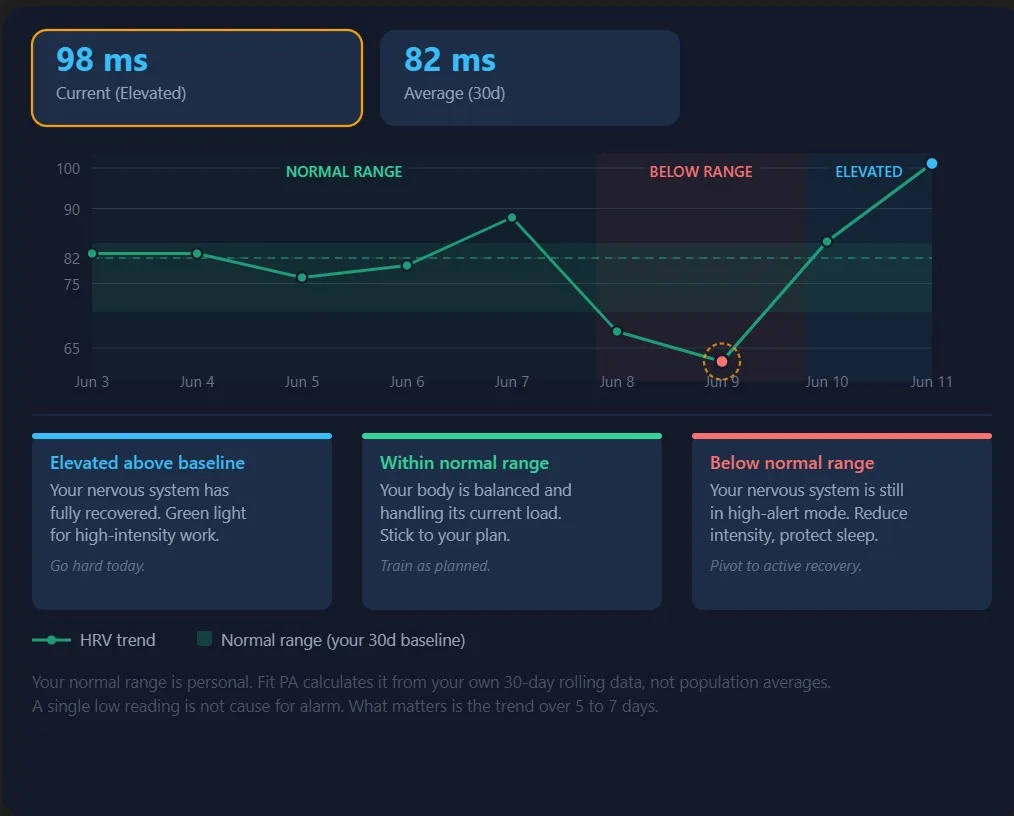
More variation is generally better. Higher HRV signals that your autonomic nervous system (ANS) -- the system that governs your heart rate, stress response, and recovery -- is operating in a recovered, parasympathetic state. Think of it as your body running on "rest and digest" mode rather than "fight or flight." Lower HRV signals the opposite: your nervous system is still managing stress and hasn't fully reset.
What shifts your HRV
This is where most people get tripped up. HRV is extraordinarily sensitive. A hard training session, a poor night of sleep, a stressful afternoon at work, two glasses of wine, early-stage illness before you feel sick, dehydration, travel across time zones -- all of it shows up in your HRV within hours.
That sensitivity is the point. It means HRV is one of the earliest signals your body sends before problems compound. But it also means a single low reading on a rough Monday morning is not a crisis. What you're looking for is the trend over 5 to 7 days, not today's number in isolation.
How to use it
A rising or stable HRV trend relative to your personal baseline is a green light for harder training. A sustained downward trend over several days -- especially if it persists through easier days -- is a signal to reduce intensity and investigate the source. Is it training load? Sleep? Life stress? Usually it's all three compounding each other.
One important note: HRV is deeply personal. A reading of 55 ms might be excellent for one athlete and below baseline for another. Fit PA benchmarks your HRV against your own 30-day rolling baseline, not population averages, so the signal is always calibrated to your physiology.
Resting Heart Rate (RHR)
RHR is the number of times your heart beats per minute when you're fully at rest -- ideally measured first thing in the morning before you get out of bed. It's one of the oldest and most reliable markers of cardiovascular fitness and recovery status.
As fitness improves over weeks and months, RHR tends to decrease. A well-trained endurance athlete might sit in the low 40s. A recreational athlete might sit in the mid 50s to low 60s. Neither number is inherently better than the other -- what matters is your personal baseline and how today's reading compares to it.
What an elevated RHR is telling you
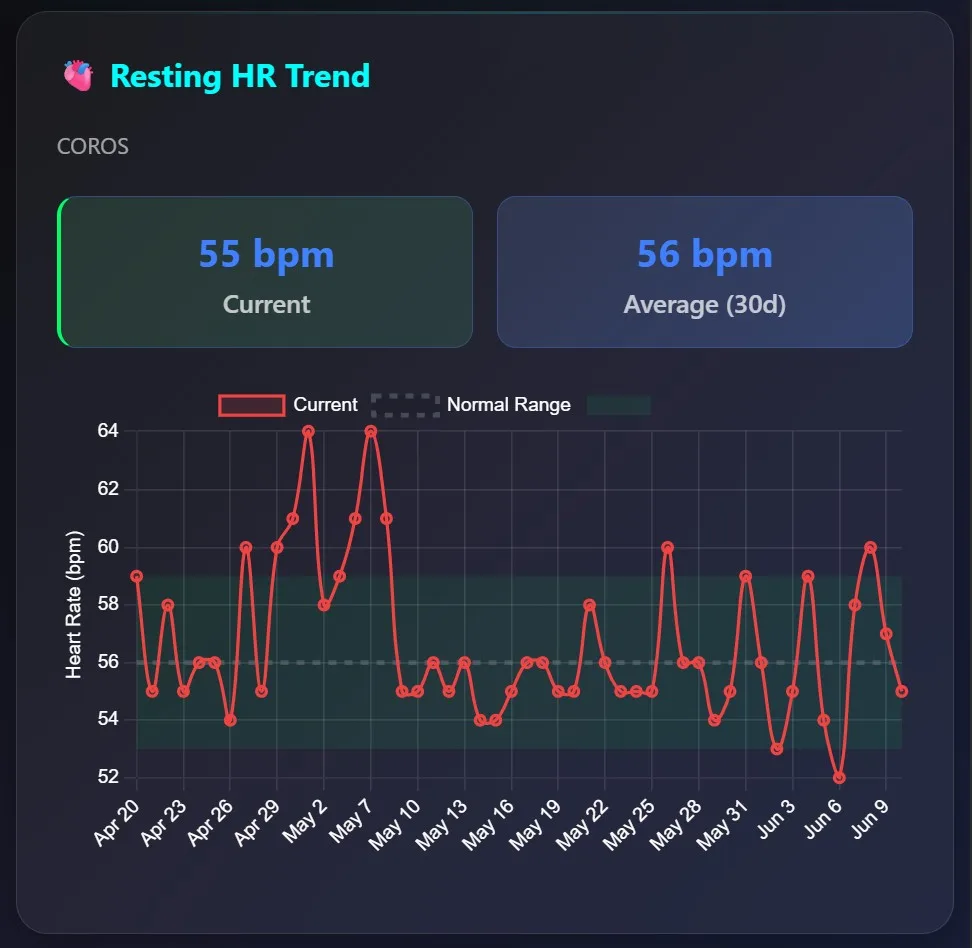
A persistent RHR elevation of even 3 to 5 beats above your normal baseline is a meaningful signal. It typically indicates that your sympathetic nervous system -- the "fight or flight" branch of the ANS -- is still dominant. Your body is in a state of elevated demand, whether from training stress, illness, poor sleep, or accumulated life load.
Think of RHR and HRV as two sides of the same coin. When HRV drops, RHR often rises. Together they give you a more complete picture of your recovery status than either metric alone.
How to use it
Use RHR as a confirmation signal rather than a primary one. If your HRV is trending down and your RHR is elevated, that's a strong two-signal confirmation that your body needs a lighter day. If only one of them is off, look at the surrounding context -- sleep quality, training load, life stress -- before making a call.
Sleep Quality
Sleep is not just rest. It is the primary window during which your body does the actual work of adaptation -- releasing human growth hormone, remodeling tissue, consolidating motor patterns learned during training, and resetting the nervous system for the next day.
Your device tracks sleep in stages: light, deep (slow-wave), and REM. Each stage serves a different purpose.
- Deep sleep is where physical recovery happens. Growth hormone is released almost exclusively during deep sleep. If your deep sleep is consistently short or disrupted, your body is not completing the adaptation cycle that hard training is designed to trigger.
- REM sleep is where cognitive recovery and motor learning happen. If you're learning a new movement pattern or training for a technical sport, REM consolidates it. Cutting REM short -- which alcohol does reliably, even in moderate amounts -- impairs both mood and motor performance the next day.
- Light sleep is the connective tissue between stages. Too much light sleep relative to deep and REM suggests your sleep is fragmented, even if total duration looks acceptable.
A note on accuracy
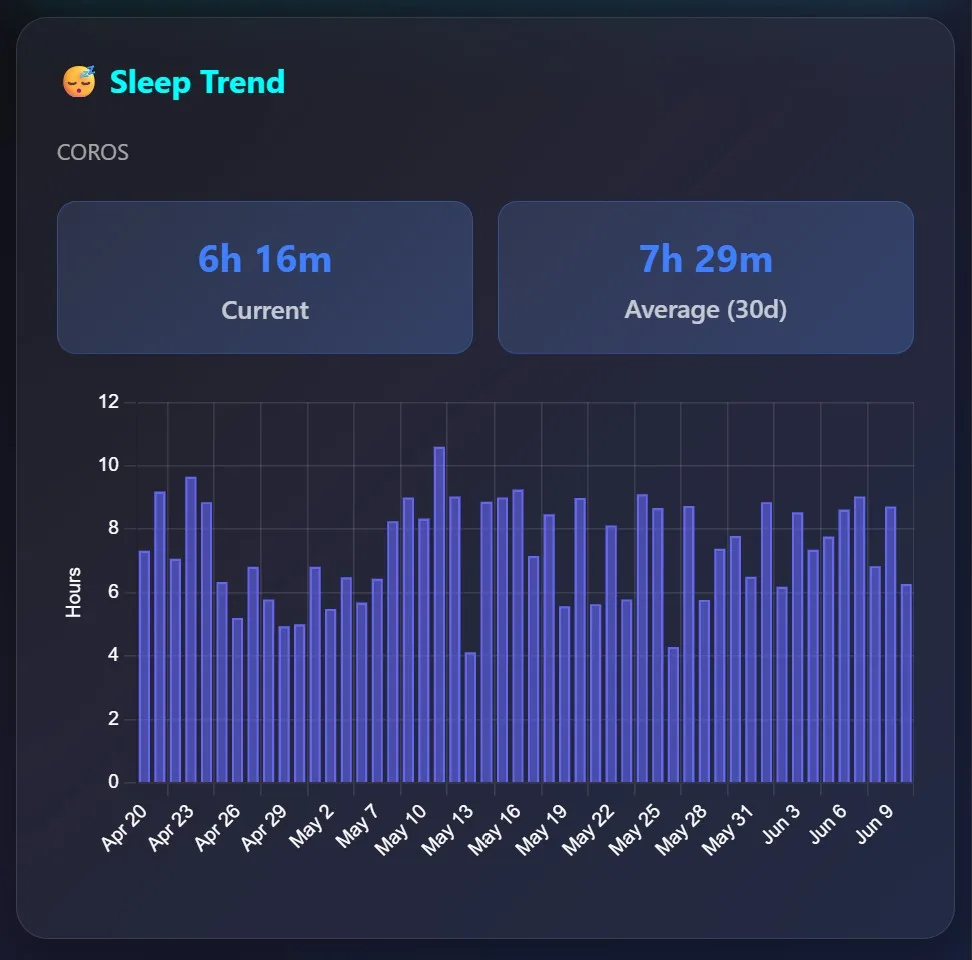
Consumer wearables are good at tracking sleep trends over time but are not perfectly accurate on any given night. Use your sleep data as a directional signal -- if your deep sleep has been consistently low for a week, that's real information worth acting on. If one night looks unusual, give it less weight before drawing conclusions.
How to use it
If your sleep score is consistently degraded, treat it the same way you'd treat a sustained low HRV reading. Reduce training intensity, protect the next night aggressively, and look at what's causing the disruption. One bad night is recoverable. A string of them compresses your adaptation window and will show up in your performance whether you acknowledge it or not.
Training Load
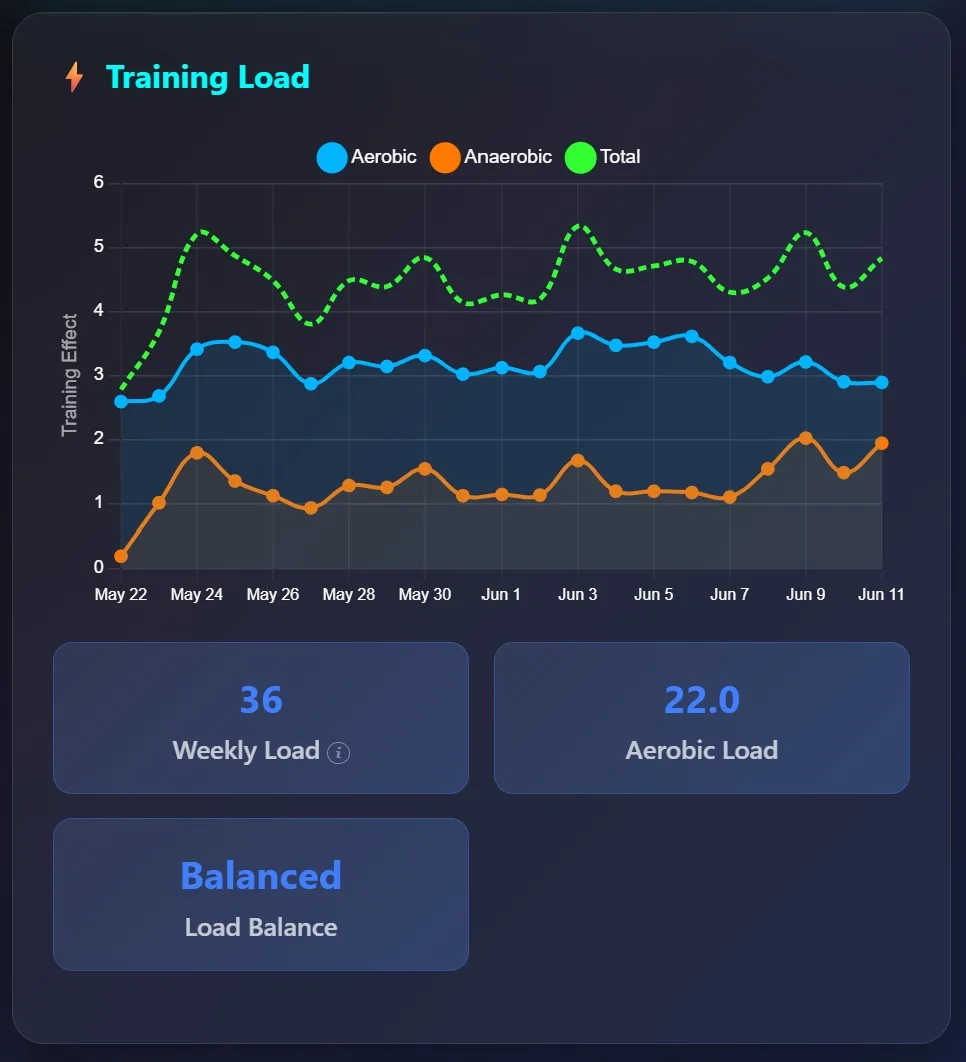
Training load is a measure of how much cumulative stress your workouts have placed on your body over a rolling time window -- typically 7 days acute and 28 days chronic. Most devices calculate it from a combination of heart rate, duration, and intensity.
The number that actually matters is not your absolute load. It's the ratio between your recent acute load and your longer-term chronic load -- often called the acute-to-chronic workload ratio (ACWR). This ratio tells you whether your body is being asked to handle more than it has been conditioned for.
The sweet spot and the danger zone
A ratio between roughly 0.8 and 1.3 is generally considered the optimal training window -- enough stimulus to drive adaptation without spiking injury risk. A ratio above 1.5 means you've ramped load faster than your body can absorb it. This is the classic recipe for overuse injury and performance regression.
The spike doesn't have to be dramatic. Adding one extra long run, doubling your weekly intensity block, or returning from a deload week too aggressively can all push the ratio into the danger zone quietly.
How to use it
Use training load to zoom out. HRV and RHR tell you how your body feels today. Training load tells you whether the pattern of the last few weeks is sustainable. If your load has been creeping up for three consecutive weeks without a deload, that context changes how you interpret a single day's HRV reading.
How the four metrics work together
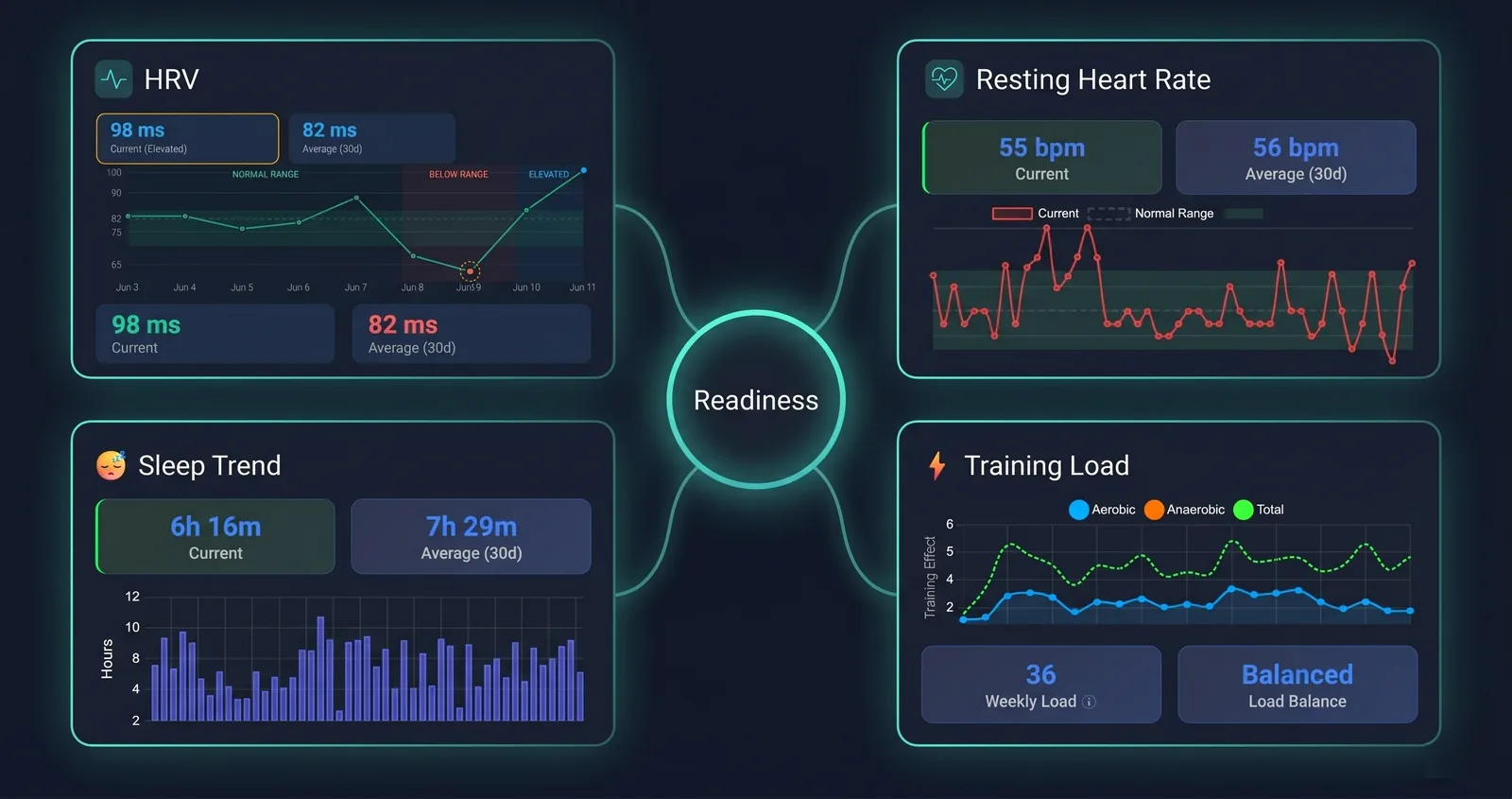
None of these metrics tells the complete story on its own. A single low HRV reading on a high-load week with degraded sleep and an elevated RHR tells a very different story than a low HRV reading after a perfectly normal week. Context is everything.
This is the core problem with checking one number in isolation -- and the reason Fit PA synthesizes all four into a single Readiness Score each morning. Rather than asking you to mentally cross-reference four separate data points, the score gives you one clear signal: here is what your body can absorb today, and here is how to adjust your training accordingly.
A simple decision framework
If you want a starting point for how to act on your data before you've built intuition for your own patterns, use this:
High readiness (HRV at or above baseline, RHR normal, sleep solid, load manageable): This is your window for quality work. Schedule hard sessions here -- intervals, threshold efforts, long runs, heavy lifts. Your body is primed to absorb the stimulus and adapt.
Moderate readiness (one or two signals slightly off): Proceed with your planned session but be honest about intensity. If the workout feels harder than it should at a given pace or weight, that's your body telling you something the numbers already suggested. Dial back rather than push through.
Low readiness (HRV trending down, RHR elevated, sleep degraded, load high): This is not a rest day. It's a precision pivot day. Zone 1 movement, mobility work, or an easy walk keeps your training continuity intact while giving your nervous system the space it needs to reset. Pushing hard here doesn't build fitness. It extends the debt.
The mindset shift that makes all of this work
Data is only useful if you're willing to act on it -- including when it tells you something you don't want to hear.
The athletes who get the most out of wearable data are not the ones who obsess over every point on the graph. They're the ones who use the trend to make one better decision per day: go hard when the signal is green, back off when it isn't, and trust that honoring the data compounds over time into better performance than grinding through every session regardless of readiness.
Your device has been trying to tell you this for months. Now you know how to listen.
Check what your four numbers are telling you today in your Fit PA dashboard and let your Readiness Score take the guesswork out of your next session.