
Race training in a wet winter: your plan B
A stormy week does not have to cost you fitness, as long as you swap sessions on purpose and not by default. NOAA's Climate Prediction Center reports that El Niño conditions are present and expected to strengthen into winter 2026-27, and its winter outlook leans wetter than average across the southern tier of the US, including California. These are probabilities, not guarantees, but if you are training for a spring race, a few weeks of rain-blocked running is a reasonable thing to plan for. This guide gives you a plan B at three levels: a gym, an indoor bike at home, and no equipment at all. Each option is tied to the research behind it, and where the research is thin, we say so.
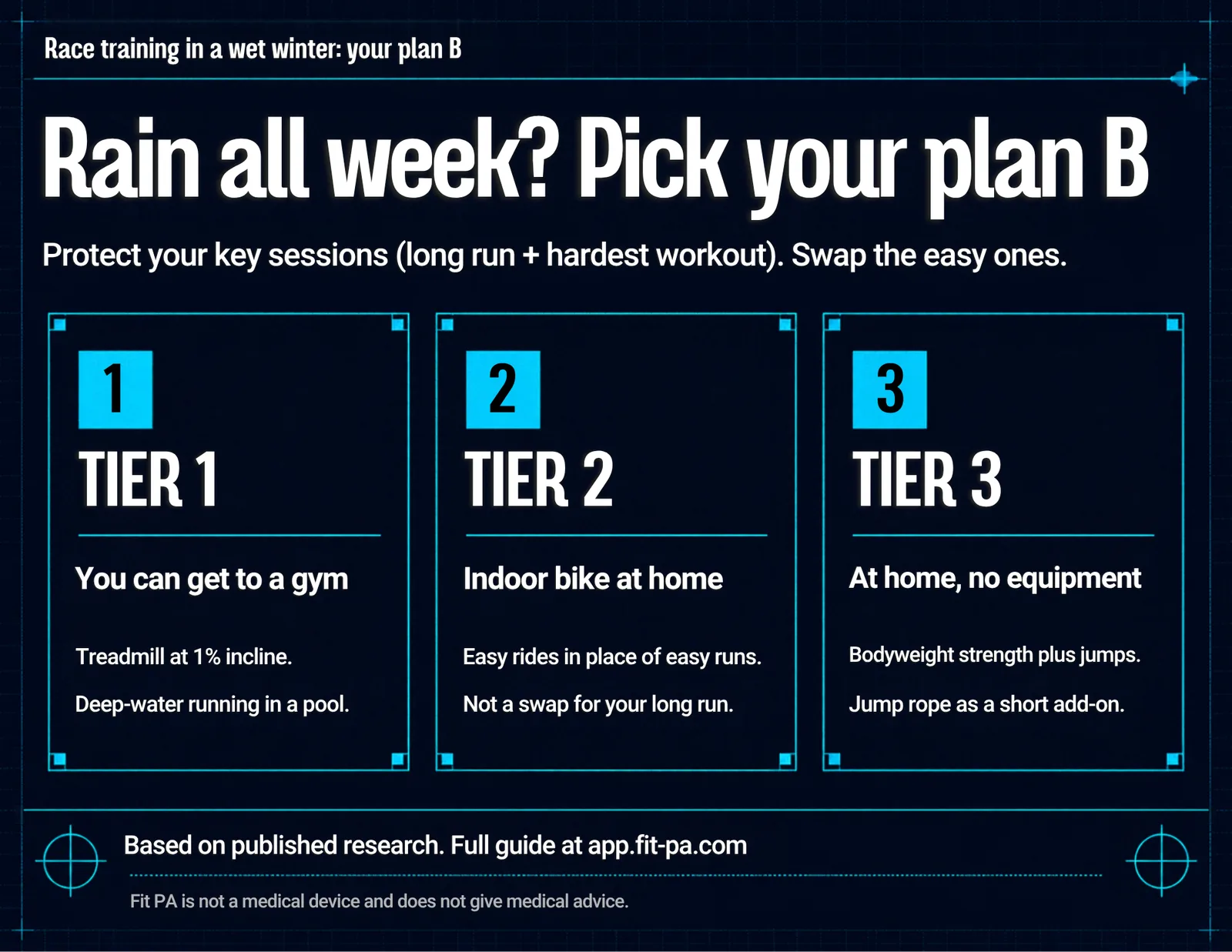
The rule: protect the key sessions, swap the easy ones
When the rain wins, give up easy and recovery mileage first, and fight to keep your long run and your hardest workout of the week. That is standard coaching practice and not a finding from the studies below. The easy runs are the sessions most safely replaced by something low-impact, while the long run and the hard workout are where running-specific fitness is built. Some days the right call is simply not to run outside. Skip lightning, hail, high wind and flash-flood warnings, and stay off flood-prone routes such as riverbanks. Cold, wet and windy together raises hypothermia risk, so avoid cotton and change out of wet clothes soon after you finish.
Tier 1: You can get to a gym
A short-term membership, a day pass or a community rec center with a pool covers a storm stretch. Two options matter most for runners.
- Treadmill at 1% incline. In a 1996 study of nine trained male runners, a 1% grade matched the oxygen cost of road running at speeds from 2.92 to 5.0 m/s. At the two slowest speeds, a flat belt was not significantly different either. (Jones and Doust, 1996)
- Deep-water running in the pool. Sixteen trained male runners did either treadmill or deep-water running for 6 weeks, five days a week, including hard 30-minute sessions. Treadmill VO2max, ventilatory threshold and running economy did not differ between groups. The authors concluded water running can maintain aerobic performance for up to 6 weeks in trained athletes. (Wilber et al., 1996)
Water running is not identical to land running. A study of eight cross-country runners found similar oxygen use and energy expenditure, but higher ventilation and carbohydrate use in the water at higher effort, which suggests different muscle recruitment. (Demaere and Ruby, 1997) Treat it as a way to maintain fitness, not a perfect copy of running.
Tier 2: You want to work out at home on an indoor bike
Easy rides are the most practical swap for easy runs. A 2026 systematic review and meta-analysis pooled seven randomized trials of at least four weeks that compared running-only with cycling-only training in trained or recreationally active people. It found no statistically significant difference for treadmill VO2max or for running time trials over 1 mile, 3,000 m and 5,000 m. (Menges et al., 2026) Two cautions apply. The confidence intervals were wide, so the review cannot prove the two are equivalent, and treadmill VO2max trended slightly in favor of running. Cycling also loads the legs differently, with little of the impact and eccentric work that running demands. Use the bike to hold aerobic fitness on easy days, and do not rely on it to replace your long run.
Tier 3: You want to work out at home with no equipment
Strength work is the strongest option here, and it needs only floor space. A meta-analysis of five controlled trials covering 93 high-level middle- and long-distance runners found that strength training improved running economy, with a large effect (SMD -1.42). The programs ran 2 to 3 times a week for 8 to 12 weeks and combined 2 to 4 lower-body exercises with up to 200 jumps and some short sprints. (Balsalobre-Fernández et al., 2016) Two details matter for a home plan.
- Jumps work best alongside strength. A 2023 meta-analysis found jump training on its own had a trivial effect on running economy (ES 0.19), while jumps combined with resistance training had a large one (ES 1.34). Gains were larger with more than 15 sessions, more than 7 weeks and more than 2 days a week. (Barrio et al., 2023)
- Bodyweight is an adaptation, not a tested protocol. Most trials in the 2016 review used low to moderate loads, so bodyweight squats, split squats, step-ups and single-leg calf raises are a reasonable stand-in rather than something those studies tested directly.
Jump rope earns a small place as an at-home add-on, and two randomized trials support it in different groups. In the first, 96 amateur endurance runners jumped rope 2 to 4 sessions a week for a total of 10 to 20 minutes a week, in place of about 5 minutes of their usual warm-up, for 10 weeks. They improved 3-km time-trial performance, jump performance and arch stiffness, and the control group did not change. (García-Pinillos et al., 2020) In the second, 52 university students aged 18 to 20 did 20 minutes of bodyweight cardio (jumping jacks, skipping, running in place) plus 10 minutes of jump rope once a week for 8 weeks, while a control group did the cardio alone. The rope group gained isometric strength, with a large effect in the right leg (d = 1.03) and the left arm (d = 0.92), and showed a small improvement on the Ruffier index, a squat-based heart rate test (d = -0.27). (Maria et al., 2025) Neither study tested marathon or ultra performance. The students were not runners, the second trial measured strength and a submaximal heart rate test rather than VO2max or race times, and the left-leg strength gain did not reach significance for the group-by-time interaction (p = 0.057). Treat a rope as a low-cost add-on to strength work and easy cardio, not a replacement for an aerobic session. Build volume gradually, since the authors note documented cases of shin pain (tibial periostitis) from excessive rope skipping. Stairs and step-ups are a practical way to keep climbing muscles working when you cannot reach a hill. See the evidence note below for what is and is not known.
What the evidence does and does not show
The research supports most of these swaps for maintaining fitness over weeks, but it does not show any of them matches the race-specific work of running itself, and stair or stepper training has no running trial behind it.
| Option | Best evidence found | Limit |
|---|---|---|
| Treadmill at 1% | Matched road oxygen cost in 9 trained men | Short bouts, small sample |
| Deep-water running | Held VO2max, threshold and economy for 6 weeks in 16 trained men | Male, trained, 6 weeks; muscle recruitment differs |
| Cycling | 7 randomized trials, no significant difference vs running | Wide confidence intervals, short trials |
| Strength plus jumps | Meta-analysis of 5 trials, 93 runners | Mostly loaded exercises, not bodyweight only |
| Jump rope | Two randomized trials: 96 amateur runners, 52 students | 3-km outcome in amateurs; second trial tested students, not runners |
| Stairs or stepper | No running trial found | Practical choice only, not proven |
We searched for peer-reviewed support for stair climbers and steppers as a vertical-gain substitute for runners and found none. The nearest items were a non-peer-reviewed single-subject case study and a small uphill-walking study. Use stairs for the climbing muscles and aerobic work, and do not count on them to replace trail climbing.
How Fit PA can help
When the forecast changes your week, you can tell the Fit PA coach in chat and ask it to rework the plan around what you can actually do. The coach builds the hard and easy structure of your plan and adapts it through 24/7 chat, so you can ask which sessions to protect and which to swap.
- Any activity counts as training. Fit PA works with any activity type from your device, so a bike, pool or gym session can sit alongside your runs.
- Check that the swap worked. Analytics shows heart rate zone distribution, training load, and your easy and hard split, so you can see whether your key sessions stayed intact.
- Strength at home. Fit PA gives how-to guidance for each strength exercise, which helps if you are building a bodyweight routine on your own.
- Plans travel with you. Training plans push to Garmin two weeks at a time and sync to Apple, Google and Outlook calendars.
Fit PA is not a medical device and does not give medical advice. Check with your doctor before starting a new form of exercise, especially if you have a health condition or an injury.
Sources
- Jones and Doust (1996), J Sports Sci
- Wilber et al. (1996), Med Sci Sports Exerc
- Demaere and Ruby (1997), J Sports Med Phys Fitness
- Menges et al. (2026), Front Sports Act Living
- Balsalobre-Fernández et al. (2016), J Strength Cond Res
- Barrio et al. (2023), Kinesiology
- García-Pinillos et al. (2020), Int J Sports Physiol Perform
- Maria et al. (2025), Sports