

Lactate Is Fuel, Not Waste: What the Research Shows
If you have ever blamed lactic acid for sore legs two days after a hard workout, the evidence says you blamed the wrong thing. Lactate is a fuel your body makes and burns all the time, even when oxygen is plentiful, and the old ideas that it is a waste product and that it causes soreness no longer fit the evidence. On lactate itself, this article follows George Brooks’s 2018 review of lactate shuttle theory in Cell Metabolism. In short
- Lactate is a fuel, not waste. Your muscles make it all the time, and your heart, other muscles and brain burn it for energy.
- It does not cause the burn of a hard effort or the soreness two days later. Both have other causes, explained below.
- For training, do most of your sessions at an easy pace where you can talk, and keep hard efforts deliberate and limited.
- For racing, how much carbohydrate to take in depends mainly on how long you will be racing.
What the research found
Oxygen is not what limits lactate production. Oxygen pressure inside muscle, measured in Torr (a unit of pressure; here, how much oxygen is available), is about 40 at rest and falls to 3 to 4 during exercise at about 65% of VO2max, the highest rate at which your body can use oxygen. That is roughly a tenth of the resting level, but mitochondria, the parts of a cell that use oxygen to make most of its energy, reach maximal respiration (full capacity) at a critical oxygen pressure of only 1 to 2 Torr, so oxygen stays sufficient. Meanwhile, the ratio of lactate to pyruvate (the molecule glucose breaks down into before it becomes lactate or enters the mitochondria) rises from about 10 at rest to above 500 during exercise. In plain terms, working muscle makes far more lactate even though it still has enough oxygen.
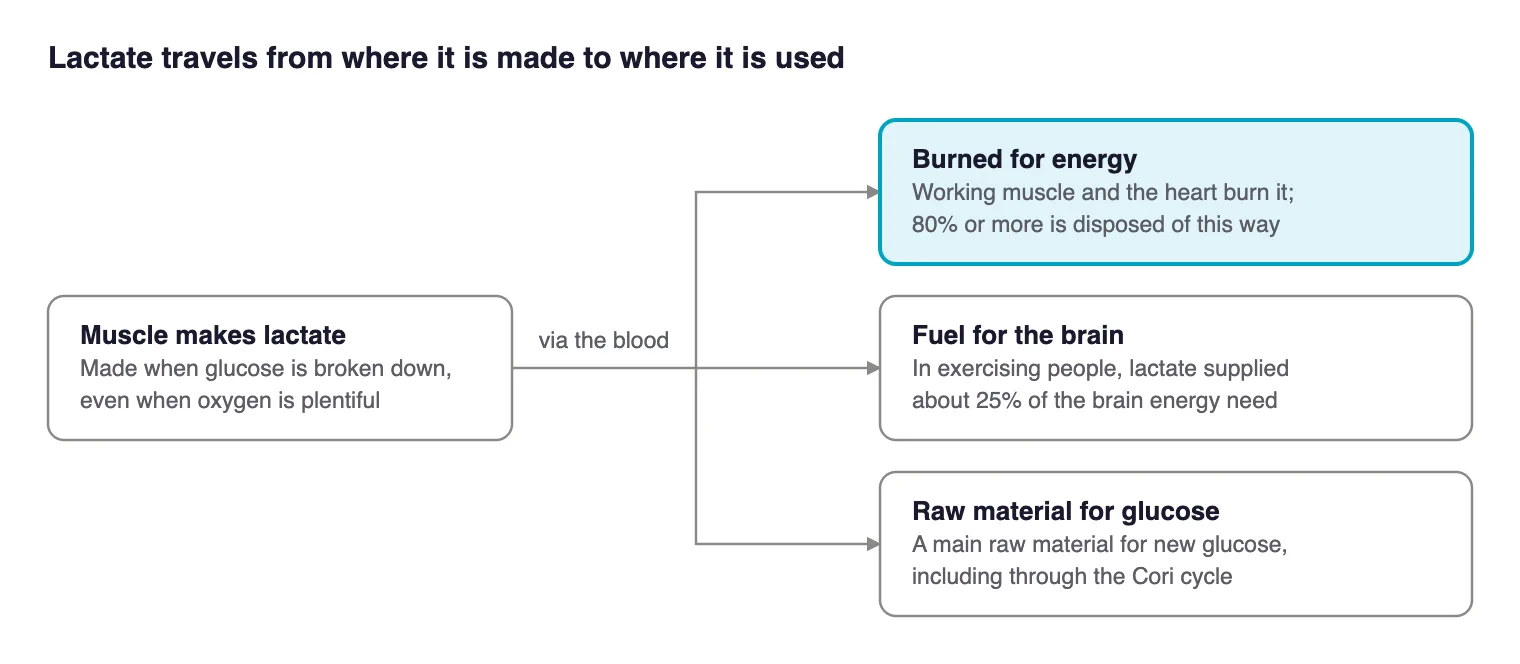
Lactate is burned for energy. Working muscle and the heart take up and burn lactate for energy (the technical word is oxidize), and 80% or more of lactate is disposed of this way. In exercising people, lactate taken up by the brain supplied about 25% of the brain’s energy need. In practice, lactate made by your legs during a hard effort can end up fueling your heart, other muscles and even your brain.
Lactate helps make glucose. Brooks calls it the major gluconeogenic precursor, meaning a main raw material the body uses to build new glucose. One route is the Cori cycle, a loop in which lactate made in muscle is rebuilt into glucose that can fuel muscle again.
Lactate is also a signal. It activates a receptor called GPR81 (a docking site on a cell that lets it respond to a signal), which inhibits lipolysis (fat breakdown) in fat cells. Infused lactate has also been linked to higher levels of BDNF, short for brain-derived neurotrophic factor, a protein that supports the growth and survival of brain cells. Much of that work is in rodent injury models, and one human study found executive function (skills such as planning and focus) correlated with blood lactate and brain lactate uptake.
**Lactate travels from where it is made to where it is used: muscle makes lactate, which travels via the blood to be burned for energy, used as fuel for the brain, or used as raw material for glucose Lactate made in working muscle is carried by the blood to tissues that burn it or use it to build glucose.
Why hard efforts feel hard
Lactate rises alongside the burning feeling of hard exercise, but it does not cause it. A 2004 review by Robergs and colleagues found no biochemical support for lactate production causing acidosis (a rise in acidity inside the muscle), and concluded that lactate production retards acidosis rather than causing it.
When mitochondria meet the muscle’s energy demand, protons (hydrogen ions, which make muscle more acidic) are used up and do not accumulate. Above steady-state intensity, an effort where energy supply no longer keeps up with demand, more ATP (the molecule cells use as energy) comes from glycolysis and the phosphagen system (a fast, short-lived energy store), which increases proton release and causes the acidosis of intense exercise. Lactate production rises under those conditions, so it works as a marker of that state and not as its cause. Think of lactate as a dashboard light that comes on when you push hard: it tells you what is happening, but it is not what hurts.
| Common belief | What the research shows |
|---|---|
| Lactate is a waste product from running out of oxygen | Muscles make lactate even when oxygen is plentiful and burn it for fuel (Brooks, 2018) |
| Lactate production causes the acidosis of hard exercise | Lactate production retards acidosis, and protons come from ATP turnover (Robergs et al., 2004) |
| Lactic acid causes soreness a day or two later | In a study of 45 minutes of treadmill running, level running raised blood lactate without significant soreness, while downhill running caused soreness without raising lactate |
Why you are sore two days later
Until the early 1980s, a widely accepted theory held that lactic acid buildup caused delayed onset muscle soreness (DOMS), the ache that builds a day or two after hard or unfamiliar exercise. Two findings broke that link.
- The clocks do not match. Lactate returns to pre-exercise levels within about an hour after exercise, while soreness comes on later and typically peaks one to three days after.
- The 1983 experiment. Schwane and colleagues had volunteers run 45 minutes on a treadmill, once on the level and once at a 10% downhill grade, and tracked soreness for 72 hours. Level running raised blood lactate without significant soreness. Downhill running never raised lactate but caused significant soreness.
The explanation reviews now favor is ultrastructural muscle damage and the local inflammation that follows, most often after unfamiliar exercise or eccentric work, where the muscle lengthens under load, as in downhill running. The exact pathway is still unknown, and some researchers argue lactate may play a part through nerve signaling, so the question is narrowed and not fully closed.
For you, soreness reflects the type of load and not how much lactate you made. In the 1983 study the run that raised lactate was the one that left runners fine, while downhill running left them sore. New or downhill work is the likelier trigger, so introduce it gradually.
Common triggers are unfamiliar load and eccentric work. Your first weightlifting session is a classic example, because the movements are new and lowering the weight is eccentric work. A long downhill hike or a new sport that uses your muscles in new ways can do the same. With repeated exposure, soreness usually lessens as your muscles adapt.
Wondering what actually helps once you are sore? Sore After Hills, Squats, or Jump Squats? What a New Review Says Actually Helps covers which recovery tools the research supports and how to ease into new work by fitness level.
What it means for you
The main change for athletes is how to read hard effort: rising lactate is part of normal energy metabolism, not proof that your muscles ran out of oxygen.
**Example: **you are climbing a steep hill on a bike, running repeats, swimming the last laps of a hard set or rowing the final 500 meters. Your muscles burn and you are breathing hard. Lactate is high, but that does not mean your muscles have run out of oxygen. It means you are working hard and your body is using fuel quickly.
- Hard efforts are not an oxygen failure. Muscle oxygen stays well above what mitochondria need, even at about 65% of VO2max.
- A lactate number is a balance. Because tissues both make and burn lactate, the level in your blood reflects production and use together, not production alone.
- Treat the brain findings as early. The link between lactate and BDNF is early evidence and not a proven training benefit.
The Brooks paper is a physiology review and does not test training or nutrition methods. The sections below on testing, training and racing draw on separate research.
What a lactate test can tell you
A lactate threshold test finds the effort level where blood lactate starts to climb, and it is a useful performance marker with real limits. Because tissues both make and clear lactate, a threshold marks a balance point.
**Example: **a runner or cyclist works through steps of increasing effort while lactate is measured. Lactate stays near baseline at easy efforts, then starts to climb at a certain effort. The effort where that climb begins marks their threshold. In a 2009 review, Faude and colleagues framed training intensity around two breakpoints: where lactate first rises above baseline, and the highest intensity at which lactate production and removal balance, called maximal lactate steady state (MLSS).
- Many methods exist. The review identified 25 different threshold concepts. Most of the 32 studies that tested whether thresholds track endurance performance found strong correlations (the threshold and performance rose and fell together), especially in running.
- A threshold is not always MLSS. How far a given threshold sits from MLSS varies between individuals and is rarely reported, so a threshold is most useful for setting intensity when it closely tracks MLSS.
- Results are repeatable enough to use. In a 2018 study, 48 well-trained male cyclists completed five maximal tests two weeks apart. All eight threshold methods compared performed adequately, with differences between them, and a fixed threshold of 4 mmol/L (millimoles per liter, the unit blood lactate is measured in) performed almost as well as the others.
A lab test is optional for most people. The talk test in the next section is a free field check that tracks a related breakpoint, the ventilatory threshold (the effort where your breathing starts to rise much faster than your effort).
For more on finding your own easy zone, see What Zone 2 Actually Means.
Putting it into practice
Across levels, the research supports one core habit: do most of your training at an easy, conversational effort and keep hard efforts deliberate and limited.
Seiler’s 2010 review found that competitive endurance athletes training 10 to 13 times a week converge on about 80% of training at low intensity, below roughly 2 mmol/L blood lactate, and about 20% at high intensity. Much of that evidence is retrospective (it looks back at what athletes already did) and comes from elite athletes.
Prospective randomized studies (people are randomly assigned a training pattern and followed) in well-trained and recreational people have found better responses to a polarized pattern (mostly easy, some hard, little in between) than to patterns emphasizing threshold or high-intensity work. Stöggl and Sperlich note that which distribution is best remains open to debate.
Most training is easy, and a minority is hard: about 80% low intensity and about 20% high intensity Hard efforts stay deliberate and limited, and easy training makes up most of the time.
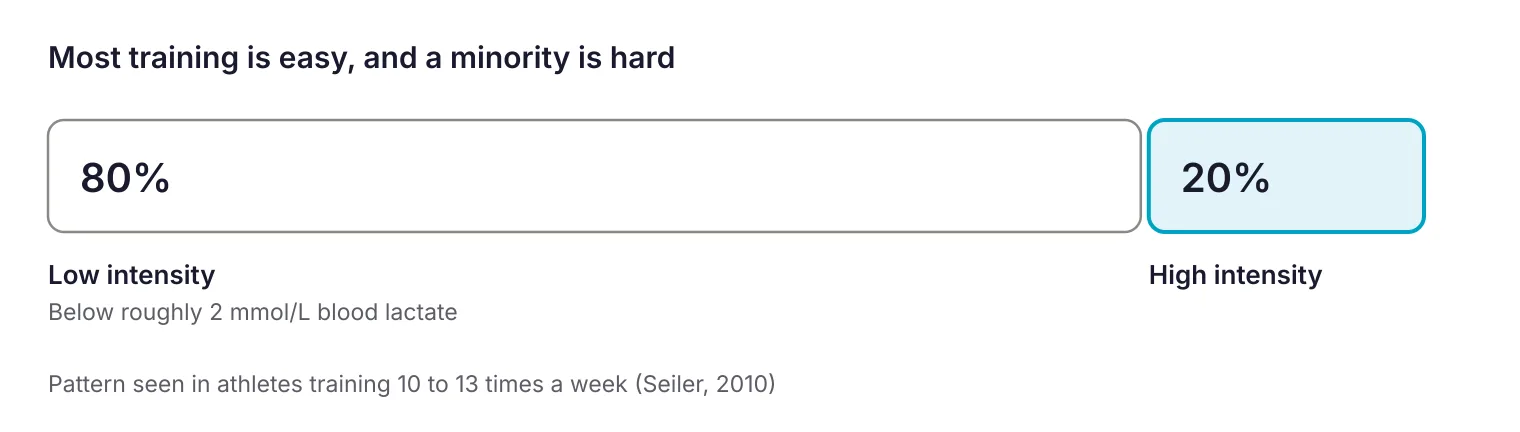
Example: in a week with five hours of training, roughly four hours would be easy and one hour hard.
How to tell easy from hard. In a 2004 study of healthy volunteers on a treadmill and a bike, the point where speech first became difficult matched the ventilatory threshold (the effort where breathing starts to rise much faster) almost exactly. When speaking was not comfortable, intensity was consistently above it. If you can talk comfortably, you are at or below that threshold.
**Try it: **on your next easy session, chat with a training partner or recite a short paragraph out loud. If you can speak in full sentences, you are at an easy effort.
| Level | Illustrative week | What the research says |
|---|---|---|
| Just starting | Three sessions of walking, jogging or cycling, all at a pace where you can talk comfortably. Add short faster segments only once that feels easy. | The talk test marks a pace at or below the ventilatory threshold. No study here tests a specific beginner schedule. |
| Intermediate | Four or five sessions: three or four easy conversational sessions plus one or two with harder intervals. | Seiler’s reviews conclude that two high-intensity sessions per week suffice to drive performance adaptations. |
| Advanced | Most weekly volume stays easy, and hard sessions remain a minority of the time. | In already well-trained athletes, studies show no convincing evidence that more emphasis on high-intensity intervals gives long-term performance gains. |
The studies cited here cover several endurance disciplines, so the easy-versus-hard split is not specific to running. They do not test strength or hybrid training such as Hyrox, so treat this as a framework for the endurance part of your week. Here is how the same easy-versus-hard idea could look in other sports. These are illustrations and not prescriptions from a study, although the talk test was studied on a bike.
- Cycling: most rides at a pace where you can talk, with one or two harder sessions such as sustained climbs or intervals.
- Swimming: mostly easy, steady sets, with one or two harder sets such as repeated fast lengths.
- Rowing: mostly steady rows at an easy effort, with one or two sessions of hard intervals.
- Hiking or trail walking: easy, steady days, and now and then a harder day with steep climbs.
- Lifting weights: these studies do not cover strength training. The soreness findings above still apply, because a first session can leave you sore whatever your lactate did.
The weeks above illustrate the idea and are not prescriptions from a study. If you have a health condition, check with a doctor before raising your training intensity.
During races
In a race, the research is most useful for fueling: how much carbohydrate to take in depends mainly on how long you will be racing. Rising lactate at race effort is normal fuel use and not a sign that oxygen has run out. Above steady-state intensity, more of your ATP comes from glycolysis, which breaks down glucose. That is one reason carbohydrate matters more as effort and duration increase.
| Race duration | Carbohydrate during the race | Notes |
|---|---|---|
| Up to about 1 hour | Large amounts are not necessary | A carbohydrate mouth rinse (swishing a carbohydrate drink in your mouth and spitting it out) may be enough to gain a benefit |
| 1 to 2.5 hours | 30 to 60 g per hour | 2016 joint position statement of the Academy of Nutrition and Dietetics, Dietitians of Canada and ACSM |
| Beyond 2.5 hours | Up to 90 g per hour | Use a mix of carbohydrate types such as glucose and fructose (two sugars the gut absorbs through different routes), because a single source is oxidized (used as fuel) at up to about 60 g per hour |
The right amount is individual, and the higher intakes apply only if your gut tolerates them. Test your plan in training before race day. Example: for a 2-hour race, 30 to 60 g per hour works out to about 60 to 120 g in total. Check the carbohydrate grams on the label of your gels, drinks or chews to see how many you would need. These ranges depend on how long you race, not on the distance, so they apply from 10Ks to ultras, and to endurance events in other sports, such as a cycling race or a triathlon, that last the same time.
Race day is only part of the picture. Eat for the Effort Ahead, and the One You Just Finished covers fueling before key sessions and recovering after hard efforts.
Heading into a race? Taper Before Your Race: Why Doing Less Can Make You Faster explains how research suggests easing off before race day, with a week-by-week example.
What about lactate gels?
Some gels and supplements now contain lactate and are marketed as a new kind of race fuel. Because your body uses lactate as fuel, the idea sounds reasonable, but the evidence that eating it improves performance is limited and mixed.
- Most cycling trials found no performance gain. In a 2024 trial, 16 endurance-trained male cyclists took calcium lactate or a placebo before repeated 1 km and 4 km time trials. Performance did not change. Effort felt easier, and some riders had stomach side effects. A 2014 trial of 40 km time trials in 7 men and a 1998 trial that added lactate to a carbohydrate drink in 7 trained cyclists also found no difference.
- One small trial found a modest gain. A 2024 pilot trial in 15 recreational exercisers found that work rate in a 20-minute cycling time trial was about 4% higher with a commercial lactate supplement (204 watts versus 197 watts). It did not change peak oxygen use or the lactate and ventilatory thresholds.
- Short, very hard efforts are less clear. The 2024 cycling trial notes that some studies reported 4 to 26% longer time to exhaustion at very high intensity, and others found no effect.
The lactate your body makes and shuttles between tissues is not the same as lactate you swallow, so the fuel findings in Brooks’s review do not show that a gel helps. These studies are small, mostly in cycling, and use different doses and products. A claim that elite athletes use a product is not evidence that it works. If you are curious, test any new product in training first, as with any race fuel. Until stronger evidence arrives, carbohydrate is still the fuel with strong support in the table above.
How Fit PA can help
Knowing that lactate is fuel is useful. Turning it into a training week is where most people get stuck. Fit PA helps with that part.
- Your lactate threshold zones, from your watch. Fit PA brings in the lactate threshold zones your watch calculates, so your effort levels are based on your own data and not on a generic chart. It works with Garmin, Coros, Suunto, Polar, Wahoo, Apple Watch and Health Connect.
- Hard and easy days, built in. When your coach creates your plan, it spaces out hard sessions and builds easy days in automatically. You do not have to ask.
- See where your time goes. The Analytics page shows how your training time splits between easy and hard effort, along with training load, fitness and fatigue, HRV and sleep. If most of your week is landing in the middle, you will see it. Not sure how to read training load? Stop Guessing Your Training Load: The 3 Models Every Athlete Must Know walks through three ways to think about it.
- Running form analysis. Upload a short video of your run, filmed from the side, and Fit PA shows you what is working in your form and what is not. Your coach knows the results, so it can talk them through with you and, if you want, build the right drills and exercises into your training plan to address what showed up. A few weeks later, upload a new clip to recheck and see what changed.
- Fuel that follows training. Daily nutrition targets scale with your training load, with guidance on eating before and after big efforts.
- Ask why. You can ask your coach in chat, at any time, what a session is meant to do or why today is easy. It answers with your plan, activity history and biometrics in view.
Whether you are training for a first 5K, a stronger season of cycling or lifting, or a 100-mile race, the idea is the same: most of your effort stays easy, and the hard days count.
Fit PA is a fitness coaching tool, not a medical device, and does not provide medical advice.
Glossary
| Term | Plain meaning |
|---|---|
| Lactate | A molecule muscles make from glucose and that many tissues burn for fuel |
| Lactic acid | The acid form of the molecule. Whether the body makes lactate or lactic acid is still discussed, and this article says lactate |
| Glycolysis | The breakdown of glucose into pyruvate, which can then become lactate or enter the mitochondria |
| Mitochondria | The parts of a cell that use oxygen to produce most of its energy |
| VO2max | The highest rate at which your body can use oxygen |
| Torr | A unit of pressure, used here for oxygen pressure in muscle |
| Ventilatory threshold | The intensity where breathing begins to rise much faster than effort |
| Lactate threshold | The intensity where blood lactate begins to climb above baseline |
| MLSS | Maximal lactate steady state, the highest intensity at which lactate production and removal balance |
| Polarized training | About 80% of training at low intensity and 20% at high intensity, with little in between |
| BDNF | A protein tied to brain function |
| DOMS | Delayed onset muscle soreness, the ache that builds a day or two after hard or unfamiliar exercise |
| Eccentric contraction | A muscle lengthening while it is under load, as when you lower a weight or run downhill |
| ATP | The molecule cells use as energy |
| Acidosis | A rise in acidity inside the muscle, caused by protons (hydrogen ions) building up |
| Oxidize | To burn as fuel using oxygen |
| Pyruvate | The molecule glucose breaks down into, which can become lactate or enter the mitochondria |
| Cori cycle | A loop in which lactate made in muscle is rebuilt into glucose that can fuel muscle again |
| Receptor | A docking site on a cell that lets it respond to a signal, such as GPR81 for lactate |
| mmol/L | Millimoles per liter, the unit blood lactate is measured in |
Sources
Figures come from the papers below, and several points in them are still debated.
- Brooks GA. The Science and Translation of Lactate Shuttle Theory. Cell Metabolism, vol. 27, April 2018. doi:10.1016/j.cmet.2018.03.008
- Robergs RA, Ghiasvand F, Parker D. Biochemistry of exercise-induced metabolic acidosis. American Journal of Physiology, Regulatory, Integrative and Comparative Physiology, 2004;287(3):R502-R516.
- Schwane JA, Watrous BG, Johnson SR, Armstrong RB. Is lactic acid related to delayed-onset muscle soreness? The Physician and Sportsmedicine, 1983;11(3):124-131.
- Faude O, Kindermann W, Meyer T. Lactate threshold concepts: how valid are they? Sports Medicine, 2009;39(6):469-490.
- Repeatability and predictive value of lactate threshold concepts in endurance sports. PLOS ONE, 2018. doi:10.1371/journal.pone.0206846
- Seiler S. What is best practice for training intensity and duration distribution in endurance athletes? International Journal of Sports Physiology and Performance, 2010;5:276-291.
- Stöggl and Sperlich. The training intensity distribution among well-trained and elite endurance athletes. Frontiers in Physiology, 2015;6:295. doi:10.3389/fphys.2015.00295
- Persinger R, Foster C, Gibson M, Fater DCW, Porcari JP. Consistency of the Talk Test for exercise prescription. Medicine & Science in Sports & Exercise, 2004;36(9):1632-1636.
- Jeukendrup A. A step towards personalized sports nutrition: carbohydrate intake during exercise. Sports Medicine, 2014. doi:10.1007/s40279-014-0148-z
- Academy of Nutrition and Dietetics, Dietitians of Canada and American College of Sports Medicine. Nutrition and Athletic Performance. Joint position statement, 2016.
- Should we void lactate in the pathophysiology of delayed onset muscle soreness? Not so fast! Let's see a neurocentric view! Metabolites, 2022;12(9):857.
- Advances in delayed-onset muscle soreness (DOMS): Part I: Pathogenesis and diagnostics. Sportverletz Sportschaden, 2018;32(4):243-250.
- Bordoli C, Varley I, Sharpe GR, Johnson MA, Hennis PJ. Effects of oral lactate supplementation on acid–base balance and prolonged high-intensity interval cycling performance. Journal of Functional Morphology and Kinesiology, 2024;9(3):139.
- Ewell TR, Bomar MC, Brown DM, Brown RL, Kwarteng BS, Thomson DP, Bell C. The influence of acute oral lactate supplementation on responses to cycle ergometer exercise: a randomized, crossover pilot clinical trial. Nutrients, 2024;16(16):2624.
- Northgraves MJ, Peart DJ, Jordan CA, Vince RV. Effect of lactate supplementation and sodium bicarbonate on 40-km cycling time trial performance. Journal of Strength and Conditioning Research, 2014;28(1):273-280.
- Bryner RW, Hornsby WG, Chetlin R, Ullrich IH, Yeater RA. Effect of lactate consumption on exercise performance. Journal of Sports Medicine and Physical Fitness, 1998;38:116-123.
- Open question: Brooks writes that it is uncertain whether glycolysis produces lactate or lactic acid, and argues for lactate.
- Open question: the mitochondrial lactate oxidation complex is described as putative, and the exact site of lactate oxidation is unresolved.
- Open question: which training intensity distribution is best remains open to debate, according to Stöggl and Sperlich.