

Why your calorie and carbohydrate targets should change around a race or a hard key session, and what the research says to do about it.
Picture a runner with a Sunday marathon on the calendar. They're also cutting a few kilos, so their nutrition app has been telling them to eat 1,500 calories on a rest day. On Friday and Saturday, the app still says 1,500 calories. On Monday, it's still 1,500.
That is the one stretch of the week when the research says restriction is the wrong call.
Most nutrition tools judge each day in isolation. Your body doesn't. The fuel for Sunday is laid down on Friday and Saturday, and the repair from Sunday is still going on Tuesday. This article explains what the research says about eating around big efforts, and how Fit PA now builds it into your daily targets.
What's in it for you
- Stronger long efforts. Muscle carbohydrate (glycogen) is the fuel for hard, long work. Start with a full tank and you can hold your pace for longer.
- Better recovery. Eating enough in the right window puts you in a better position for the next session.
- No more guessing. You'll know when to eat more, how much more, and why, and when a regular day is fine.
- A deficit that doesn't sabotage you. If you're losing weight, the plan pauses the deficit exactly when it would cost you the most, and carries on afterwards.
- Less food on days that don't need it. The science doesn't say "eat more all week." It says eat more at specific moments.
Part 1: Why the days around a big effort matter
Your muscles store carbohydrate as glycogen, and it is limited. How fast you burn it depends heavily on how hard you're going.
In a classic study of muscle biopsies, Gollnick and colleagues found glycogen depletion was 2.7 times greater at 64% of VO2max and 7.4 times greater at 84% than at 31% (Gollnick et al., 1974). After three hours of low-intensity cycling, large amounts of glycogen were still sitting in the muscle. Easy hours barely touch the tank. Hard hours drain it.
Duration matters too. In trained cyclists riding at 71% of VO2max, glycogen fell at about 51 mmol/kg per hour for the first two hours, and they were exhausted at around three hours (Coyle et al., 1986). And where you start sets your limit: in Bergström's 1967 study, the same people rode at 75% of VO2max until exhaustion after three different diets. They lasted 59, 126 or 189 minutes, depending on how full their glycogen stores were (Bergström et al., 1967).
So the science points to two moments that matter: the days before a demanding effort, and the day (or two) after it.
Part 2: Before the effort
Loading for long races: the two days before
The joint position stand from the Academy of Nutrition and Dietetics, Dietitians of Canada and the American College of Sports Medicine (Thomas, Erdman & Burke, 2016) recommends carbohydrate loading for events lasting longer than about 90 minutes: 10–12 g of carbohydrate per kg of body weight per day for 36–48 hours.
You don't need a brutal depletion phase to do it. In Sherman's 1981 study, runners who tapered their training and ate a 70% carbohydrate diet for the last three days reached muscle glycogen of 203 mmol/kg, against 207 for the classic depletion method and 159 on a normal (50%) diet, with no depletion phase. And in Bussau's 2002 study, eight endurance-trained men eating 10 g/kg while resting raised their muscle glycogen from 95 to 180 mmol/kg wet mass in a single day (Bussau et al., 2002).
Energy has to go up, not just the carbohydrate share. Tarnopolsky and colleagues gave six men and six women a high-carbohydrate diet (75% of calories) for four days. The men's glycogen rose. The women's only rose when total energy also went up by about 34% (Tarnopolsky et al., 2001). Their conclusion: low energy intake may explain why women appeared to load less well. In other words, you can't load on a diet.
Short races don't need loading
Here's the honest part. In the same 1981 study, carbohydrate loading made no difference to run times over 20.9 km in trained runners (Sherman et al., 1981). The guidelines tie loading to events beyond about 90 minutes. A 5K or 10K is fuelled by your normal, well-fed training diet.
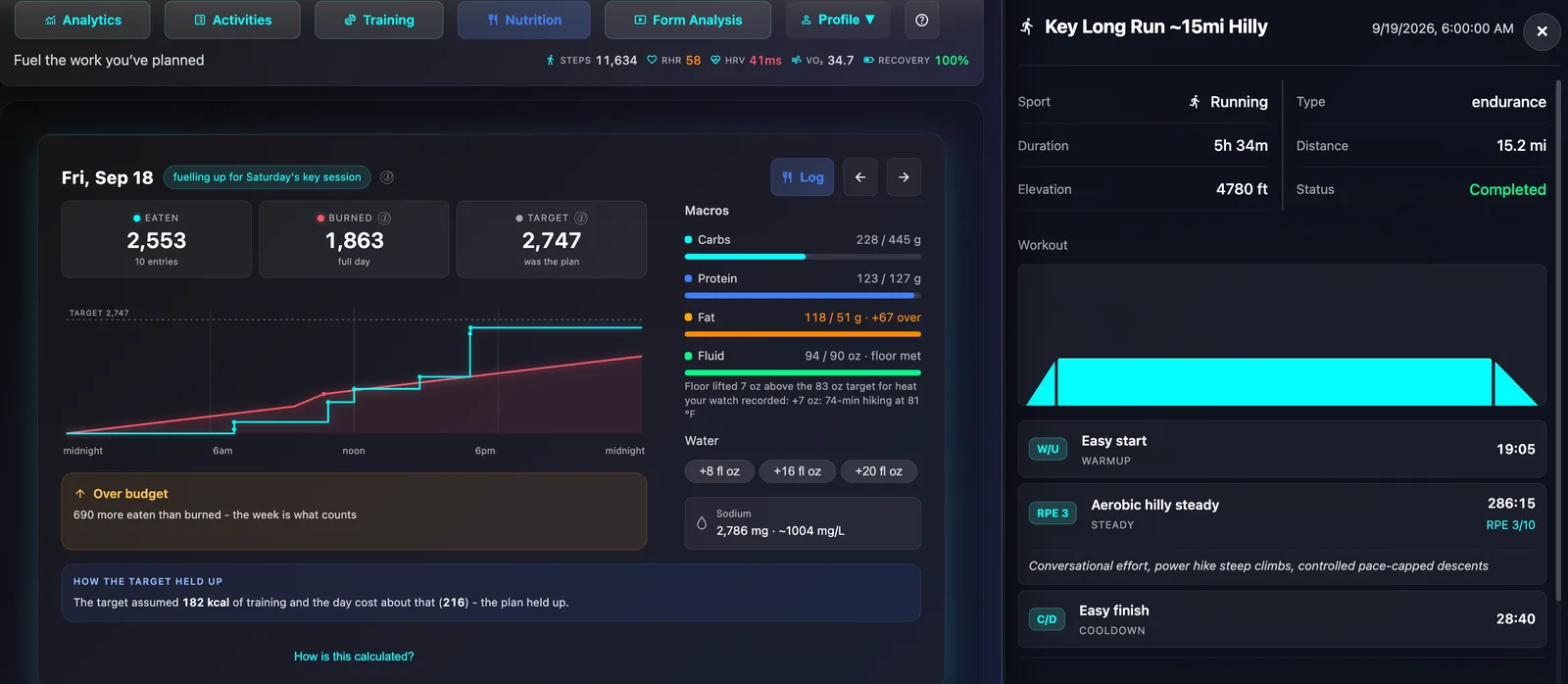
Key training sessions: fuel up the day before
Loading is for race day. But the same logic applies to your hardest sessions. The guidance and the research on "fuelling for the work required" (Impey et al., 2018; Stellingwerff et al., 2019) say you adjust carbohydrate to the demands of what's coming. Sessions that need the carbohydrate (long, hard, key) get it. Easy, steady sessions below threshold are the ones where low carbohydrate availability is tolerable.
That's why Fit PA doesn't look at duration alone. A three-hour easy hike and a hard 2.5-hour long run are very different fuel problems.
Part 3: After the effort
The first hours and the next day
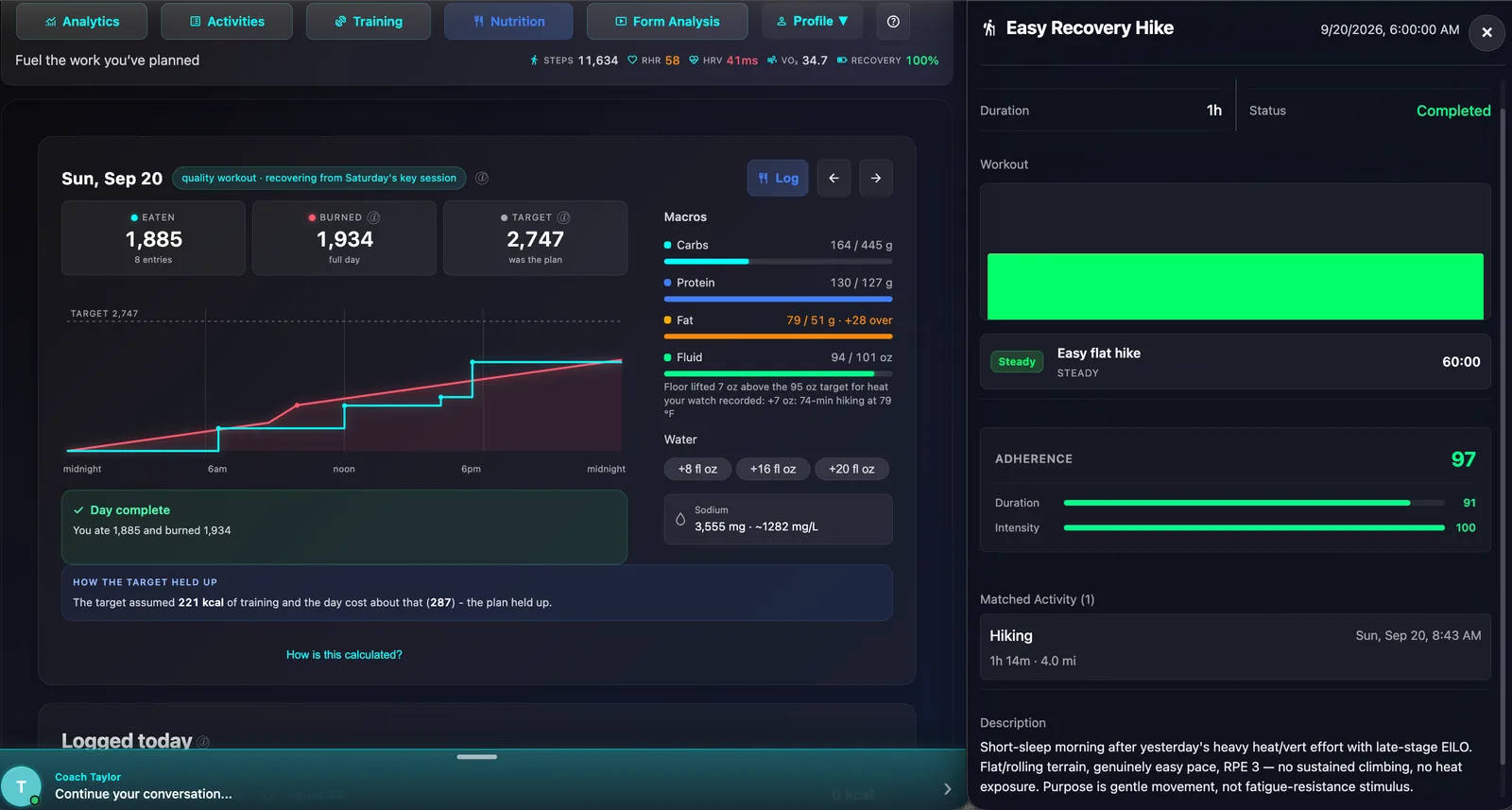
Early recovery is a race against a slow process. In the first four hours after exercise, about 1 g/kg of carbohydrate optimises glycogen resynthesis. From 4 to 24 hours, what matters is that your total intake meets the needs of your next session; the type and pattern matter less (Burke, van Loon & Hawley, 2017). Without severe muscle damage, the position stand says glycogen can be back to normal within about 24 hours of reduced training and adequate fuel.
Timing does matter if your next hard session is soon. In a small study of nine active men, those who delayed carbohydrate for three hours after hard cycling intervals (while eating the same ~7 g/kg over 24 h) managed about 5 fewer intervals the next day and rated them harder (Díaz-Lara et al., 2024). Muscle glycogen itself was similar. It's a small study, so treat it as a nudge: if you're training again within 24 hours, don't put off the first meal.
After a marathon, it takes longer
A full marathon is different. Asp and colleagues measured glycogen in seven marathon runners. It fell from 758 to 148 mmol/kg dry weight during the race. Even on at least 7 g/kg of carbohydrate a day, it was still 30% lower two days later, and only back to normal by day seven (Asp et al., 1997).
Two things follow. Fuel the days after a very long race and don't diet through them. And don't expect eating a mountain of food to fix it: the slow recovery is driven by factors in the muscle itself, and nothing in the research shows that eating beyond the daily band overcomes it. Rest, then steady fuelling.
Putting it together: three real-world examples
(Illustrative numbers. Fit PA works yours out from your own training plan and weight.)
1. The marathoner on a deficit. A 65 kg runner has a 3 h 20 min race on Sunday. Fit PA's loading band is 10 g/kg, the low end of the guideline range, which is about 650 g of carbohydrate on each of the two days before. That is a big number against a normal rest day of around 1,500 kcal. It lands at about 3,600 kcal. The deficit is paused, and the page tells them why. After the race the recovery days follow: because it's a 180+ minute race, two days at 7 g/kg (about 455 g) instead of one.
2. The weekend long-run athlete. A 70 kg runner has a hilly 2 h 40 min key long run planned on Saturday. The plan flags it as a key session, so Friday gets the fuel-up band: 7 g/kg, roughly 490 g of carbohydrate, with any deficit on hold. Sunday gets the same band to restore what Saturday used. Monday goes back to normal.
3. The easy-hiker. A walker has a relaxed three-hour hike on Saturday. Easy intensity means it sits in the light carbohydrate row, so nothing special happens on Friday. They eat to their usual plan. Long doesn't always mean hard, and the engine knows the difference.
And the race that doesn't count. A 32-minute race earns no loading at all. During development, treating the day before a short race as a fuel-up day added nearly 1,800 calories for a weight-loss athlete. It was loading in disguise, and the rule was withdrawn.
How Fit PA helps
Fit PA's nutrition targets are worked out from your actual training plan, and now they look at the days around each session, too.
- It reads your plan, not just today. For any day, it looks at the planned sessions on the days either side.
- It uses the science's triggers. Loading for races of 90+ minutes. A fuel-up before sessions the plan marks as hard (quality, key or long) that total 90+ minutes. Recovery after those, and two days after a 3+ hour race.
- Easy days stay easy. Low-intensity time doesn't push you into a bigger carbohydrate band.
- Your deficit gets out of the way. On a loading, fuel-up or recovery day, the deficit pauses, and the page says so.
- It tells you why. Each day carries a label like "carb loading · Sunday's race" and a plain-language explanation of the band, the event and the research behind it. The day before a role begins, you get a heads-up so you can shop and plan.
- Your coach knows too. Your Fit PA coach can see the upcoming fuelling day, so you can ask "what should I eat Friday?" and get an answer built on the same numbers.
- Everything adjusts as your plan does. Move a long run and the fuelling day moves with it.
What we deliberately don't do
Good nutrition advice says where the evidence stops.
- No loading for more than two days, or for events under 90 minutes.
- No extra food beyond the daily band to "beat" post-marathon recovery. The evidence doesn't support it.
- No meal-by-meal timing targets. Pre-event meals, in-race fuelling (about 30–90 g/h) and the first-hours refuel are real, well-supported guidance. They stay as coaching conversations, not rigid rules.
- A transparent convention. The 90-minute line for key training sessions comes from the guideline's loading threshold. No study states an exact cutoff for training days, so we mark it as a convention.