
The soreness you feel after hills, lifting, and jumping isn't one thing. A 2026 review finds each type works differently, so recovery should match the workout.
What the research found
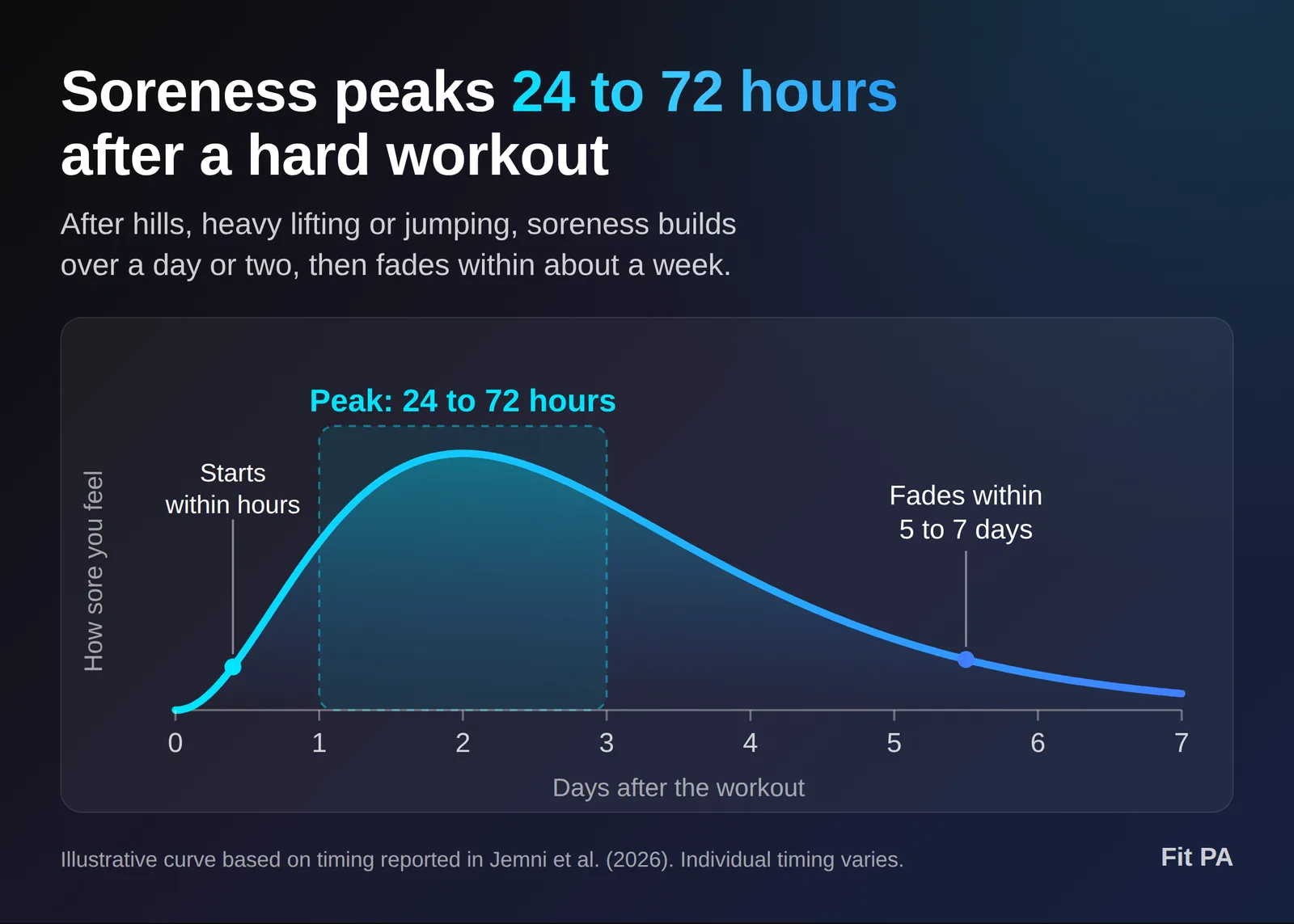
Delayed onset muscle soreness (DOMS) shows up hours after unfamiliar or hard exercise, especially when muscles lengthen under load. It peaks 24 to 72 hours later and usually fades within about a week. You may also feel stiffness, swelling, reduced range of motion, a clumsy feel, and a temporary strength loss.
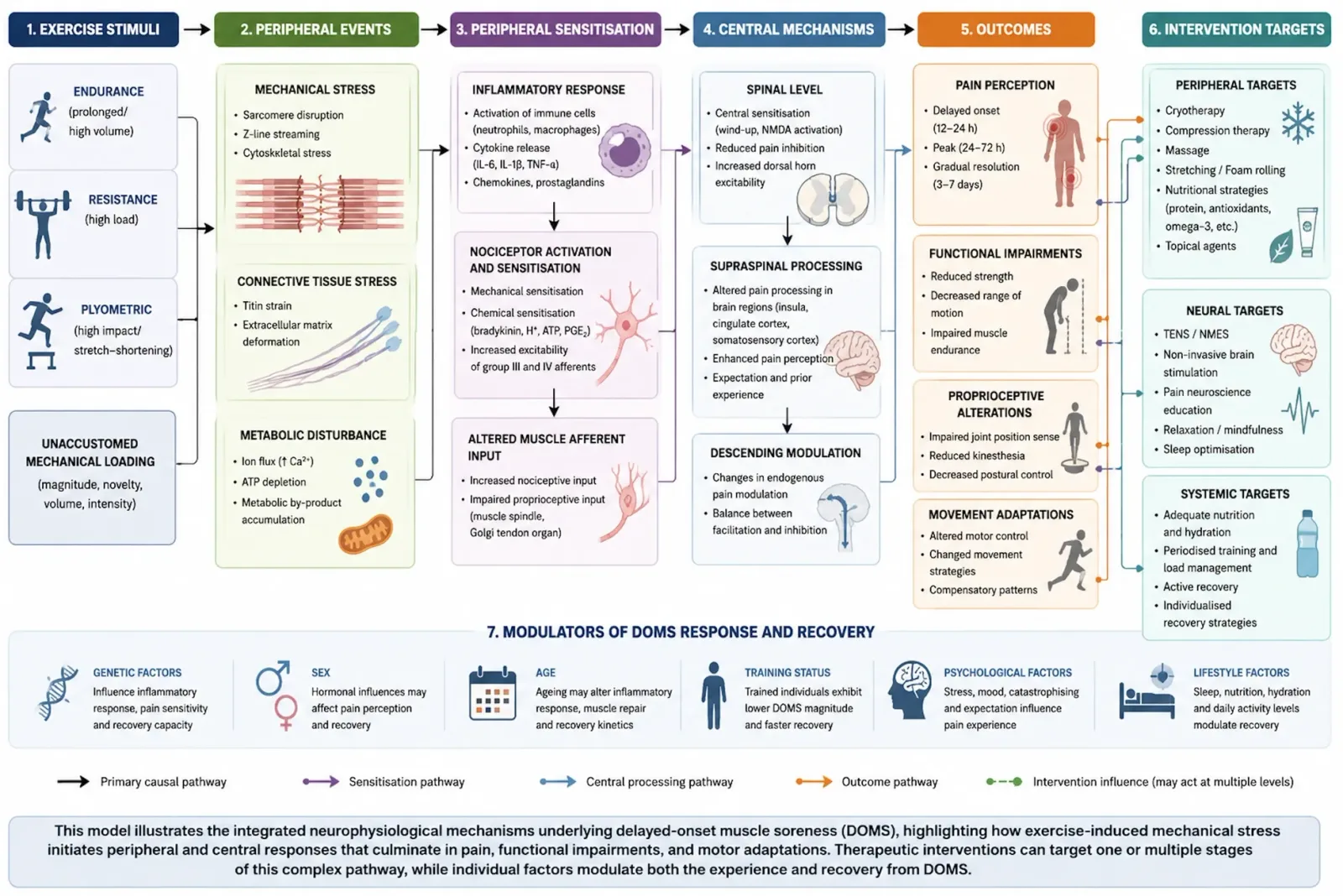
A Frontiers in Sports and Active Living review (Jemni et al., September 2026) says soreness isn't just muscle damage, and lactic acid has been ruled out. MRI scans have found DOMS without detectable muscle fiber damage. Pain nerves, inflammation, and how your brain processes pain all play a part.
The mix depends on the activity:
- Running (especially downhill): Inflammation builds, and IL-6 (an inflammation signal) rises within 48 hours. The response lessens with repeated exposure.
- Lifting: Strength drops, and pain-sensing nerves become more sensitive.
- Jumping: Landing disrupts your sense of body position, which can make movement feel clumsy.
Many recovery tools reduce soreness, but the effects are modest
- Massage: In a 99-study meta-analysis, it was the most effective tool for soreness and fatigue.
- Compression garments: They have a moderate effect (g = 0.40).
- Foam rolling: It has a small to moderate effect (g = 0.47). The meta-analysis authors call the overall effects minor, and one trial found it no better than rest.
- Acupuncture: It has a small to moderate effect (SMD -0.49 across six trials).
- Easy movement: Walking or easy cycling can help, though results are mixed.
- Vitamin C: In a downhill running trial, it didn't reduce soreness, and strength recovery was delayed.
Protein showed a benefit for strength. In a small trial of nine active men, 100 g of protein (including 40 g of essential amino acids) after a downhill run kept strength at normal levels for 72 hours. On placebo, strength fell about 10% at 48 hours. Soreness didn't differ between groups. The evidence has limits. Most trials were small and many included only young men. The review also notes there's no long-term follow-up.
What it means for you
Beginner
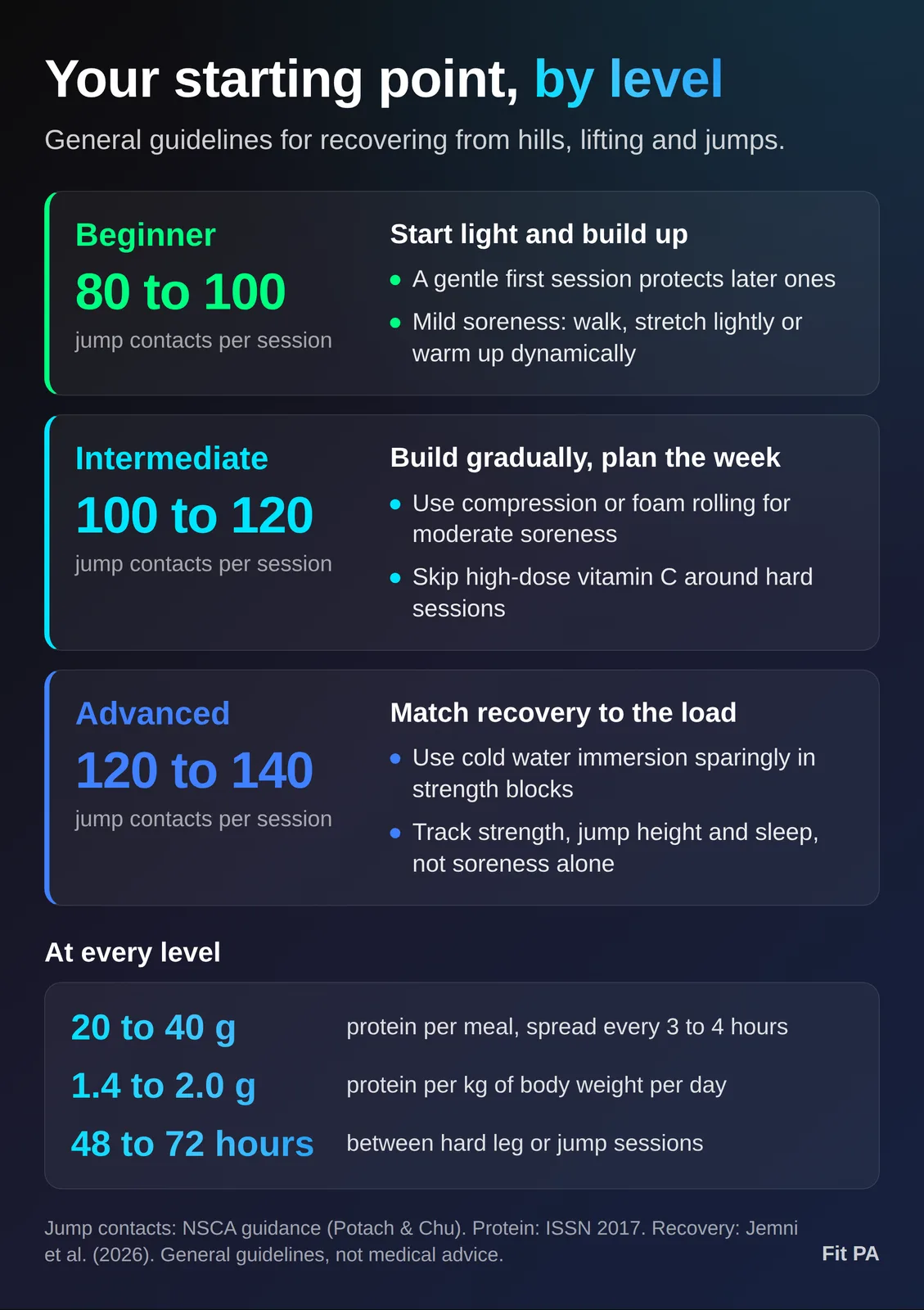
- Start light. A gentle first session protects you against a harder one later, a protection that lasts for weeks.
- For jumps, start with 80 to 100 ground contacts per session, with 48 to 72 hours between sessions.
- Leave 48 hours between hard leg sessions. In one trial of resistance-trained men, 72 hours felt better.
- Eat 20 to 40 g of protein after hard sessions, within a day total of 1.4 to 2.0 g per kg of body weight.
- Mild soreness: walk after running, stretch lightly after lifting, and do a dynamic warm-up before jumps.
Intermediate
- Progress gradually. In one lab study, six weeks of twice-weekly eccentric knee training eliminated soreness after a downhill run.
- Jumps: 100 to 120 contacts per session.
- Spread protein across meals every 3 to 4 hours.
- Match the tool to the workout: easy movement after runs, compression after lifting, foam rolling or massage after jumps. Expect small gains.
- Skip high-dose vitamin C around hard sessions.
Advanced
- Scale recovery to load. The review suggests light movement for mild soreness, targeted tools for moderate, and massage for severe.
- Before an event with big descents, build eccentric-focused sessions in weeks ahead.
- Jumps: 120 to 140 contacts per session.
- Use cold water immersion sparingly. It can reduce soreness, but it blunted muscle growth in strength-training studies.
- In one small study, repeated amino acid doses over four days helped, while a single dose around the session did not.
- Clinic options like acupuncture and photobiomodulation have trial support but need a qualified provider.
- Don't judge recovery by soreness alone. Check strength, jump height, and sleep too.
Seek medical care for severe pain, major swelling, or dark urine.
How Fit PA can help
Soreness is as much a planning problem as a recovery problem. The best protection is a plan that builds exposure gradually and spaces out your hardest days. That is what Fit PA's coach does when it builds your plan.
It builds exposure gradually. Connect your watch (Garmin, Coros, Polar, Suunto, Wahoo, Apple Health, or Health Connect). The coach reads your history and builds a plan around your goal, your available days, and any niggles. Before it builds the plan, it checks it against your recent weekly volume and longest routine run. If a proposed jump doesn't add up, it shows you the numbers and asks first. That's the "start light and progress" principle from the repeated bout research.
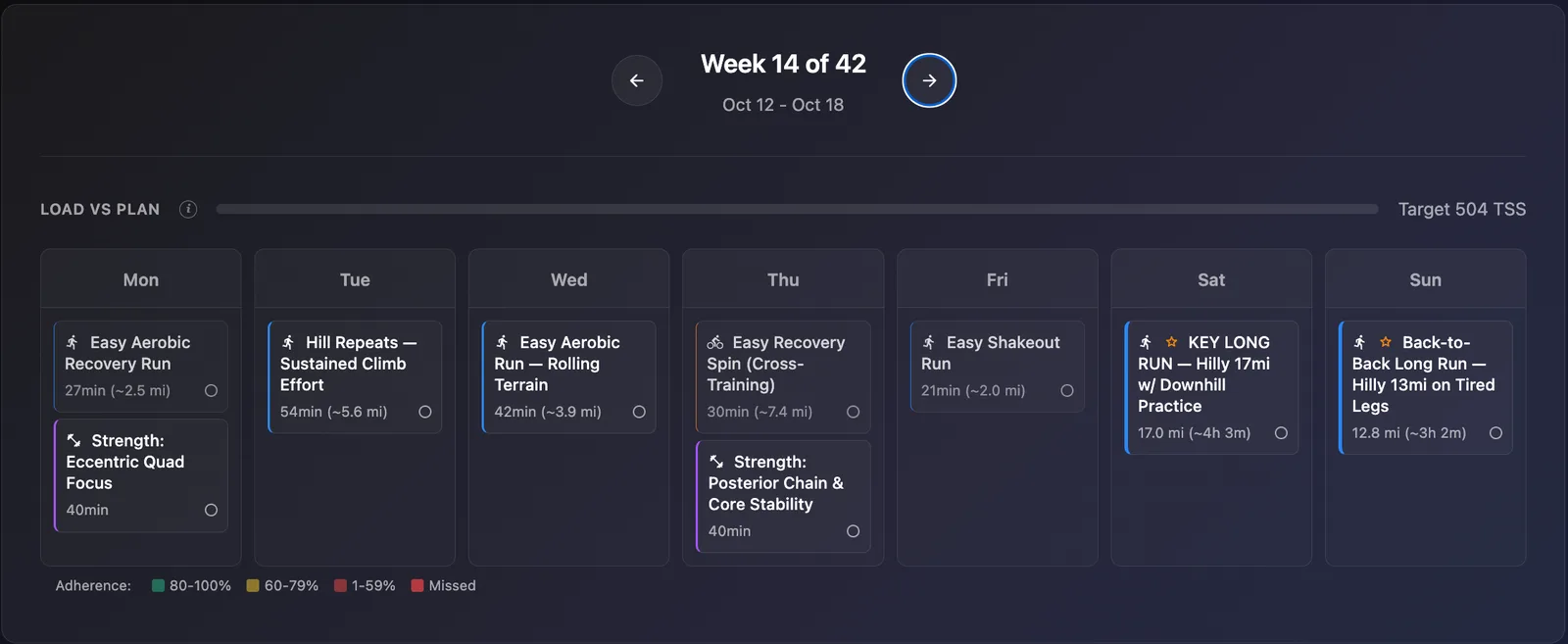
It spaces your hard days for you. Look at the sample week below: easy and recovery days sit around the hill sessions, and strength and cross-training are built in. Sessions sync to your calendar and watch, and strength sessions arrive with sets, reps, and loads spelled out.
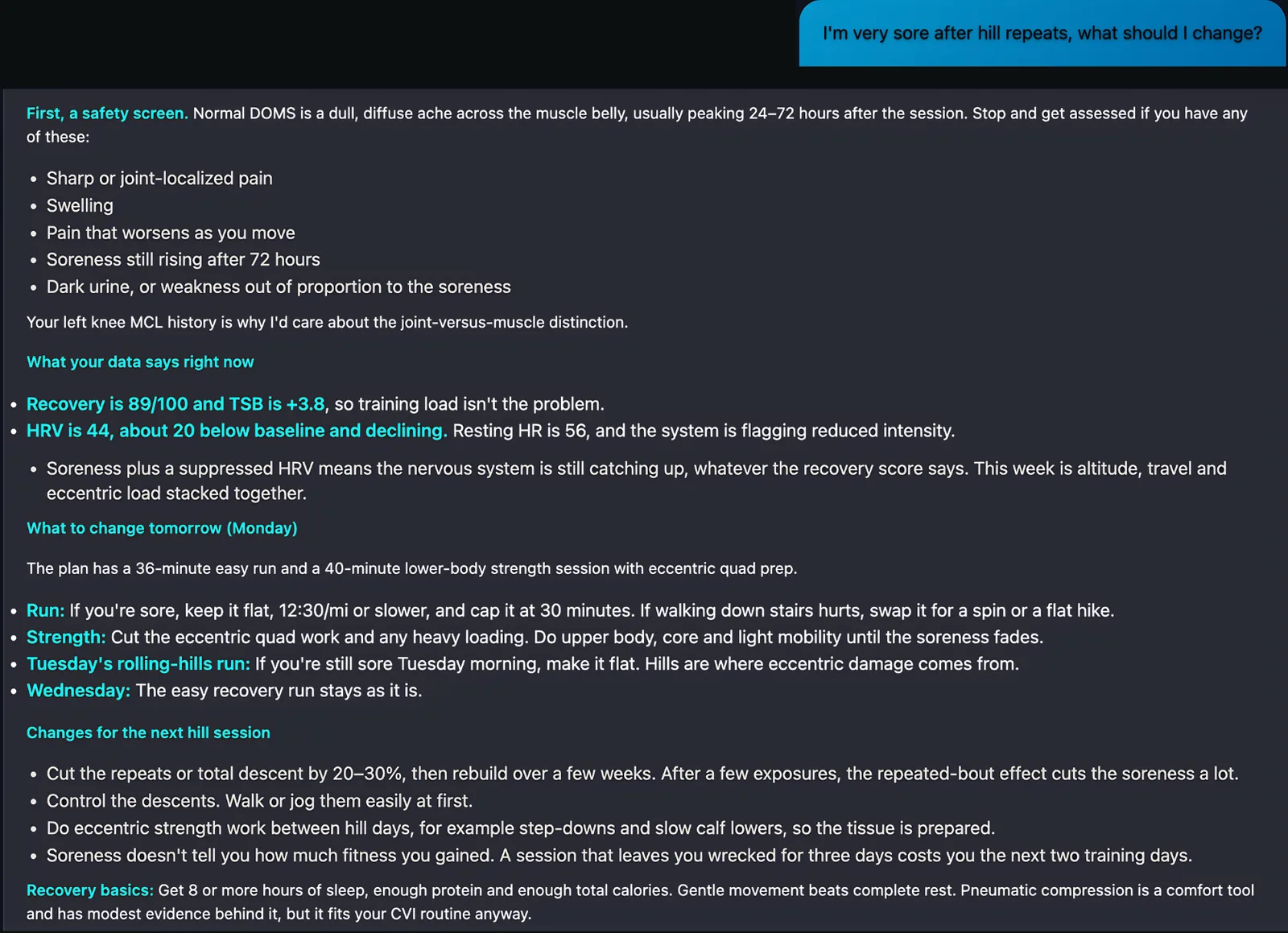
It reads your response with more than soreness. The review says pain ratings alone can mislead. Fit PA adds a daily readiness score from HRV, resting heart rate, and sleep. It also tracks fitness, fatigue, and form against your plan. If you tell your coach you're sore, ill, or missed a week, it reworks the plan in the same conversation. Niggles stay on file and are planned around.
It helps you fuel around hard sessions. Your calorie target rises on big training days and drops on rest days. Nutrition tracking logs protein by photo, sentence, or by telling the coach, and it recommends eating more before and after big efforts. Routines can log supplements automatically.
Ask your coach. Your coach knows your plan, your recovery data, and what you've told it. Try:
- "I'm really sore after Thursday's hill repeats. Should I change anything on Friday?"
- "How should I fuel before and after my long hilly run?"
- "My legs feel heavy after strength day. Can we adjust this week?"
Your first coach-built plan is free, no card needed. Start at app.fit-pa.com.
Fit PA is a coaching tool, not a medical device. It doesn't replace a physical therapist or doctor.
Sources
- Jemni M, et al. Front Sports Act Living. 2026;8:1709704.
- Etheridge T, et al. Appl Physiol Nutr Metab. 2008;33(3):483-488.
- Close GL, et al. Br J Nutr. 2006;95(5):976-981.
- Dupuy O, et al. Front Physiol. 2018;9:403.
- Hill J, et al. Br J Sports Med. 2014;48:1340-1346.
- Wiewelhove T, et al. Front Physiol. 2019;10:376.
- Huang C, et al. Front Physiol. 2020;11:666.
- Kay AD, et al. Scand J Med Sci Sports. 2018;28:2299-2309.
- Jäger R, et al. J Int Soc Sports Nutr. 2017;14:20.
- Roberts LA, et al. J Physiol. 2015;593:4285-4301.
- Fyfe JJ, et al. J Appl Physiol. 2019.
- Cleary MA, et al. J Athl Train. 2002;37(1):32-36.
- Repeated bout effect: Int J Sports Med, doi:10.1055/s-2007-964866.
- Nosaka K, et al. Int J Sport Nutr Exerc Metab. 2006;16:620-635.
- Goulart KNDO, et al. Eur J Sport Sci. 2021;21:935-943.
- Plyometric volumes: NSCA guidance (Potach & Chu).