

Traversing 100 miles of wet and rocky terrain, the kind of brutal landscape found in the Old Dominion 100, or pushing past 200 miles entirely, like the Cocodona 250, is an assault on the human frame. Athletes endure temperatures ranging from below freezing to above 100 degrees Fahrenheit, facing a gauntlet of physical ailments from lacerations and sprains to hypothermia and severe gastrointestinal distress. Research on ultra-endurance performance keeps circling back to something easy to miss in the middle of all that damage: the body's breakdown is real, but it's often the mind that decides whether someone keeps moving through it. To understand how a human survives such a feat, we have to look past the muscles and into the neurological and psychological machinery that keeps a runner moving when the body is screaming for rest.
Dreaming with Open Eyes: The Resilience of the Sleep-Deprived Brain
For those who push past the 24 to 30-hour mark of continuous activity, the line between reality and imagination often blurs. This phenomenon is well documented in sleep science as hallucinations tied directly to time awake: a review of sleep-deprivation research found symptoms including hallucinations, distorted thinking, and misperceptions beginning to appear after roughly 24 hours without sleep, worsening in frequency and intensity, and potentially progressing toward acute psychosis with sustained wakefulness beyond 48 to 90 hours (Waters et al., Frontiers in Psychiatry, 2018).
Ultra races confirm this isn't theoretical. A 2024 study of runners at the Suffolk Backyard Ultra, the format that pushes competitors until only one remains, measured cognitive performance before the race and again after each runner's eventual withdrawal. Reaction time slowed significantly, and executive function, the ability to override an automatic but wrong response, was measurably impaired. Decision-making and planning, tested separately, were not affected, a useful distinction: sustained sleep deprivation doesn't degrade every mental function equally, it hits some circuits harder than others. Adverse events were common at this level of fatigue: eight of the eleven runners studied reported at least one, including four who fell, four who developed ataxia (loss of movement coordination), three who were injured, and two who hallucinated (PLOS ONE, 2024). That tracks with the underlying mechanism: sleep deprivation measurably weakens the connection between the prefrontal cortex and the amygdala, which is why the emotional, reactive brain starts running the show while the logical, decision-making brain checks out.
This isn't a benign quirk to shrug off, it's a real sign the brain is being pushed past a safe operating limit. But it's also a specific, well-documented response to sustained wakefulness that experienced ultrarunners and sports psychologists treat as manageable rather than automatically a medical emergency. The guidance from ultrarunning coaches is concrete: feed the brain, since it burns through glucose faster than almost any other organ; take a short nap when the race allows it, even 15 to 20 minutes measurably wards off or reduces hallucinations; and keep attention pointed outward at the trail rather than turning inward, since a more introspective mental state is linked to more frequent hallucinations, not fewer. The distinction that actually matters for safety is escalation: a leaf that briefly looks like an animal is a different situation from confusion that doesn't clear, real disorientation, or losing track of where you are, and that shift, not the hallucination itself, is the real signal to stop rather than push through.
The High-Performance Iceberg and the Paradox of Experience
Sports psychologists have long described a pattern in elite and ultra-endurance athletes called the "iceberg profile": low scores on negative mood states (tension, depression, anger, confusion) sitting below a normal population's baseline, with one positive trait, vigor, rising above it. Participants in the Yukon Arctic Ultra, a 690 km race through subarctic cold, showed exactly this profile at the start line (Rundfeldt et al., Frontiers in Physiology, 2018). A separate study of the same race, this one splitting participants into finishers and non-finishers, found the profile eroded very differently between the two groups as the race wore on: non-finishers saw confusion, anger, depression, and tension-anxiety all climb while vigor fell, but finishers' tension-anxiety actually dropped over the same stretch, even as fatigue rose in both groups (Kienast et al., Frontiers in Physiology, 2022).
There's a related finding worth naming precisely, since it's easy to overstate. A study of 221 ultra-trail runners found finishers scored significantly higher on self-efficacy and intention to finish the race than non-finishers did, while non-finishers scored higher on avoidance coping, the tendency to sidestep a stressor rather than face it directly. Seeking social support and setting self-referenced, mastery-focused goals also protected against dropping out (Corrión et al., PLOS ONE, 2018). Worth being honest about what this doesn't say: the study never measured years of experience, so the sport's own folklore, that a runner with a dozen finishes can still DNF, may well be true, but it isn't what this research actually established. What it does establish is more specific and more useful: belief in your own ability to finish, and a coping style that faces discomfort instead of avoiding it, are measured predictors of completion.
Being Fast Doesn't Replace Time on Your Feet
Here's a finding worth being precise about, because it's easy to misread. Among people who already train for and run ultras, personal-best times at shorter distances and running speed during training correlate with finish time more strongly than weekly training volume does (PLOS ONE, 2025; supporting work on marathon and 100 km race prediction). A separate analysis of the UTMB found something similar from a different angle: even pacing, sustaining a consistent effort across the whole distance rather than swinging between too fast and too slow, was directly associated with faster finishing times (Suter et al., International Journal of Environmental Research and Public Health, 2020).
That finding answers one specific question: among trained ultra runners, who tends to finish faster. It says nothing about what happens when the question shifts from finishing fast to finishing at all. A far more extreme case makes that difference clear. In the Trans Europe Foot Race, a 4,487 km race across 64 days from southern Italy to the North Cape of Norway, runners who finished had trained at roughly double the weekly volume of runners who didn't (ScienceDirect, bioprofiling study of TEFR finishers). At that distance, training volume wasn't a secondary factor sitting behind speed, it was the difference between finishing and not.
The two findings aren't in conflict, they're describing different jobs. A faster 10K time is a proxy for aerobic fitness, which helps at any distance. But fitness alone doesn't build the specific durability an ultra demands. Sustained aerobic training drives adaptations that speed work doesn't: more mitochondria, more capillaries in working muscle, and a shift toward burning fat instead of glycogen, all of which come from time spent training at that intensity, not from being fast (case study review of ultra-endurance training adaptations, 2022). The muscles' resistance to the kind of fatigue that accumulates over 20-plus hours of running is a related, separate adaptation: research treating ultramarathons as a model for studying the body's response to extreme, sustained load has found that strength loss in the legs follows a predictable curve during these events, plateauing only after roughly 20 hours, evidence of just how much repeated exposure to that specific kind of stress the body has to already be prepared for (Millet & Millet, BMC Medicine, 2012). None of that shows up on a shorter, faster time trial, and none of it can be trained by skipping the long miles.
The honest read: speed work sharpens the engine, time on feet builds the chassis that actually has to survive the distance. Skipping the long, slow miles in favor of speed work is a well-documented way for less experienced ultra runners to get hurt, not a shortcut. Both matter, and they build different things.
The Gut as an Endurance Organ: The Real Fueling Bottleneck
Energy expenditure scales fast with distance, a 50-mile effort can burn around 6,000 kcal, a 100-mile effort well over 10,000. But the number that actually separates finishers from strugglers isn't total calories, it's carbohydrate intake specifically. A study of runners at the Lake Biwa 100-mile race found that higher-placing finishers consumed significantly more carbohydrate than lower-placing finishers throughout the race, especially in the first half, and that runners with more stable blood glucose (fewer large swings) ran faster segments overall.
There's a direct brain mechanism behind why this matters, not just a performance correlation. The "central fatigue hypothesis" proposes that carbohydrate intake affects how much of the amino acid tryptophan crosses into the brain; less tryptophan means less serotonin production, and rising brain serotonin is linked to the specific sense of fatigue that sets in during prolonged exercise (Newsholme et al., 1987). Falling blood glucose over the course of a long race similarly depletes the brain's own glycogen reserves, a mechanism specifically implicated in central fatigue, the kind that originates in the brain rather than the muscles (Meeusen, 2014). This isn't just theoretical: a study of carbohydrate intake across a full day of sustained aerobic activity found it directly improved vigilance and mood compared to no intake, and a more recent meta-analysis found carbohydrate drinks measurably improved executive function, the same higher-order decision-making this article has already covered breaking down hour after hour on the trail (ScienceDirect, 2002; Frontiers in Psychology, 2023).
The strategic hurdle is that the body's ability to process nutrients under this much stress is compromised, so successful athletes train the gut deliberately to handle high-glucose loads even as appetite disappears and GI distress sets in. This is also where a static nutrition tracker runs out of road: it can tell someone what they ate yesterday, but it has no idea what tomorrow's long run is going to demand of their glycogen stores, or their brain's. Fit PA's nutrition target moves with the day an athlete is actually having, a rest day, a walk, a long run, anticipating what a session is going to demand rather than averaging what already happened. That matters as much for the brain doing the pacing and decision-making as it does for the legs doing the running.

The Cognitive Process of Pain: Associative Techniques
Finishing an ultra comes down to a willingness to tolerate the profound discomfort of hard physical labor, mile after mile, choice after choice. Sport psychology has long distinguished between two coping strategies under sustained effort: "dissociative" techniques (daydreaming, singing, mentally checking out) and "associative" techniques (actively monitoring the body's sensory input, like breathing rhythm and muscle tension, and making small real-time adjustments). Elite ultra-endurance athletes lean associative. A "head-to-toe inventory," staying present with the pain and treating it as data rather than a threat, is a trainable skill, not an innate trait, and it's one of the more consistent findings across the ultra-psychology literature.
Managing the Perfect Storm
As the hours stack up, judgment is exactly the thing an ultra runner can no longer trust in themselves. Two real strategies help a fatigued brain keep functioning:
- Caffeine, to mask fatigue. Caffeine works by blocking adenosine receptors in the brain. Adenosine is the chemical that builds up the longer someone's been awake, and it's part of what produces that drowsy, sluggish feeling. Caffeine doesn't add energy, it blocks the brain from registering how tired it actually is, which is why alertness returns even though the underlying fatigue hasn't gone anywhere. Save it for when the body actually needs it, the circadian low point and the hours of accumulated wakefulness, not a specific clock time. For a typical morning-start race, that low point tends to land overnight, which is why "after midnight" shows up so often in ultrarunning guidance, but the driver is the body's state, not the hour on a watch. Sports-nutrition guidance for ultra racing also recommends small, frequent doses rather than one large hit, roughly 50 mg an hour for 3 to 4 hours, tapering off once daylight and the body's own rhythm start working in the runner's favor again.
- Power napping, to actually reduce fatigue. Unlike caffeine, a short nap clears some of that built-up adenosine and gives fatigued neural circuits, including the ones behind reaction time and working memory, real recovery instead of a mask. A 2026 study of UTMB runners found that brief naps (participants averaged under 30 minutes of total sleep across a 41-hour race) improved reaction-time performance on standardized cognitive tests compared to pushing through without sleep. Longer naps risk sleep inertia, waking up groggier than before, because they cross into a deeper sleep stage that a short nap stays out of.

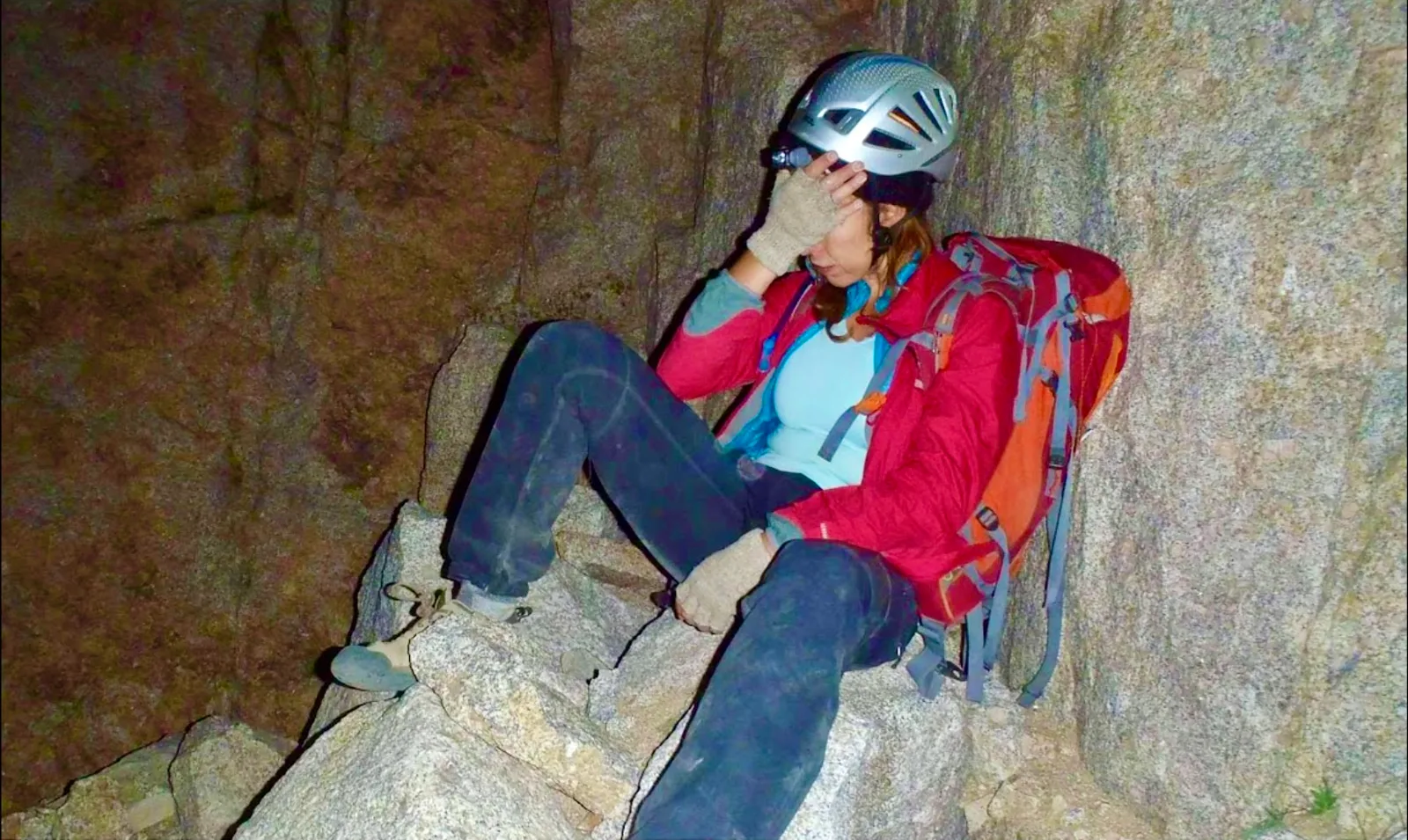
Trail nap while refueling during a self-supported adventure in Yosemite National Park. Photo by Verdi.
Where the Real Work Actually Happens
That's where the real work of preparing for an ultra actually lives, and it's where a system that applies the same checks every time has an edge over a person managing it alone across months. Fit PA does this in practice:
- Plans checked against real numbers. Built from an athlete's actual training history, never a generic template. Before anything locks in, the coach asks the specifics that actually matter, then walks through a draft: the plan itself and the reasoning behind it, including why it calls for the long, slow miles this article already covered rather than the speed the athlete's history doesn't support yet. The athlete sees the thinking, not just the output, and can push back before a single week is scheduled.
- A coach that keeps watching. Load checked against recovery in real time, flagging over- or under-training before it becomes a problem, not after an injury forces the issue. The same ongoing attention holds an old injury or a pattern from three weeks ago in view, referenced in every conversation, not just at onboarding, so it stays part of the plan instead of getting overlooked. When it matters, the coach acts on it directly, recommending a rehab protocol built into the training itself.
- Nutrition that moves with the day. Fueling the brain doing the pacing as much as the legs doing the running, not a static number.
- Nutrition that moves with the day. Fueling the brain doing the pacing as much as the legs doing the running, not a static number.
Each of those runs whether or not a runner is impaired, and whether or not there's a signal at mile 80. Fit PA is built for the months before the race, exactly where a pacer can't help at all.
Conclusion: Two Different Jobs
Managing stress, training the gut as deliberately as the legs, knowing that a pacer's job and a coach's job aren't actually the same thing, none of this comes down to one trick. If the limit of human endurance really is a cognitive decision as much as a physical wall, the more useful question isn't just what you're capable of when your brain says "enough." It's what kind of support actually holds up, and when: a pacer for the acute stretch where judgment fails on the trail itself, and the months of ordinary, unglamorous decisions beforehand that determine whether someone reaches the start line able to find out.
Sources
- Waters, F., Chiu, V., Atkinson, A., & Blom, J.D. (2018). Severe Sleep Deprivation Causes Hallucinations and a Gradual Progression Toward Psychosis With Increasing Time Awake. Frontiers in Psychiatry.
- Suffolk Backyard Ultra cognitive performance study (2024). The effects of sleep deprivation and extreme exertion on cognitive performance at the world-record breaking Suffolk Backyard Ultra-marathon. PLOS ONE.
- Corrión, M. et al. (2018). Psychosocial factors as predictors of dropout in ultra-trailers. PLOS ONE.
- Mojica, A. & Sanguinetti, research on ultrarunning hallucinations, feeding and attention strategies. Trail Runner Magazine.
- Ultra Running Sports Psychology: Mental Training Guide, coaching guidance on hallucination management and escalation signs.
- Rundfeldt, L.C. et al. (2018). Cardiac Autonomic Modulations and Psychological Correlates in the Yukon Arctic Ultra. Frontiers in Physiology.
- Kienast, C. et al. (2022). Adiponectin, leptin, cortisol, neuropeptide Y and profile of mood states in athletes participating in an ultramarathon during winter. Frontiers in Physiology.
- Suter, D. et al. (2020). Even Pacing Is Associated with Faster Finishing Times in Ultramarathon Distance Trail Running: The Ultra-Trail du Mont Blanc 2008–2019. International Journal of Environmental Research and Public Health.
- Schütz, U.H. et al. Bioprofiling study of Trans Europe Foot Race (TEFR) finishers vs. non-finishers, training volume comparison. ScienceDirect.
- Millet, G.P. & Millet, G.Y. (2012). Ultramarathon is an outstanding model for the study of adaptive responses to extreme load and stress. BMC Medicine.
- Case study review of training-induced physiological adaptations in ultra-endurance runners: mitochondrial biogenesis, capillarization, and fat oxidation (2022). PMC.
- Lake Biwa 100-mile carbohydrate intake and blood glucose study (2024). PMC.
- Newsholme, E.A. et al. (1987). Central fatigue hypothesis (tryptophan/serotonin mechanism).
- Tiller, N.B. et al. (2019). Position statement on caffeine and sleep deprivation in ultra-endurance racing. Journal of the International Society of Sports Nutrition.
- Meeusen, R. (2014). Brain carbohydrate metabolism and central fatigue during endurance exercise, review.
- Carbohydrate administration, vigilance, and mood during sustained aerobic activity (2002). ScienceDirect.
- Effects of carbohydrate drinks on executive function in athletes: systematic review and meta-analysis (2023). Frontiers in Psychology.
- UTMB power-napping and cognitive performance study (2026). ScienceDirect.
- Foundational associative/dissociative coping framework: Morgan & Pollock (1977), sport psychology literature.
This is a sensitive-adjacent topic in that it touches sleep deprivation, hallucination, and extreme physical stress; none of it is medical advice, and anyone experiencing concerning symptoms during or after endurance events should consult a physician.