
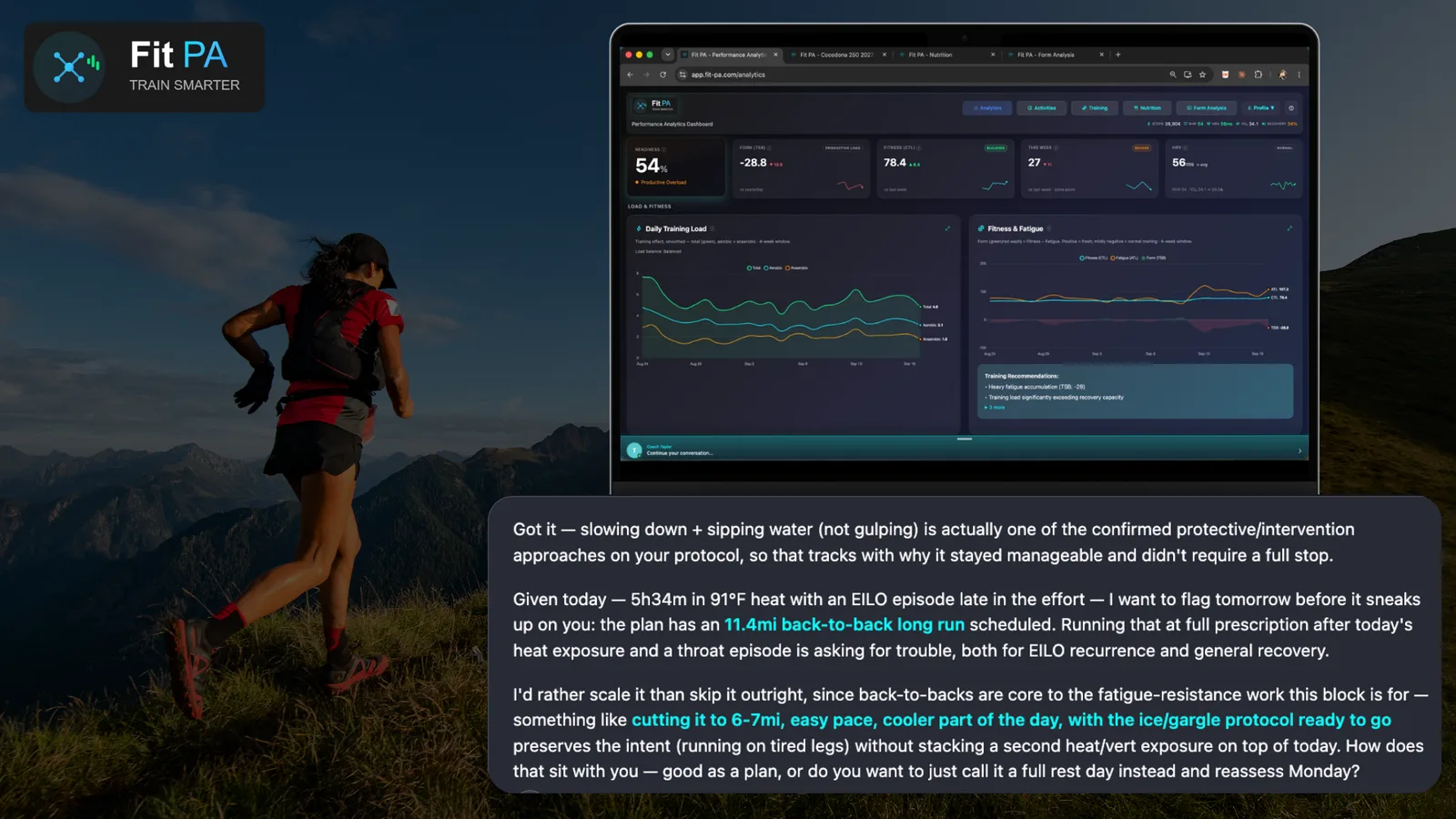
Most AI fitness apps are rule-based templates in disguise. See how a real AI training coach reads your data, adapts your plan, and protects you. We're living in the golden era of recreational endurance and hybrid sports. Race fields are packed, local marathons sell out in minutes, and everyday athletes are training with an intensity once reserved for elites. A multi-billion-dollar tech economy has grown up around this boom, promising to make us faster, leaner, and healthier. Yet beneath the surface of premium smartwatches and subscription apps, everyday athletes are hitting a wall. More stressed. More frequently injured. More confused by their own data than ever. The digital fitness landscape is fragmented, static, and fundamentally disconnected. Here's what's actually going wrong, what the training science behind it means in plain terms, and what a genuinely connected system looks like instead.
1. The Death of the "App Stack"
Look at your phone's home screen. You likely have a digital fitness graveyard: one app for GPS runs, a separate app for meals, a spreadsheet for strength training, a dashboard for your watch's biometrics. The cost isn't just financial. It's physiological. When your fitness software is siloed, your data can't talk to itself:
- Your calorie tracker treats your metabolism like a desk job unless you manually log a workout
- Your training calendar pushes a hard interval session without knowing whether you slept three hours or eight
- You're left playing translator between three different systems that were never built to agree with each other
2. The Danger of the Static Training Plan
Millions of athletes train off a rigid, linear plan: week 1 is baseline, week 4 intensifies, week 12 peaks. But life isn't linear. A fixed plan assumes your sleep, stress, and recovery will stay perfectly stable for months. They won't. Sports scientists track this with a handful of numbers:
- CTL (Chronic Training Load): your fitness base, a rolling average of your training over the past several weeks.
- ATL (Acute Training Load): your short-term fatigue, a rolling average of just the last several days.
- TSB (Training Stress Balance): the gap between the two. When ATL climbs faster than CTL can absorb it, TSB drops, signaling you're accumulating fatigue faster than you're recovering from it.
- TSS (Training Stress Score): a single number blending a workout's intensity and duration into how much load that session added.
- Readiness: a same-day snapshot built from last night's sleep, HRV, and resting heart rate, separate from TSB's multi-week trend. A good Readiness score doesn't erase weeks of accumulated training stress sitting underneath it, and the two numbers can genuinely disagree with each other on the same morning.
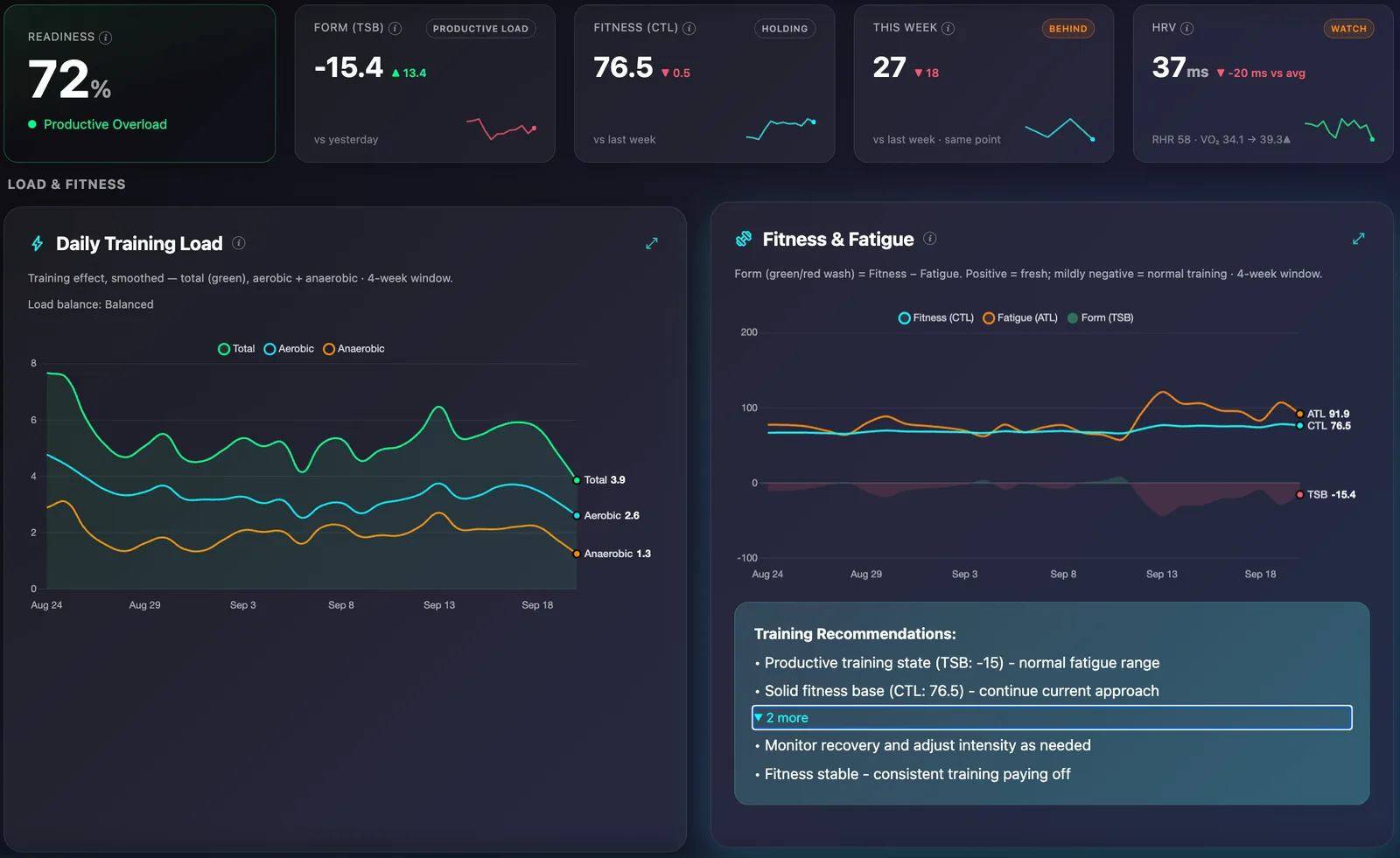
A static plan sees none of this, and it definitely doesn't remember your history. Here's what a real system does with it, across one weekend. An athlete training for a 250-mile ultra runs 15.3 miles with roughly 4,800 feet of combined gain and descent in 91°F heat. She also manages Exercise-Induced Laryngeal Obstruction, or EILO, a condition where heavy exertion, especially combined with heat and sustained climbing, can cause the airway to narrow, which first appeared for her after a COVID infection. (Fit PA isn't a diagnostic tool and doesn't replace a physician; it works from conditions an athlete has already identified with her own care team, and tracks how they show up in her training over time.) The next morning, her dashboard shows exactly the kind of numbers that confuse a static plan: Readiness at 72%, TSB at -15.4 (up 13.4 from an even lower reading the day before), CTL holding steady at 76.5, and HRV down 20ms from her average. Read separately, that HRV drop alone could look like an overtraining alarm. Read together, against yesterday's actual training, it's a coherent, expected picture.
3. What a Coach Actually Does With All of That
(A note on health conditions: Fit PA isn't a diagnostic tool and doesn't replace a physician. It works from conditions an athlete has already identified with her own care team, and tracks how they show up in training over time.)
It reads a symptom against the objective data, not in isolation. When EILO symptoms show up late in the run, the coach doesn't treat that as an isolated alarm. It cross-references it against the actual conditions (heat, sustained climbing, accumulated fatigue) and against the synced heart rate data for that same window, confirming the effort genuinely stayed easy despite the terrain. That combination is what lets it conclude the intervention protocol worked, rather than flag a false alarm.
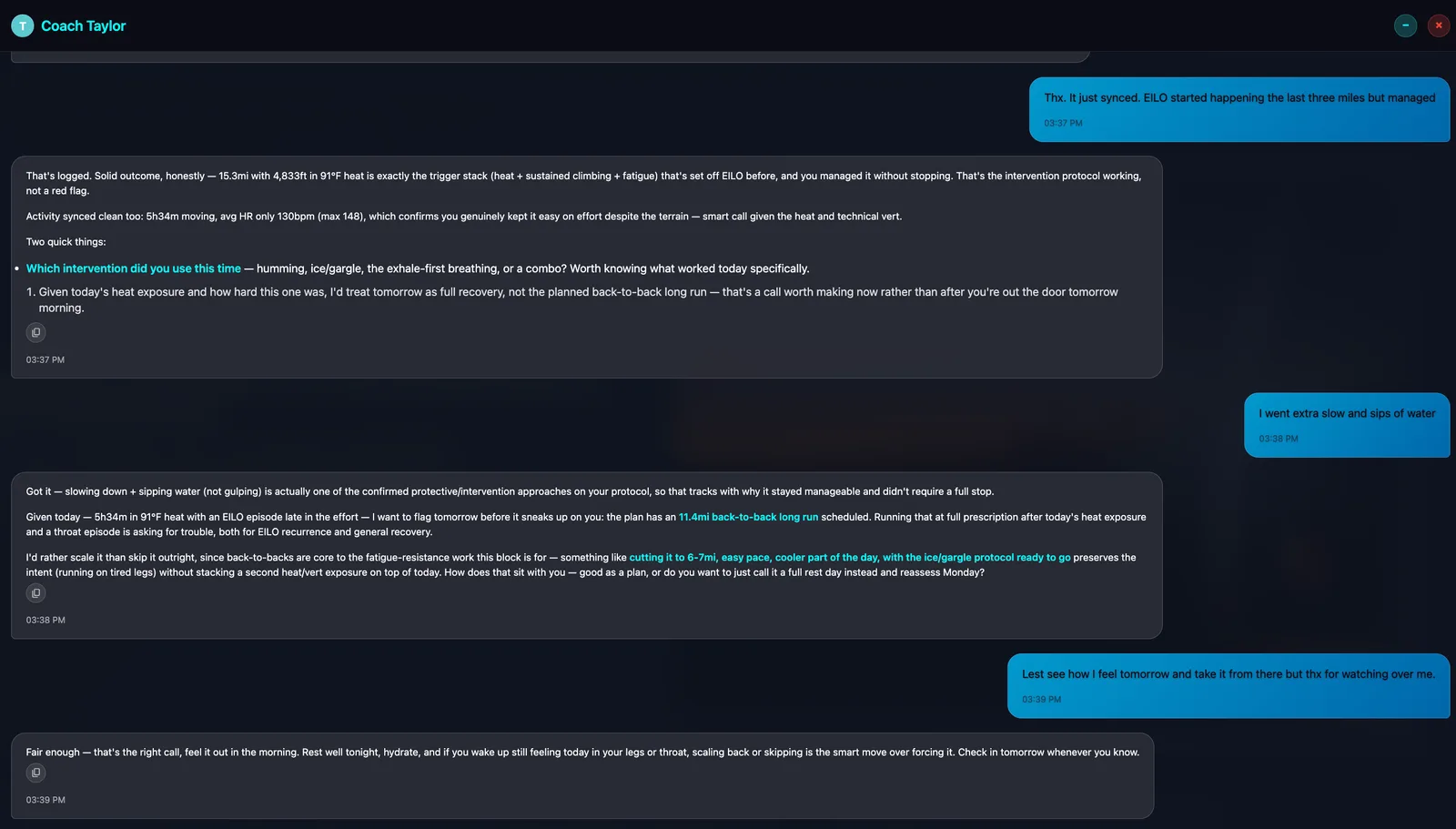
It flags a downstream conflict before being asked. Without waiting for a question, it checks today's outcome against tomorrow's scheduled session, an 11.4-mile back-to-back long run, and identifies that running it at full prescription would compound today's heat and airway stress. Rather than a binary go/no-go, it proposes a modified version that preserves the training intent while removing the specific risk, and leaves the decision with the athlete.
It opens the next conversation with synthesis, not a check-in question. The following morning, before she says anything, it presents sleep, HRV, TSB, weekly TSS, and two conflicting recovery readings, the same overnight signal behind her Readiness number, as one connected picture, and treats the inconsistency between those two readings as information in itself rather than picking whichever number is more convenient.
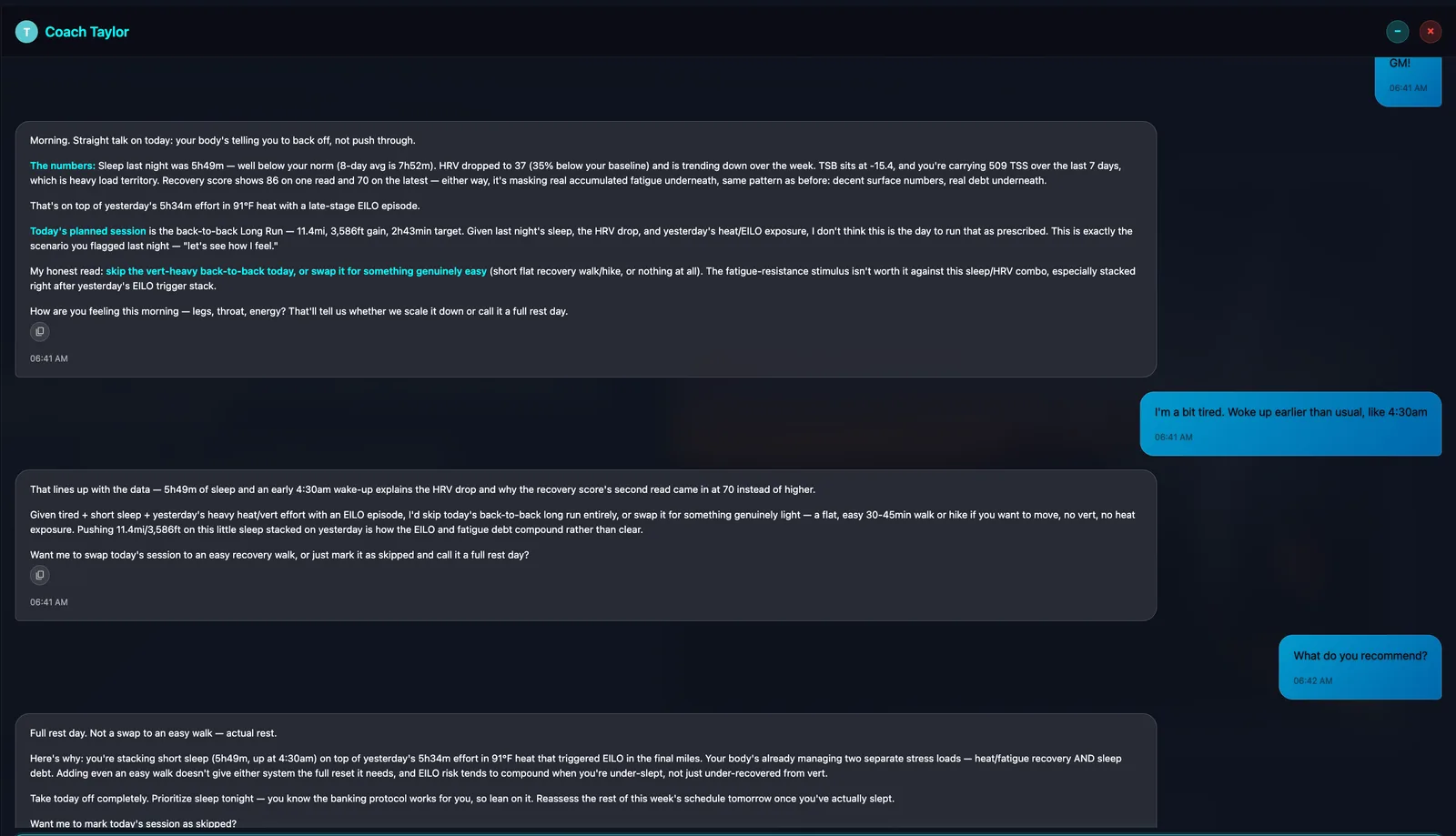
It updates its read as new information arrives, without losing the thread. When she adds a detail it didn't have (an unusually early wake-up), the coach doesn't restart the conversation or ask her to re-explain her situation. It folds the new input into everything it already knows and sharpens its recommendation accordingly, arriving at a direct answer rather than a hedge.
It negotiates instead of dictating, and recalculates for each new option. She pushes back twice, once proposing indoor cross-training, once proposing an outdoor hike, and instead of repeating its original recommendation, the coach reworks its reasoning from scratch for each new proposal, weighing what that specific option would and wouldn't solve.
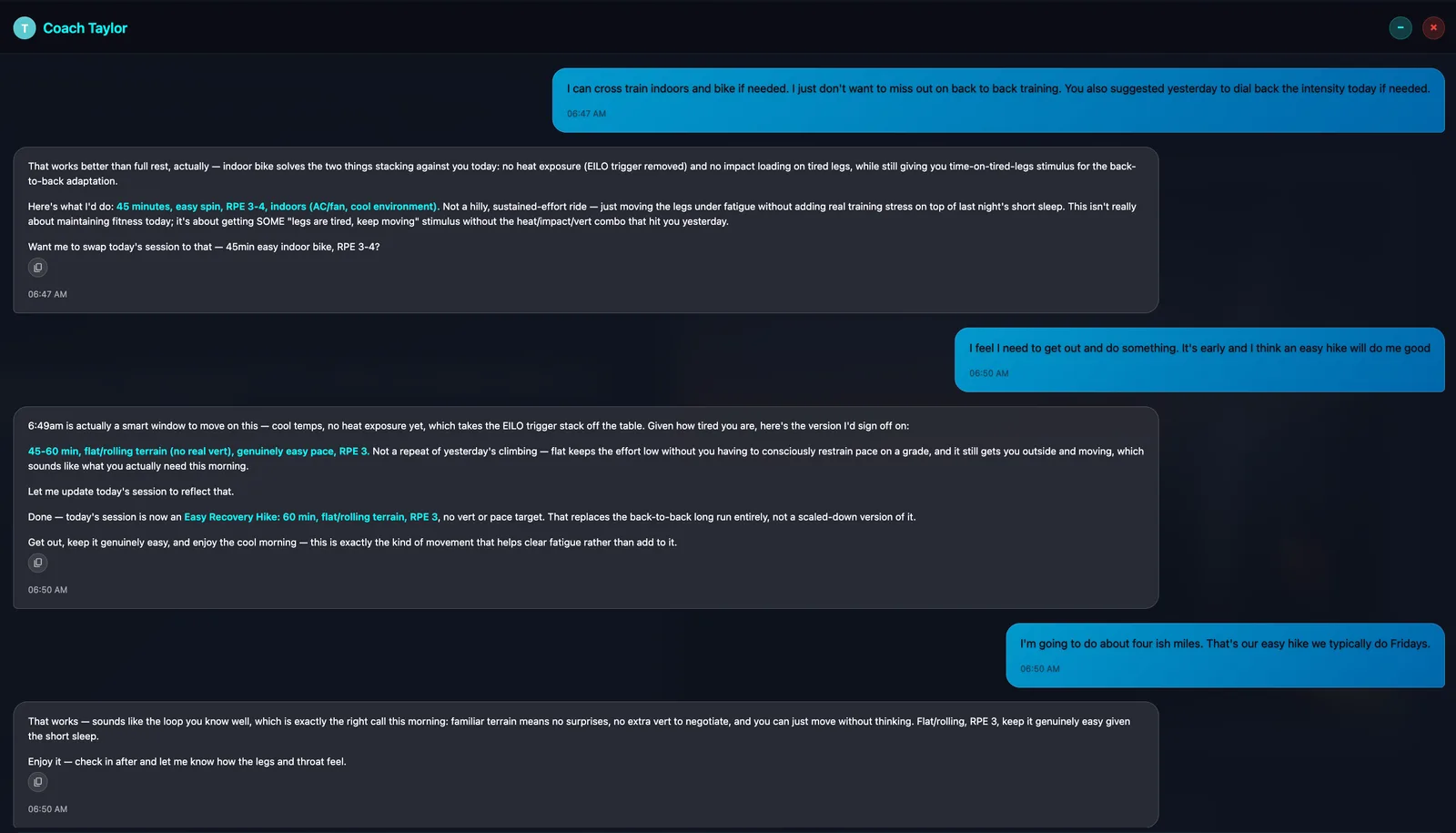
It acts on the conversation, not just advises from the sidelines. Once a plan is agreed on, the coach doesn't leave the athlete to update her own calendar. It edits the actual training plan in real time, replacing the scheduled session outright and labeling it clearly as a full swap rather than a scaled-down version of the original.
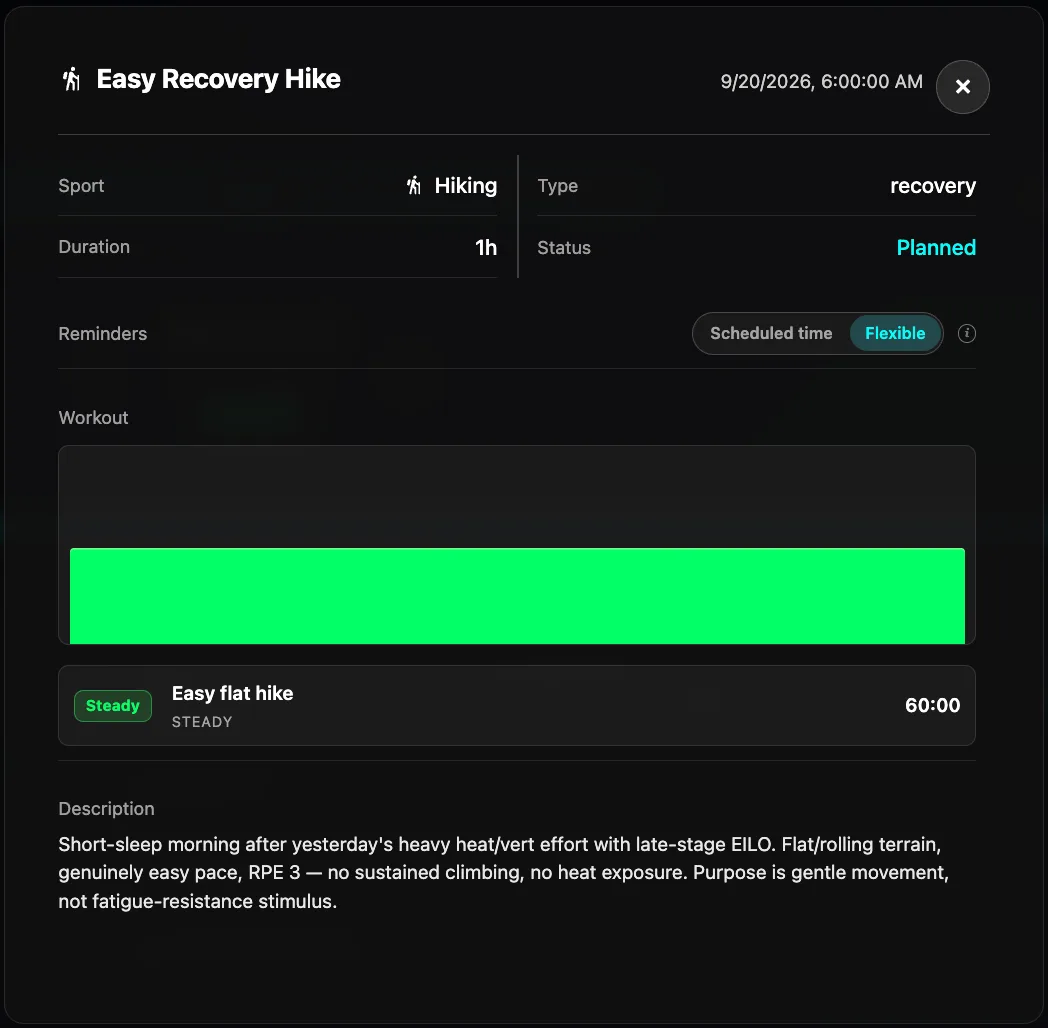
That's a full negotiation, reasoning that updates itself with new information, and a training plan that actually changes as a result, all within one continuous relationship.
The same kind of reasoning applies to what she eats that day, not just what she trains.
4. Beyond Fixed Calorie Targets
Most nutrition apps hand you a flat daily number, say 2,000 calories and 150g of carbohydrates, and never adjust it. For an active endurance or hybrid athlete, a flat target is scientifically out of step with how the body actually works. Sports nutrition research has documented REDs (Relative Energy Deficiency in Sport): a condition where athletes consistently under-fuel relative to how much they're training. Left unaddressed, this shows up as suppressed glycogen stores and sudden performance drop-offs ("bonking"), hormonal disruption, and a higher rate of stress fractures.
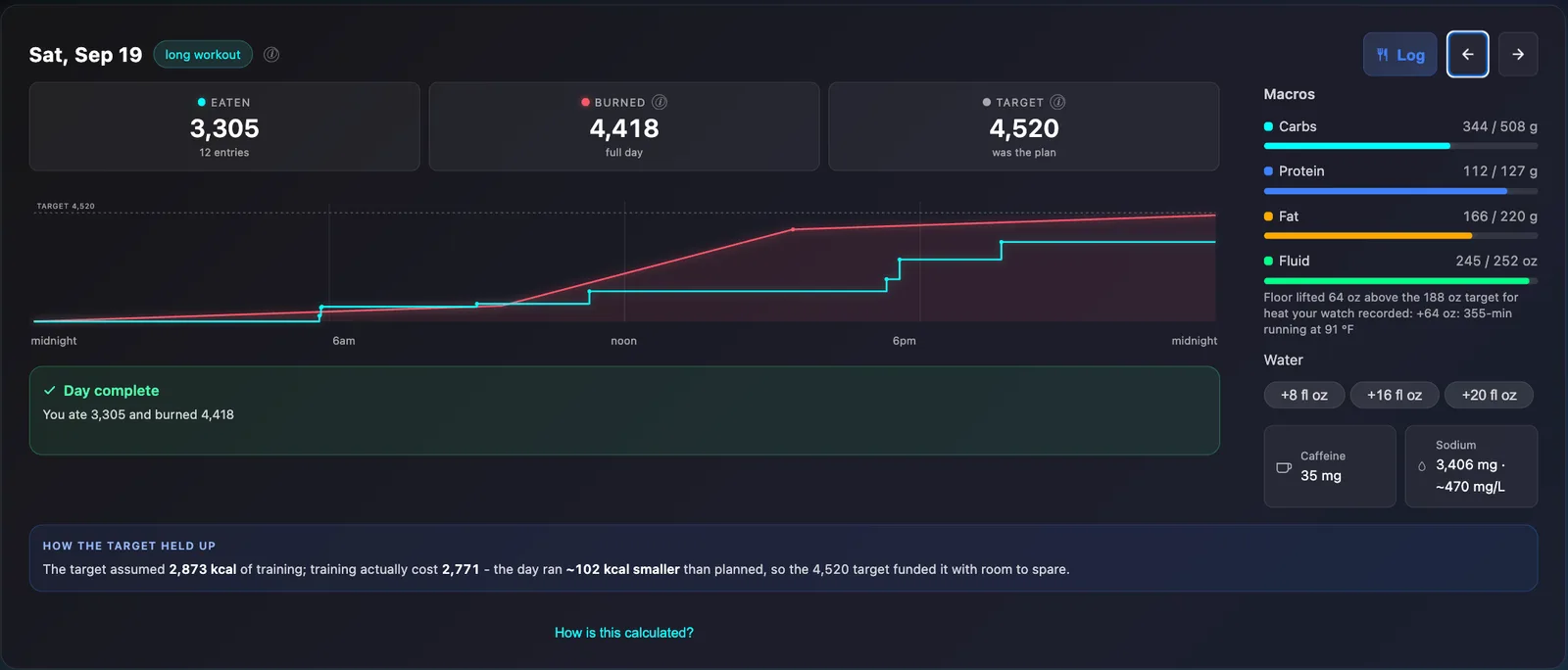
That same Saturday shows how a dynamic target should work. The plan projected the workout would burn roughly 2,873 kcal; the watch recorded an actual cost of 2,771 kcal, close enough that the day's 4,520 kcal target still covered it with a small margin. Fluid told a sharper story: the baseline daily target was 188oz, but the day's heat and duration, 355 minutes of running at 91°F, automatically lifted that floor by 64oz, to 252oz. A flat nutrition app would have shown 188oz regardless of conditions.
Why This Isn't Just Another AI Chatbot
A wave of newer apps now market an "AI coach," but most of them are a chat window bolted onto a workout log: ask a question, get an answer, nothing connects to the next conversation, and nothing it says actually changes anything in the app.
What's described above is different on every count. Reasoning carries across separate conversations and days without the athlete re-explaining herself. A recurring health condition is tracked and factored in specifically, not treated as a one-off. Weather and heat load are pulled in automatically on both the training and fueling side, most fitness apps don't factor the day's actual conditions into a plan at all. The coach can also go beyond its own stored data, researching current information when a question calls for it, rather than only ever reasoning from what's already logged. And when the conversation reaches a decision, the coach doesn't just say what it would do, it goes and does it, updating the actual training plan.
That's the difference between a chatbot and a coach with real rational skills: judgment that holds up under pushback, and a real say in what changes.
How Fit PA Closes the Loop
The fix isn't more apps or more data. It's one coach who sees everything, remembers what came before, and acts on it.
- It starts with a real training plan. Fit PA syncs directly with Garmin, Coros, Suunto, Polar, Wahoo, Apple Watch, and Health Connect, so training, biometrics, and coach all live in the same place from day one. Your coach builds that plan from your actual race, your experience, and your biometrics, not a generic template, and works the same way whether you're walking your first 5K or training for a 200-mile ultra. It's a standout at ultra-distance and hybrid athlete training specifically.
- Nutrition works the same way, in real time. Calorie, macro, and fluid targets adjust automatically against what training actually cost that day, heat and duration included. Logging is built to actually get used: type it, say it out loud, snap a photo of your plate, scan a barcode, or just tell your coach in chat.
- And when something in your movement needs a second look, form analysis findings go straight into that same conversation, reviewed with you in plain language, with a corrective protocol built directly into your plan if needed.
One coach. One relationship, that gets smarter about you over time. Every piece of your training, from the plan to the plate to your recovery, reporting to the same brain. Stop guessing, stop overtraining, and stop paying for a scattered app stack that doesn't talk to itself. Build your baseline at the Fit PA web app.