

For decades, endurance runners have adhered to a sacred "golden rule": the single, unbroken long run is mandatory.
The intuition is deeply embedded in our training culture. We assume that a continuous, grueling three-hour effort builds a fundamentally different biological engine than doing 90 minutes in the morning and 90 minutes in the evening. We equate the magnitude of our suffering in the present moment with the magnitude of the physiological fitness we will reap later.
But does the research actually back this up?
Recent training studies suggest that for most athletes, this standard folklore may be costing us more fatigue for equal returns. The math only changes when you step off standard distances and onto the grueling trail of extreme ultra-endurance.
When Split May Be Just as Effective (General Fitness and Standard Distances)
For general cardiovascular fitness, 10K training, or preparing for your first half-marathon, the research is genuinely surprising: how you distribute your training volume across a day appears to matter far less than coaching folklore suggests, as long as total volume and intensity stay the same. That holds whether your long run is building toward a 5K, marathon, or an ultra past 50K, as long as it's an easy, conversational-pace effort. If you're asking this same question about a structured threshold or interval session instead, our article on double threshold training is the better guide.
A 2006 study on untrained subjects found that a group training in two long, back-to-back weekend sessions improved VO2max just as much as a group training the same total minutes spread across five days. A 2008 study on trained cyclists and triathletes found that once-daily and split-session protocols produced similar gains in performance and endurance capacity. And when researchers went as deep as looking at the actual gene expression behind mitochondrial adaptation, comparing one leg trained once daily to the other trained twice every second day over 10 weeks, they found no significant difference in how those genes responded to training between the two protocols.
The Cost of Continuous Stress
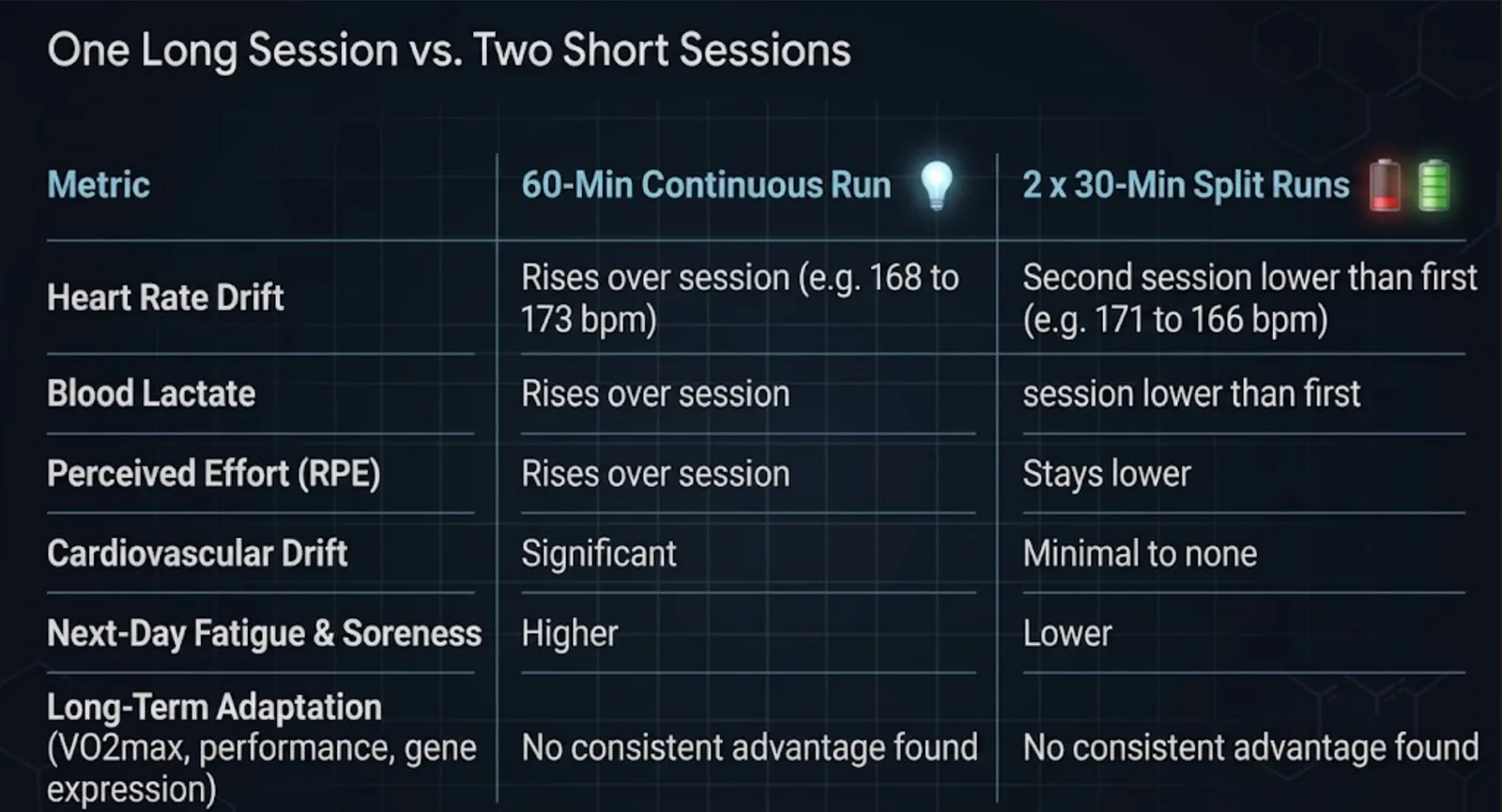
Even so, a continuous long run isn't a free lunch. A 2024 study directly compared one 60-minute session to the same volume split into two 30-minute sessions 6.5 hours apart, and found real differences in how the body experienced them:
Cardiovascular Drift: During the single long session, heart rate, blood lactate, and perceived effort all climbed over the second half, even though pace stayed constant. The split sessions didn't show this drift, and in the second session, heart rate and lactate were actually lower than in the first.
Recovery Cost: The morning after the single long session, athletes reported more fatigue and more muscle soreness than after the split protocol.
So the single session isn't producing a bigger adaptation, based on the research above, but it is producing a bigger short-term cost. Splitting the same volume may let you train at a similar quality with less accumulated fatigue.
When Duration Becomes Mandatory: Ultra-Endurance and the Durability Limit
Here's where the math changes. All of the research above was done using standard training sessions, generally an hour or two at most. None of it tested what happens deep into a 4, 8, or 20-hour effort, and that's exactly the territory ultramarathons live in.
Researchers have proposed a concept called durability: the point at which physiological markers like heart rate and perceived effort start to decouple from pace or power the longer an effort continues. Multi-hour ultra events are, in large part, a test of durability. And the training stimulus for durability appears to depend on sustained duration itself, not just total weekly volume, which is exactly what the general-fitness studies above were measuring.
What Sustained Duration Is Actually Training
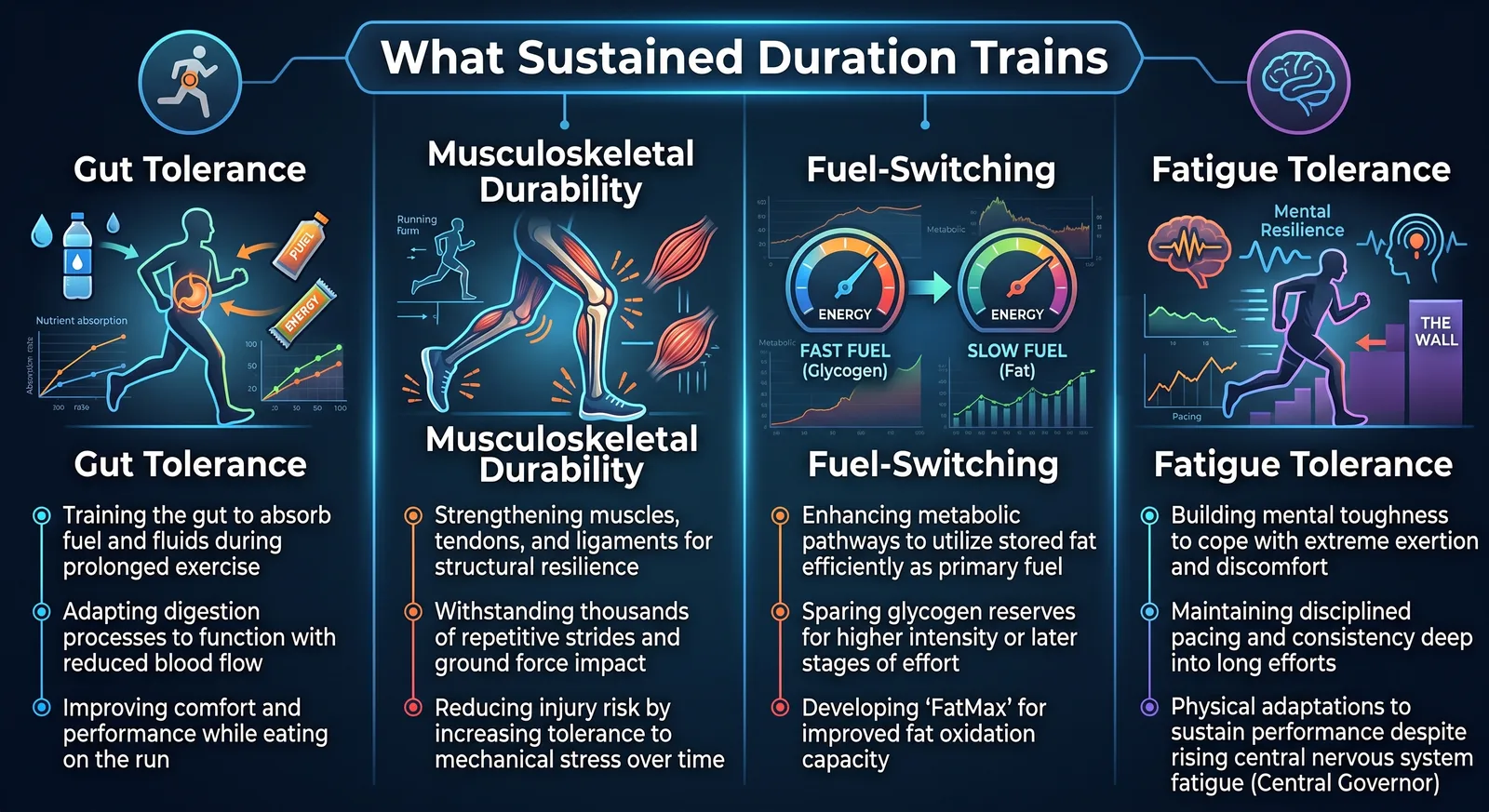
Ultra coaching practice points to a handful of demands that only show up once you're several hours into continuous effort, and these are reasoned inferences from exercise physiology and ultrarunning experience, not all directly tested in controlled studies the way the general-fitness findings above were:
Gut Tolerance: Past roughly 3 to 4 hours, blood flow shifts away from the digestive system to support working muscles and cooling, and the gut has to keep absorbing fuel under that reduced blood flow. This is widely believed to be trainable, which is part of why ultrarunners practice race-day fueling specifically during long runs, but a split run with a meal in the middle doesn't put the gut under that same prolonged strain.
Musculoskeletal Durability: The repetitive impact of multi-hour running, especially downhill, loads muscles, tendons, and connective tissue in a way that accumulates over time. Building tolerance to that load is generally understood to require time under sustained load, not just total distance.
Fuel-Switching: Stored glycogen covers roughly 90 to 120 minutes of hard effort. Past that point, the body increasingly relies on fat oxidation to keep going. A run that's split with a recovery window and refueling in between doesn't force the same degree of prolonged reliance on fat as fuel.
Pacing and Fatigue Tolerance: Late-race fatigue isn't purely physical, it involves real mental and perceptual strain from hours of accumulated discomfort. Some researchers frame this through the lens of the brain actively regulating effort as a protective mechanism (sometimes called the Central Governor hypothesis), though this remains a debated, not fully settled, model in exercise science. Whatever the exact mechanism, most ultra coaches agree that tolerance to pushing through deep fatigue is something you build through repeated exposure to it, not something a shorter effort teaches you.
A same-day split run relieves the pressure on all four of these before it has a chance to build, since the recovery window in between lets the gut, tissues, glycogen stores, and mind all reset.
The Logistical Loophole: The Back-to-Back Solution
For a normal person with a job, family, and a mortgage, carving out five continuous hours on a single Sunday is often impossible. This is where ultra coaches turn to a well-established workaround: the back-to-back long run.
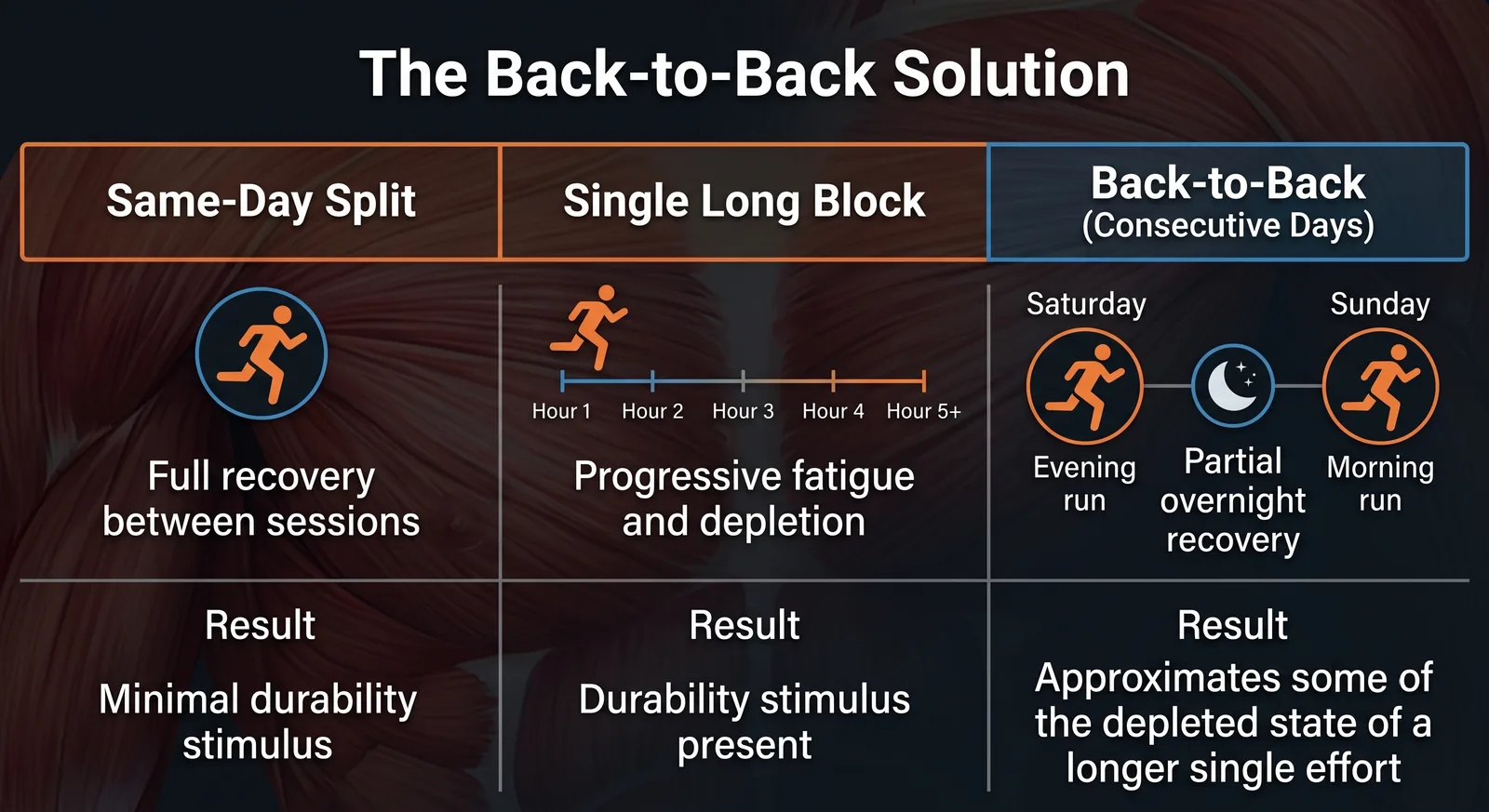
Instead of splitting the volume within the same day, you run on consecutive days, for example, three hours Saturday afternoon and two hours Sunday morning. The overnight gap, especially with sleep in between, generally isn't long enough to fully replenish glycogen or fully clear muscular fatigue from the day before.
You start Sunday's session already somewhat depleted and fatigued. This back-to-back approach is thought to approximate some of the deep-fatigue conditions of hours four and five of a continuous effort, without requiring the same single-day time block.
Actionable Takeaways
For General Fitness and Distances up to a Half Marathon: Splitting your runs is a reasonable option. Research on matched-volume training hasn't found a consistent adaptation advantage for continuous sessions over split ones, so if splitting fits your schedule better, it's a legitimate choice, not a compromise.
For Ultra-Endurance Durability: Past the 3 to 4 hour mark, sustained duration is doing something a split session can't replicate. A single, continuous long run remains the more direct training stimulus for gut tolerance, musculoskeletal durability, fuel-switching, and fatigue tolerance.
Logistical Compromise: If a single long block genuinely isn't possible, the back-to-back long run, not a same-day split, is the better substitute. Running long on consecutive days preserves the depleted, fatigued state that ultra-specific adaptation seems to depend on, in a way that a same-day split with a full recovery window doesn't.
Putting This Into Practice
Deciding whether to split your long run, or how to structure a back-to-back weekend when a single long block isn't realistic, is exactly the kind of call that benefits from seeing your own numbers, not just averages from a study. Fit PA connects to Garmin, Coros, Polar, Suunto, or Wahoo, syncs your training data automatically, and turns it into training load, recovery, and readiness analytics you can actually act on. Its integrated coach builds an adaptive training plan around your goal and current fitness, whether that's a 10K or your first ultra, and adjusts as your training and recovery change. Ask it whether you're ready for a long run or should split it this week, and it answers grounded in your own data, not a generic rule of thumb.
Sources
- Talsnes et al. (2024), Frontiers in Physiology — acute physiological comparison of one long vs. two short training sessions
- Meyer et al. (2006), European Journal of Preventive Cardiology — weekend-concentrated vs. daily training volume in untrained subjects
- Yeo et al. (2008), Journal of Applied Physiology — once-daily vs. split-session training in trained cyclists and triathletes
- Mortensen et al. (2007), Journal of Applied Physiology — gene-expression response to once-daily vs. split-session training
- Maunder et al. (2021), Sports Medicine — the concept of physiological "durability" in endurance athletes