

In the elite endurance world, the "Norwegian Method" is no longer a secret, it's the gold standard. By utilizing lactate-guided thresholds to maximize training volume without tipping into overtraining, athletes like the Ingebrigtsen brothers have redefined what's possible. Central to this strategy is "Double Threshold" training: splitting a high-volume day into two distinct sessions. But is this just a way to handle more work, or is there a fundamental physiological advantage to breaking up the long haul? Recent research in Frontiers in Physiology and the Journal of Applied Physiology has finally provided the data we need to move from "coaching intuition" to "tactical precision." That's the question for anyone whose training includes structured threshold or interval sessions, whether you're racing anything from a 5K to a marathon. If you're asking this same question about an easy, aerobic long run instead, our article on splitting your long run is the better guide.
1. The Invisible "Drift" of Single Long Sessions
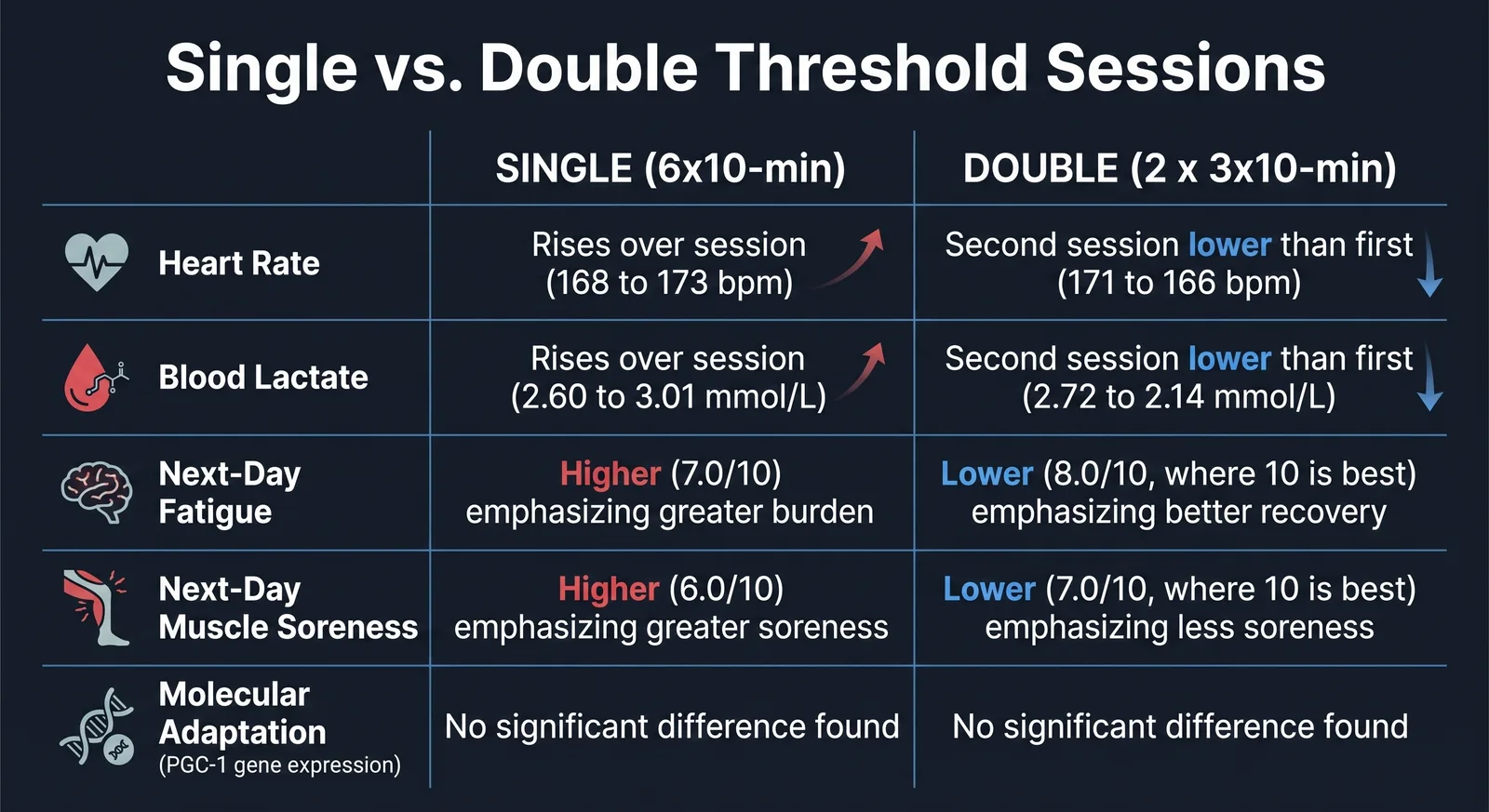
The tactical takeaway from the Frontiers study is clear: the longer you go, the more your internal and external loads decouple. In the "SINGLE" protocol (6x10-min intervals), athletes maintained a stable external intensity (speed/power), but their internal systems experienced significant physiological "drift." While oxygen uptake (VO2) and energy cost remained remarkably stable, proving that the body's efficiency in oxygen delivery didn't fail, the metabolic and autonomic costs rose during the second half of the session:
- Heart Rate (HR): Drifted from 168 to 173 bpm.
- Blood Lactate (Bla): Rose from 2.60 to 3.01 mmol·L⁻¹.
- Rating of Perceived Exertion (RPE): Climbed from 13.4 to 14.8.
This "internal-to-external decoupling" means that even if your watch says you are hitting your splits, your heart and metabolic systems are operating in an entirely different, more stressful zone by the end of the workout.
"The benefits of performing fewer, but longer sessions at moderate intensity may include a larger acute training stimulus caused by greater work per session and a duration-dependent 'drift' in internal intensity measures, which is speculated to upregulate molecular signaling and subsequent adaptations."
2. The "Double" Advantage: Higher Intensity, Lower Metabolic Cost
The most profound "game changer" for the endurance strategist is how the body responds to the second session in a "DOUBLE" protocol (2 x 3x10-min). When athletes were given a 6.5-hour recovery window, the physiological cost of the second session actually decreased compared to the first. During the second block of work, markers of stress dropped:
- Heart Rate: Decreased from 171 bpm to 166 bpm.
- Blood Lactate: Dropped from 2.72 mmol·L⁻¹ to 2.14 mmol·L⁻¹.
Why does this happen? The researchers suggest this is likely due to preconditioning effects from the morning session or circadian variations (time-of-day effects) that prime the body for efficiency. Tactically, this means you can accumulate the exact same volume of work as a single long session but at a significantly lower metabolic and autonomic price. You are essentially getting "free" volume with less disturbance to your internal systems.
3. The Morning-After Hangover: Readiness to Train
As a strategist, your concern isn't just today's session, it's the quality of tomorrow's. The study found that while total volume was identical, the "organization" of that volume dictated the athlete's recovery status the next morning. The SINGLE session left a measurable "hangover" that was absent in the DOUBLE protocol. On a scale of 1 to 10 (where 10 is the best or least stressed), the morning-after results were:
- Perceived Fatigue: 7.0 for SINGLE vs. 8.0 for DOUBLE.
- Muscle Soreness: 6.0 for SINGLE vs. 7.0 for DOUBLE.
A single long session induces greater autonomic disturbance (confirmed by higher supine heart rates in recovery) and muscle damage, potentially compromising the "readiness to train" for the next block. Double thresholds allow you to pile on volume while keeping the engine clean for the next day.
4. "Durability": Testing the Floor vs. Building the Ceiling
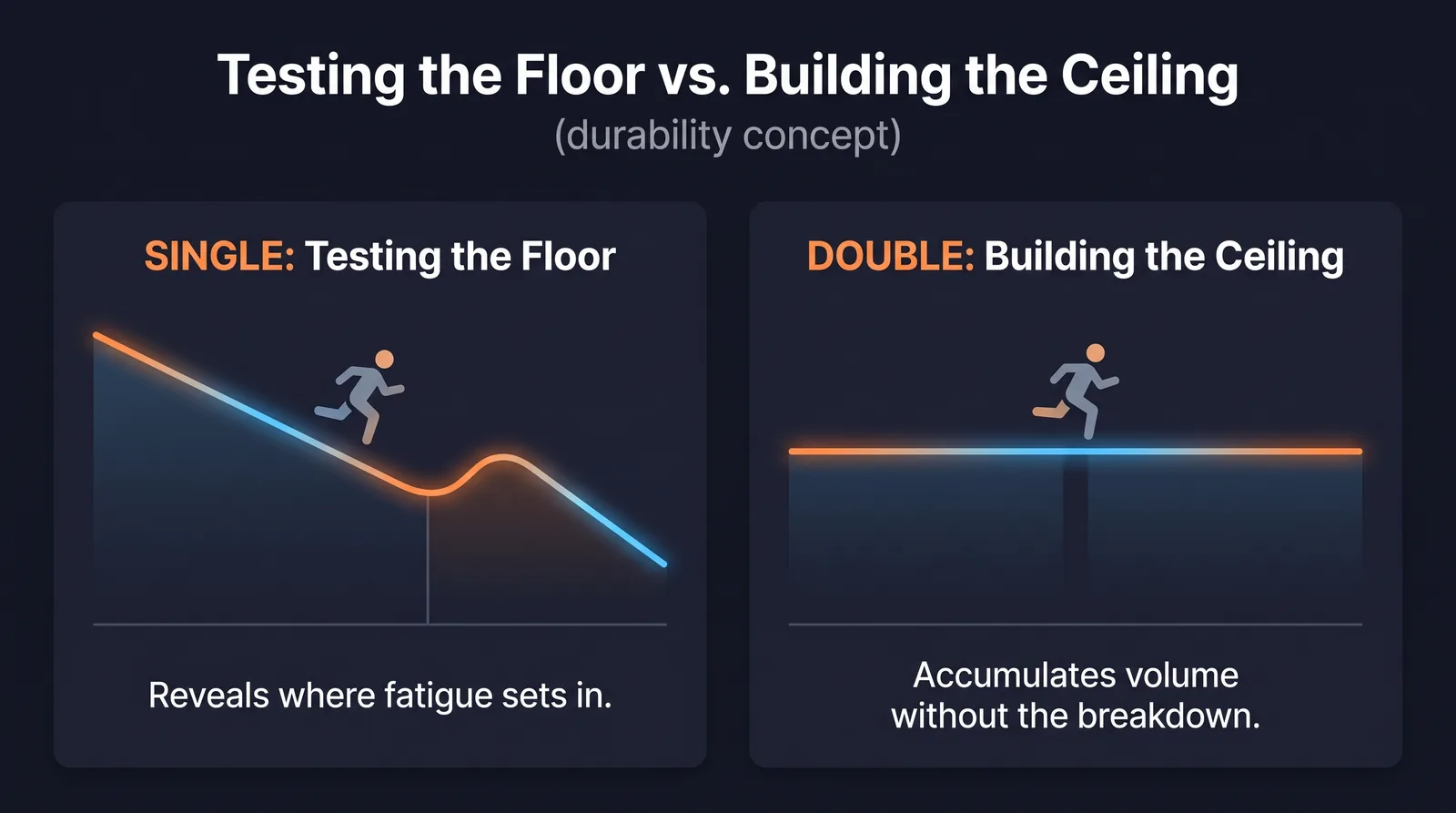
The study highlights a critical metric in endurance science: durability. Defined by Maunder et al., durability is "the time of onset and magnitude of deterioration in physiological characteristics during prolonged exercise." In tactical terms:
- SINGLE sessions are a "test of the floor": they are a durability test that reveals exactly when your internal systems begin to break down under the weight of duration.
- DOUBLE sessions are "building the ceiling": they allow you to accumulate massive amounts of time at your specific threshold intensity without reaching that breakdown point, effectively raising your performance ceiling.
5. The Molecular Reality Check: PGC-1 and the 10-Week Data
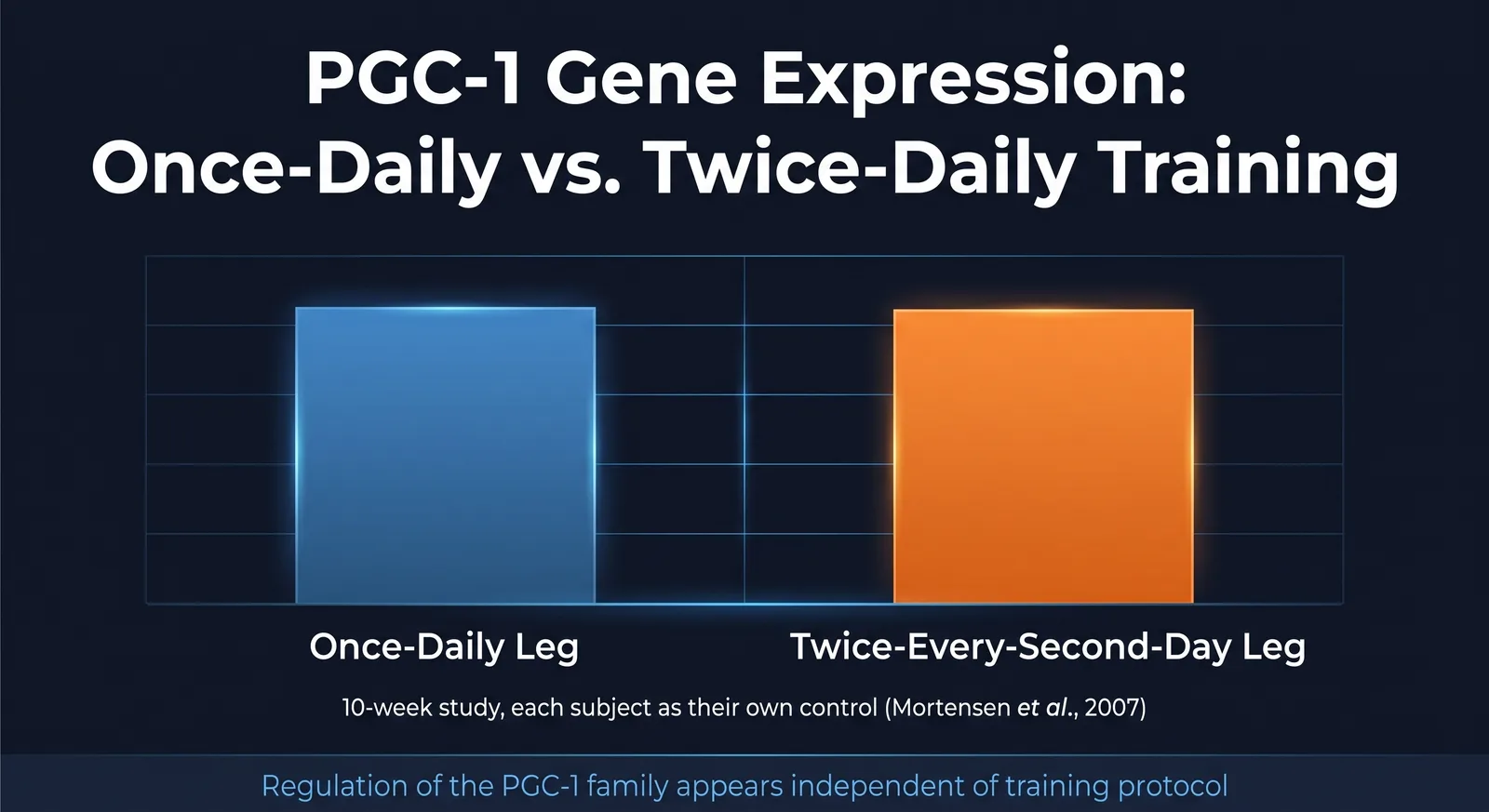
Here is where the "double is simply superior" narrative needs a qualifier. When Mortensen and colleagues (2007) took this exact question down to the molecular level, training one leg once daily and the other leg twice every second day for 10 weeks, with total training dose equalized between legs, they measured PGC-1α, PGC-1β, and PRC, a family of genes that act as the master switches telling your muscle cells to build more mitochondria, the cellular structures responsible for aerobic energy production. If any training protocol were going to reveal a molecular advantage, this is where you'd expect to see it. Instead, the finding was more nuanced than "twice-daily wins":
- No significant difference was found between the once-daily leg and the twice-daily leg in how these genes responded to training. The authors' own conclusion: regulation of the PGC-1 family is independent of training protocol.
- PGC-1β was actually downregulated by training in both legs, regardless of protocol.
- PGC-1α trended upward with training, but the increase did not reach statistical significance, and was noted specifically in the once-daily leg, not the twice-daily leg.
In other words, this is genuinely useful evidence, but it argues against a clean "double sessions win at the molecular level" story. It shows that splitting training volume into two sessions does not appear to change the underlying molecular signal for mitochondrial adaptation compared to keeping it in one session. If anything, this strengthens the case that the choice between single and double sessions is a fatigue-management decision more than an adaptation-superiority decision.
Strategic Summary: Finding Your Signal-to-Stress Ratio
The choice between a single long threshold session and a double threshold day is less about which one produces a bigger molecular signal (the evidence doesn't clearly favor either side there) and more about managing your signal-to-stress ratio across a training week:
- Deploy DOUBLE sessions when your goal is to accumulate more total volume at a lower per-day metabolic and autonomic cost, while preserving readiness for the following day.
- Deploy SINGLE sessions deliberately when you want to specifically test or build durability, the ability to hold form and output as fatigue accumulates, since only a genuinely prolonged effort recreates that late-session physiological drift.
Where this tends to matter most by goal:
- 5K and 10K racers spend relatively little race time in a drifted, fatigued state, so double sessions can be the default most weeks, they let you accumulate quality volume without digging a fatigue hole that compromises the rest of your training.
- Marathon runners race for two-plus hours, well into the territory where drift and fatigue resistance actually decide the outcome, so working in occasional single sessions specifically to rehearse holding form under that drift is worth the added recovery cost.
- During base or high-volume training blocks, when the priority is accumulating work without burying yourself, lean toward DOUBLE.
- In the weeks closer to a key race, lean toward occasional SINGLE sessions to rehearse the specific demand your race will place on you.
Before your next training block, ask yourself: is today's session about accumulating clean volume, or about training your durability under drift? That is the real decision this research points to.
Putting This Into Practice
Deciding between a single long threshold day and a double threshold day is exactly the kind of call that benefits from seeing your own numbers, not just the averages from a study. Fit PA connects to Garmin, Coros, Polar, Suunto, or Wahoo, syncs your training data automatically, and turns it into training load, recovery, and performance analytics you can actually act on. Its integrated coach builds an adaptive plan around your goal and current fitness, and adjusts as your training and recovery change. Ask it whether you are ready for a hard session or a split day, and it answers grounded in your own data, not a generic rule of thumb.
**Sources:**
- Talsnes et al. (2024), Frontiers in Physiology — acute physiological comparison of one long vs. two short training sessions
- Mortensen et al. (2007), Journal of Applied Physiology — gene-expression response to once-daily vs. split-session training
- Maunder et al. (2021), Sports Medicine — the concept of physiological "durability" in endurance athletes