
How to Fuel and Hydrate for an Ultra: A Practical Guide With Troubleshooting
Most ultras are won or lost on eating and drinking, not fitness alone. Stomach trouble is the rule, not the exception: reviews report gut symptoms in roughly 60 to 96% of ultra athletes during long efforts (one review of six ultra-trail studies found 65 to 82%). The good news is that most of the problems are predictable, and the best-supported fixes are things you can practice in training.
This guide covers how much to eat, what to drink, how fueling and hydration can differ for women and men, and what changes when it is very hot, and what to do when things go wrong at 3 a.m. It is general information for healthy adults, not medical advice. If you have a medical condition, take medications, or have a history of heat illness, kidney problems or an eating disorder, talk to your doctor or a sports dietitian first.
Evidence labels used below: "Studied" means published research supports it. "Experience" means it comes from runners and coaches, not trials. Where research and common advice disagree, this guide says so.
The short version
- Start from a carbohydrate number you can already eat comfortably on long runs. Most runners land between 40 and 90 grams per hour. Build up in small steps over several weeks.
- Gut training is the best-supported prevention for stomach trouble. Practice eating at race effort, in the heat, with the exact products you plan to use.
- Drink to thirst. Overdrinking, not too little salt, is the main cause of dangerously low blood sodium in ultras. Weight gain and swollen hands are warning signs.
- Women and men share most of the same rules, but a few things differ: low energy availability is a bigger concern for women, hydration needs are individual, and women report more gut symptoms in some studies. Most research was done on men, so track your own pattern.
- In very hot races, appetite and digestion both get worse. Cool your body, shift toward cold, salty and liquid calories, and slow down.
- Write a Plan A, Plan B and Plan C for food, and rehearse Plan B in training.
- If your stomach turns: slow down, sit for a few minutes, sip small amounts of cold fluid, pause solids for 15 to 30 minutes, then restart with liquids and small bites.
1. Why fueling matters
Your body stores a limited amount of carbohydrate as glycogen. After about 60 to 90 minutes of moderate to hard effort you need to add fuel to avoid hitting the wall. Fat is plentiful, but it cannot be burned fast enough to replace carbohydrate at ultra pace.
What it means for you: if you wait until you feel hungry or low, you are already behind. Under-fueling can also cause nausea, because low blood sugar makes you feel sick, so skipping food to protect a sensitive stomach can backfire.
2. How much to eat per hour
There is no single right number. The published ranges differ, and the differences are worth understanding.
| Source or situation | Range | What it means for you |
|---|---|---|
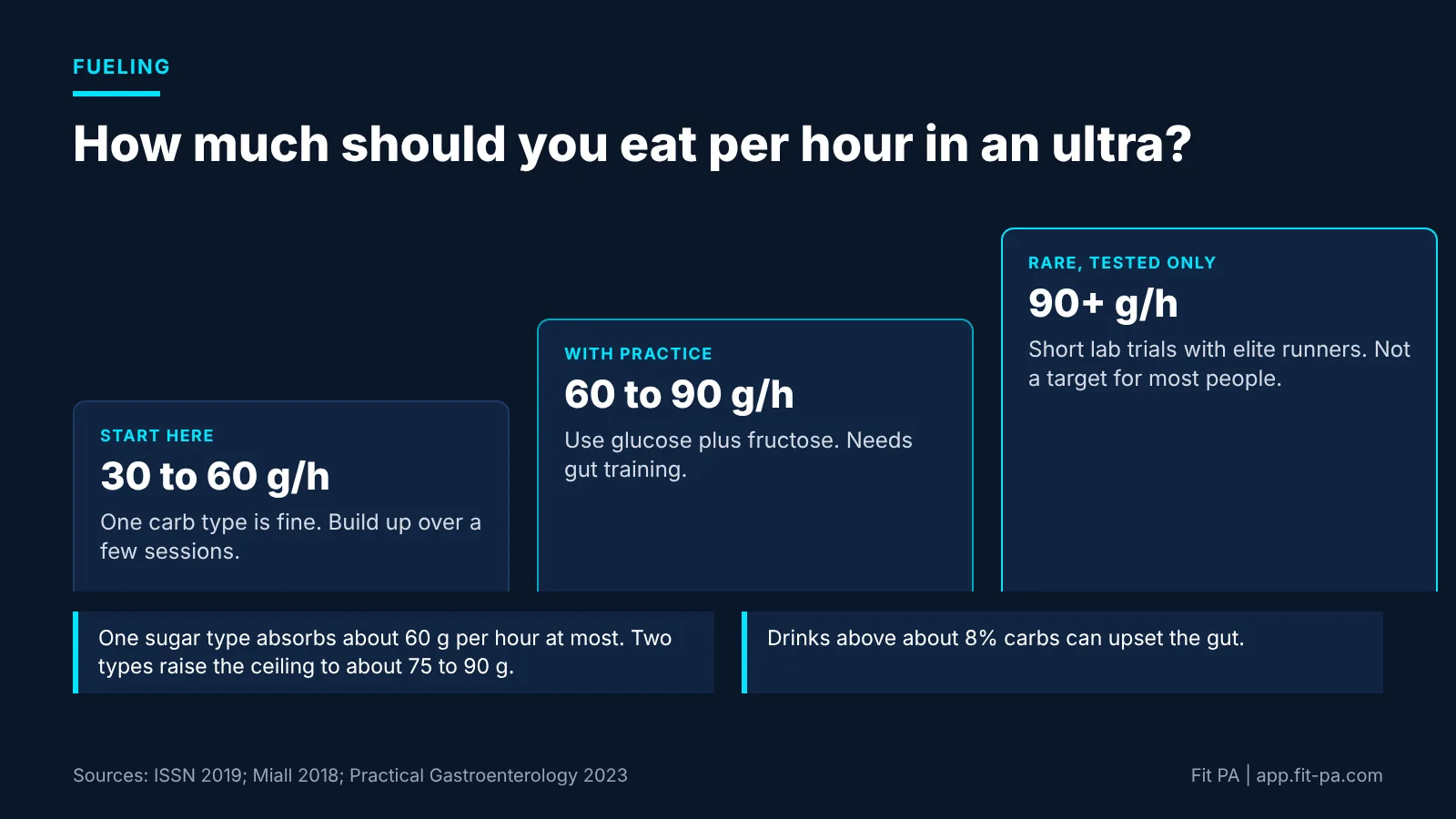
| New to fueling, or a first long run | Start around 30 g per hour, and build toward 60 g over a few sessions | A sports nutritionist and ultrarunner (Stephanie Howe, quoted by UltraSignup) says most runners end up closer to 40 to 60 g per hour, and fewer people than we think need 90 g |
| Trained runners in long efforts | 60 to 90 g per hour when tolerated (a 2019 review of ultra nutrition gives about 90 g per hour for runs of three hours or more) | This is a ceiling that practice can unlock, not a target to start with |
| International Society of Sports Nutrition (ISSN) position stand on ultramarathons | 30 to 50 g per hour of carbohydrate, within 150 to 400 kcal per hour | Lower than many coaching guides. It leaves room for slower, lighter runners who burn less per hour |
| Weight-based rule of thumb | About 0.8 to 1.0 g per kg of body weight per hour | For a 60 kg runner that is about 48 to 60 g per hour. For an 80 kg runner, about 64 to 80 g. Smaller, slower runners usually need less |
| What runners actually eat | A 24 hour race study of ultra runners found a mean in-race intake of 33 g per hour, below recommendations | Under-eating is common. Most people have room to improve, but only as far as their stomach allows |
How to read this: the ranges disagree because pace, body size, heat and tolerance all change the answer. Take the lower end if you are new, slow, light, or prone to stomach trouble. Take the higher end only if you have practiced it. Intakes of 120 g per hour or more have been tested in short lab trials with elite runners (a 2025 study of eight well-trained runners). They are not a target for most people.
Why 60 and 90 come up so often
Your gut absorbs a single type of sugar (such as glucose) at roughly 60 g per hour at most. Using two types at once (glucose plus fructose, often at a 2:1 ratio) uses separate transporters and raises the ceiling to about 75 to 90 g per hour.
What it means for you: if you aim above 60 g per hour, check labels for more than one type of carbohydrate. Below 60 g per hour, the mix matters less.
A quick conversion: a standard sports drink is about 6 g of carbohydrate per 100 mL, so a liter is about 60 g. Gels and chews vary widely, so read the label.
A caution from the ISSN position stand: it calls high carbohydrate intake the primary nutritional cause of gut upset in ultras, and singles out very concentrated drinks (above about 8% carbohydrate) as a particular problem. More fuel only helps if your gut can handle it, which is why gut training and dilute drinks matter.
3. Train your gut
Studied. A 2023 review found that gut training may reduce gut discomfort. In a randomized trial of 18 endurance runners (Miall and colleagues, 2018), those who did a 1-hour run at moderate effort every day for two weeks while taking in 90 g of carbohydrate per hour had fewer gut symptoms and less carbohydrate malabsorption afterward. A placebo group did not improve. The ISSN position stand also says nutrition strategies should be practiced in training, well before racing, to allow your gut to adapt.
Limits: those trials were short lab efforts, not multi-day races. In a study of male endurance and ultra runners, 38% showed signs of carbohydrate malabsorption at 90 g per hour, and symptoms were worse at 90 than at 76 g per hour and worst at high intensity. More is not always better, and your gut can reach a limit.
How to do it (a practical approach, not a studied protocol):
- Start with the amount you already tolerate on long runs.
- Raise it by about 5 to 10 g per hour every week or two, only while your stomach stays calm.
- Do it at race effort and in heat, because both make symptoms worse.
- Use the exact products you plan to race with.
- Keep a log of what you ate, how much, and how you felt, so you can repeat what works.
4. Gels, real food, or both
No controlled trial shows that real food beats gels in ultras, or the reverse. Coaches disagree. Some say gels deliver energy faster, and others say real food is easier on the stomach at a slower pace.
What it means for you: test both. Choose a mix you can still face at hour 20, and carry a simple backup for when sweet gets hard to swallow. Palate fatigue is a common reason runners stop eating, so vary flavors and textures, and include something savory.
Foods that tend to sit well
No study gives a proven list of easy foods for ultras, so this is a set of common patterns.
| Type of food | Examples | Why runners reach for it | How solid is the support |
|---|---|---|---|
| Simple, starchy carbs | Boiled or salted potatoes, rice, plain bread, crackers, pretzels, bananas | Low in fat and fiber, so often gentler on the stomach | Fits the research hint below. Which foods work is mostly experience |
| Salty and warm | Broth, ramen soup, plain noodles | Adds fluid and sodium when sweet stops appealing | Mostly experience |
| Sweet and light | Flat cola, applesauce, watermelon | Easy to sip or eat in small amounts when nothing sounds good | Experience. Watermelon is high in fermentable sugars and bothers some runners |
| Heavier aid station food | Breakfast burritos, grilled cheese, veggie burgers | Real food for long stretches | Experience. Save for aid stations and calmer stretches |
| Test carefully | Sugar-free gels or candy (sorbitol), lots of caffeine, high-fat or high-fiber foods, apples, honey | Linked to more symptoms in some runners | Preliminary. In one small study of a 56 km trail race, runners with severe stomach problems had eaten more fat, more sugar alcohols and more caffeine. That shows a link, not a cause |
5. Drink to thirst
Studied. The Wilderness Medical Society guidance and the Third International Exercise-Associated Hyponatremia Consensus both say to drink according to thirst, no more and no less. Exercise-associated hyponatremia (EAH) is low blood sodium during or after exercise. It is mostly caused by drinking more than your body can get rid of. The ISSN position stand suggests about 450 to 750 mL per hour (roughly 150 to 250 mL every 20 minutes) as a starting range for ultras, and warns that excessive intake can cause dilutional hyponatremia.
What it means for you: a planned hourly range gives you a starting point. Your thirst, your stomach and the weather adjust it. Do not force fluids to hit a number, and do not copy a friend's number.
An honest caveat: some coaches argue thirst can be unreliable after hours of heat and dust, and that most ultras do not give you the chance to test it. The middle path is a planned range, checked against thirst, how your stomach feels, and any trend in your body weight if the race weighs runners.
Cool conditions: in cooler stretches or at night, thirst fades while the chance to drink stays constant. Drinking the same volume as in daytime heat can overshoot. Adjust down.
What about sodium and salt tablets?
The evidence is split, so here is the plain version:
- The ISSN position stand suggests about 500 to 700 mg of sodium per liter of fluid, and about 300 to 600 mg per hour when it is hot (above about 77°F, or 25°C) or humid (above about 60%).
- The Wilderness Medical Society guidance says sodium-rich foods and fluids should be available, but they will not prevent hyponatremia if someone overdrinks. A study of runners in a 161 km race found that sodium intake did not prevent muscle cramping, dehydration, hyponatremia or nausea.
- Some coaches also warn that salt tablets can encourage extra drinking.
What about cramps? The cause is still debated. Studies of ultra runners, marathoners and triathletes found no consistent link between blood sodium, potassium, calcium or magnesium and cramping. At a 161 km race, runners who cramped did not differ in sodium intake or blood sodium, and cramping was linked more to prior cramping history and muscle damage. In 210 Ironman triathletes, cramping went with faster race times, not with dehydration or blood electrolytes. Magnesium is unproven: a Cochrane review found no trials in exercise-related cramps and little benefit in older adults, and oral magnesium often causes diarrhea. These studies are observational and cannot rule out an effect for some people, so treat sodium as a comfort and taste choice, not a cramp cure.
What it means for you: get sodium from a drink and salty food (broth, pretzels, potatoes), use it for taste and comfort, and do not treat salt as protection against low sodium. Rehearse your plan in training.
Warning signs of low sodium from overdrinking
- Bloating, a sloshing stomach, no thirst
- Weight gain during the event, or swollen hands and fingers
- Headache, nausea, vomiting
- Confusion, weakness, or collapse
These overlap with heat illness, so you cannot sort it out alone. Stop taking in extra fluid and see the aid station medical team. Salty food is the usual first step for mild cases, but severe cases need emergency treatment.
6. Caffeine
Studied, with caveats. For general endurance performance, the ISSN caffeine position stand finds benefits at 3 to 6 mg per kg of body weight, and says caffeine may help alertness and cognition under sleep deprivation. For ultras, the ISSN ultramarathon position stand takes a gentler approach: small repeat doses of about 50 mg per hour are likely to be well tolerated, mainly for night running, and it does not recommend big single doses of 4 to 6 mg per kg as frequent doses.
What it means for you: if you use caffeine, test it on long training runs, start low, and save it for the later hours, when alertness matters most. Remember that caffeine was higher in runners with severe stomach symptoms in the 56 km study above, which suggests a link, not a cause. If it upsets your stomach, drop it.
7. When it is very hot, and other things that shut down appetite
Heat is one of the most common reasons a tested fueling plan falls apart. Your appetite drops, solid food gets harder to swallow, and your gut handles it worse. This section explains why and what runners do about it.
What happens in the heat
Studied.
- Your gut gets less blood. Blood is sent to working muscles and to the skin for cooling. The ISSN position stand lists reduced gut blood flow, often driven by dehydration or a rising core temperature, as one of three main causes of gut upset in ultras. The other two are high carbohydrate intake and leakage of bacterial endotoxin through a stressed gut lining.
- Hot days produce more symptoms. In a small trial, 10 endurance runners ran 2 hours at moderate effort in 95°F (35°C) and in 72°F (22°C). In the heat their core temperature rose more (4.3°F vs 2.5°F, or 2.4°C vs 1.4°C), 90% reported gut symptoms vs 70%, and the symptom severity score was far higher (720 vs 58). The rise in core temperature was linked with nausea.
- Appetite really does drop. In a lab study, people rated their appetite as lower after working at 86°F (30°C) than at 14°F (-10°C). In that study actual food intake over 24 hours did not differ, so the evidence on how much heat cuts real intake is mixed.
- Flavor preferences shift. The ISSN position stand reports that sweet foods and gels become unappealing in the heat, and that savory foods are favored in longer races.
What it means for you: feeling unhungry in the heat is real, but your body still needs fuel. Plan for it instead of waiting for appetite to come back.
What to do
Most of this is runner and coaching experience, with a few studied points noted.
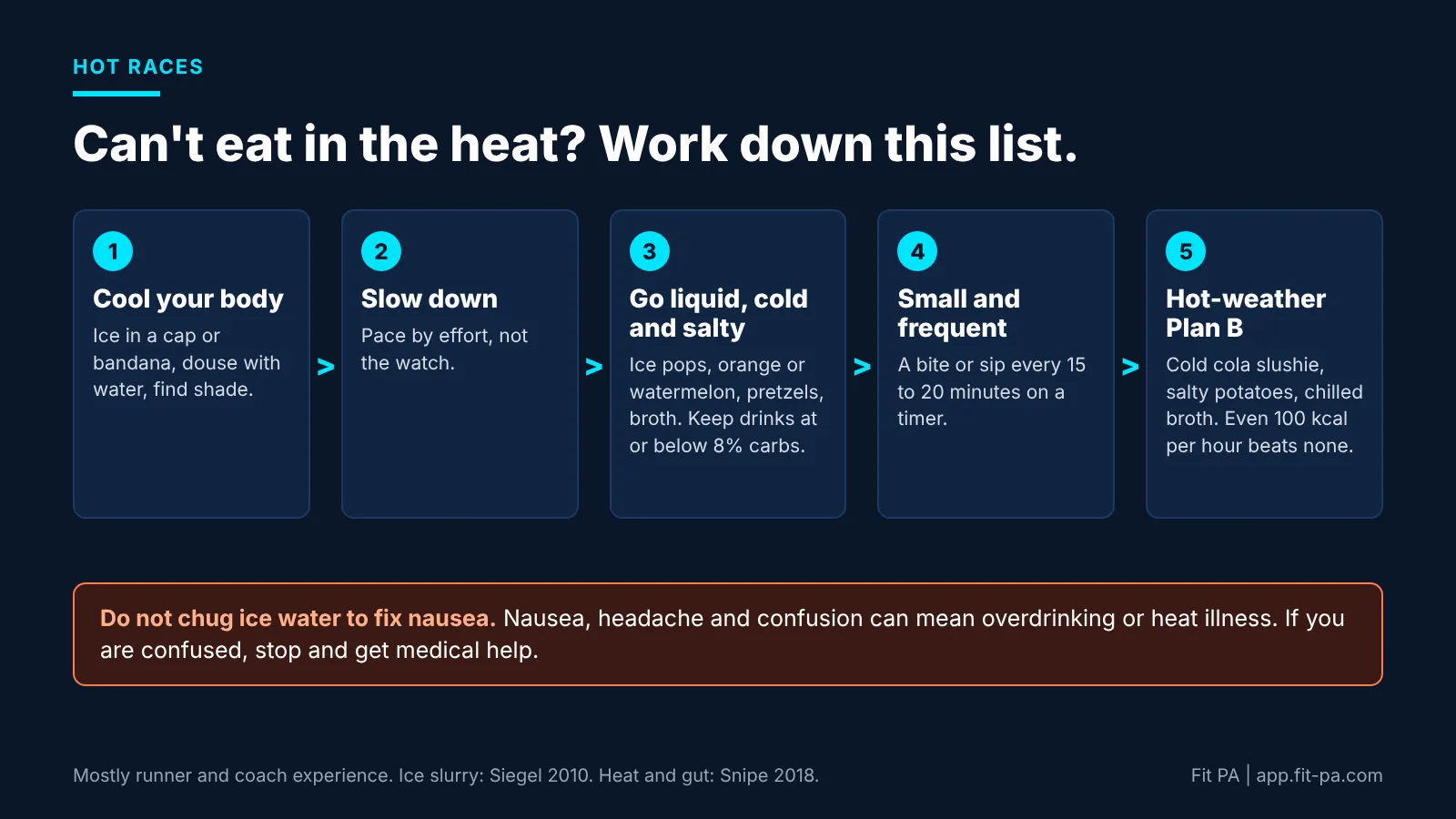
- Cool your body first. Core temperature is linked with nausea, so cooling is part of your fueling plan. Common tools are ice in a cap or bandana, ice in sleeves, dousing with water, shade, and walking the hottest stretch. In a lab trial of 10 men, drinking an ice slurry before running in 93°F (34°C) extended run time by 19% compared with cold water. A review concluded that cold water or ice slurry during exercise appears effective and practical for endurance in the heat, though the cooling effect from the ingested fluid is partly offset by reduced sweating. It has not been proven to protect your stomach.
- Slow down. Gut symptoms increase with intensity and heat. Pace by effort, not by the watch, on hot days.
- Front-load calories in the cooler hours. Eat well early in the morning, in the evening and in shaded stretches, when appetite and digestion are better, so you are less behind at midday.
- Lean on liquid calories and simple sugars. Many runners find it easier to drink calories than to chew and swallow dry food in hot, dry air. Keep drinks at or below about 8% carbohydrate (the ISSN warning on concentrated drinks), and consider using one bottle for calories and one for plain water, so you can eat on a schedule and drink to thirst separately.
- Go cold and salty. Ice pops, slushies and cold fruit such as orange slices or watermelon are easy to take in. Add salty foods such as pretzels, chips, salted potatoes and broth. Check labels on ice pops and slushies for carbohydrate content.
- Adjust sodium, but still drink to thirst. The ISSN range rises to about 300 to 600 mg per hour above about 77°F (25°C) or 60% humidity. The ISSN position stand also suggests capsules or tablets rather than effervescent tablets in water, which can make drinks taste worse in long or hot races. Salt does not protect you if you overdrink.
- Go small and frequent. A bite or two on a 15 to 20 minute timer is easier on a hot gut than a large serving.
- Do not chug ice water to fix nausea. Heat makes you want to drink more, which raises the risk of overdrinking and low blood sodium. Nausea, headache and confusion can come from heat illness or from overdrinking, so if you feel confused, stop and get medical help.
- Acclimate if you can. Runners and coaches commonly use about 10 to 14 days of repeated heat exposure (hot runs, or a hot bath or sauna afterward) before a hot race. It improves heat tolerance and lowers heart rate. This guide did not find a trial showing it prevents stomach symptoms directly, but it reduces the heat strain that drives them.
- Have a hot-weather Plan B. For example: a cold cola slushie, watermelon or orange slices, salty potatoes or pretzels, and chilled broth or sports drink. Even 100 calories an hour beats none.
Women and men: the heat table in section 8 notes that core temperature runs a little higher in the luteal phase. If you menstruate, a hot race in that phase may feel harder, so plan cooling and pace around it.
Cold, night and altitude
Experience, with limited lab support. In lab work, hunger fell less after exercise in the cold, and a lab study of altitude (hypoxia) found lower appetite and energy intake. For cold nights, many runners favor warm broth, tea or soup and eat before they get cold. At altitude, expect appetite to drop, lean on a timer and liquid calories, and rehearse Plan B.
8. Men and women: what differs and what does not
Most sports nutrition research was done on men, and recommendations were extended to women. The ISSN position stand itself gives no sex-specific racing recommendations, and women made up less than about 30% of participants in recent hydration studies. Treat the points below as the best current picture, not settled rules.
| Topic | What the research says | What it means for you |
|---|---|---|
| Hourly carbohydrate | The same ranges are used for both sexes. A 2023 review notes that carbohydrate guidance was largely studied in men and extrapolated to women, and that it may not account for monthly hormone shifts | Use the same ranges as a starting point. Practice through every phase of your cycle and keep notes |
| Total energy | Low energy availability (eating too little for your training) is fairly common in female endurance athletes, and the 2021 review in Sports Medicine suggests aiming for about 45 kcal per kg of fat-free mass per day. Men can be affected too (RED-S applies to both) | Fuel training days, not just race day. Watch for missed or irregular periods, which can signal low energy availability. Hormonal birth control can hide this sign |
| Low sodium (hyponatremia) | Several reviews list female sex as a risk factor, linked to smaller body size, longer race times, overdrinking and hormones. A Boston Marathon study cited in a clinical review found the two most severe cases were both women. But a study of 100 km ultramarathoners found no higher rate in women (1 of 19 women and 3 of 24 men had mild, symptom-free low sodium), and the Wilderness Medical Society summary does not list sex as a risk factor | The evidence is mixed. Everyone should drink to thirst and watch for weight gain. Women, especially smaller women running long and slow, have extra reason not to overdrink |
| Sweat | At the same absolute heat production, men and women sweat similarly. Women tend to sweat less on average, mostly because they work at lower absolute workloads, though at very high heat loads women have a lower maximum sweat capacity | Do not copy a male training partner's fluid plan. Work out your own from training |
| Cycle and hydration | A Gatorade Sports Science Institute review found menstrual cycle phase does not seem to change overall fluid balance. Other researchers suggest more water retention and a different thirst setpoint in the high-hormone (luteal) phase | If your thirst or bloating changes through the month, note it and adjust. Do not assume it will |
| Heat | Core temperature runs about 0.5 to 0.9°F (0.3 to 0.5°C) higher in the luteal phase and on higher-hormone contraceptives, and women tend to report feeling hotter at the same core temperature | A hot race in your luteal phase may feel harder than the same race in your follicular phase. Plan cooling and pace |
| Stomach symptoms | Surveys of marathon runners found women reported more upper and lower gut symptoms than men. A 2021 review found women report more gut symptoms at rest, especially around menstruation, but not clearly during exercise. Female gut physiology is under-researched | Track symptoms against your cycle during training. If symptoms cluster in one phase, test a lower-fiber, lower-fat plan for those days |
Takeaway: the core rules (practice your fueling, drink to thirst, treat weight gain as a warning) apply to everyone. The female-specific extras are energy availability, a closer watch on overdrinking, and tracking your own cycle against your own results.
9. Before the race
- Training diet. The ISSN position stand recommends about 5 to 8 g of carbohydrate per kg per day in training (7 to 10 g for higher mileage or faster paces) and about 1.6 g of protein per kg per day, with up to 2.5 g per kg in demanding blocks.
- Carb loading. The ISSN position stand recommends a contemporary loading strategy of about 10 g of carbohydrate per kg per day in the 48 hours before the event. For a 60 kg runner, that is roughly 600 g per day. Choose familiar, low-fiber foods, spread the intake across the day, and expect to feel full.
- Low-carbohydrate diets. A 2019 review found that low-carbohydrate, high-fat diets raise fat burning during submaximal exercise, but benefits for ultramarathon performance are not supported.
- Rehearse. Do at least one long run that mimics race day: same food, same timing, same heat if you can.
10. Build your race plan
- Set your hourly carbohydrate target from the range you have tested, not from a guide or a friend.
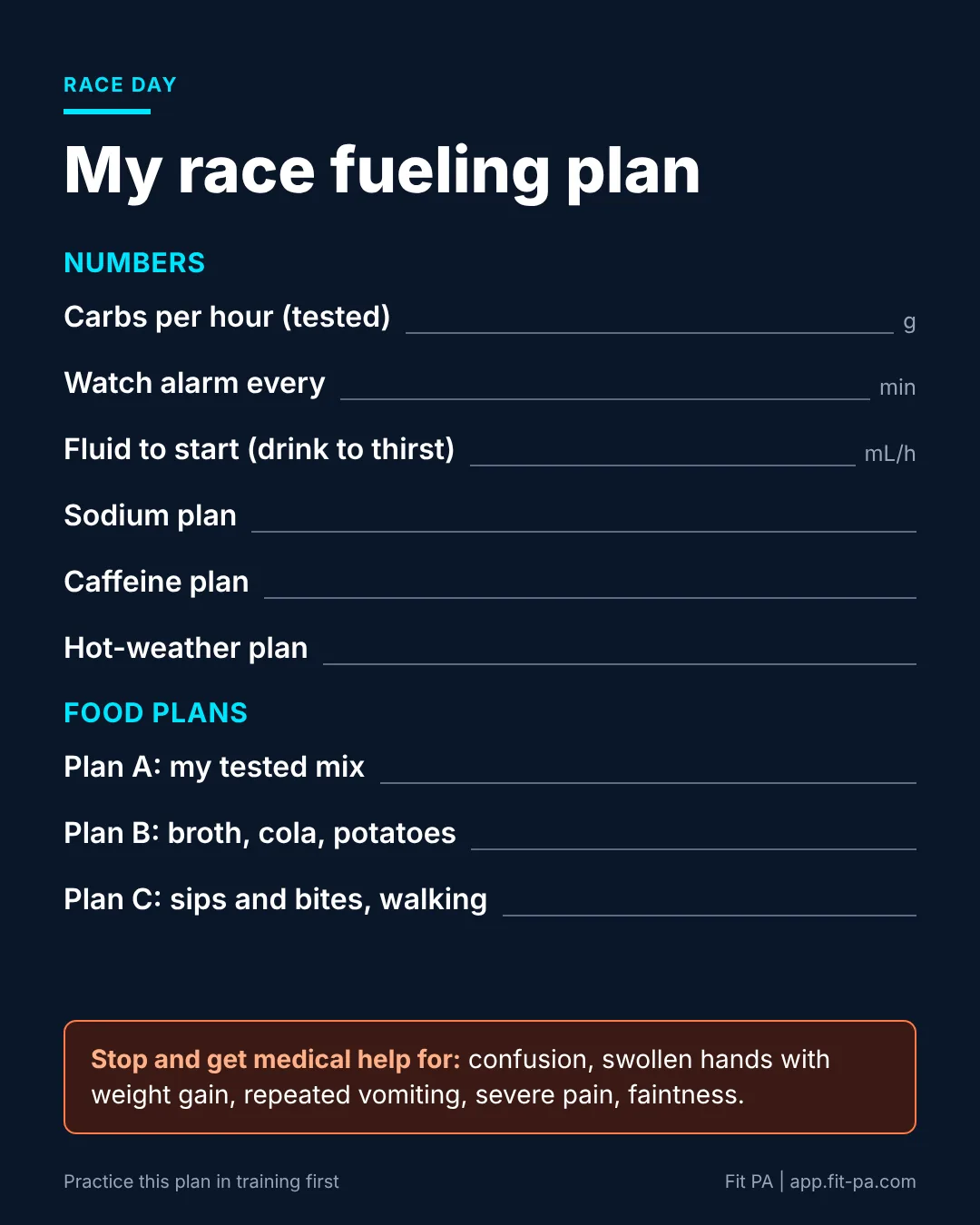
- Turn it into a schedule. Set a watch alarm every 20 to 30 minutes. At 60 g per hour, that is about 30 g every 30 minutes. Small and frequent works better than big and rare, and appetite and memory both fade late in a race.
- Set a starting fluid range (the ISSN range is 450 to 750 mL per hour) and adjust to thirst, heat and how your stomach feels.
- Plan your sodium through drink and salty food.
- Write three plans:
- Plan A: your normal tested mix.
- Plan B: simple foods, such as broth, flat cola, boiled potatoes and crackers.
- Plan C: small sips and bites while walking until your stomach settles.
- Plan for the gaps. Know where food and water are, and carry enough to bridge the long stretches. Stock real-food backups where your crew or drop bags will be.
- Check in every hour or two. Thirst, stomach, energy, hand swelling, and any weight trend.
- Rehearse Plan B in training so a food you have never tried at 3 a.m. is not your first test.
11. Troubleshooting: when your stomach turns
Prevention is the best-supported fix. These steps are mostly runner experience and coaching advice, not trials, so treat them as things to try.
The reset
- Slow down or walk. Heat and effort raise gut distress, and in one ultra-trail race study (Costa and colleagues, 2014, cited in a 2021 systematic review) the faster group had about 2.5 times more gut symptoms than the slower group.
- Sit for 5 to 10 minutes and sip small amounts of cold water or ginger ale. A review found cold fluids reduced gut symptoms in the heat.
- Pause solid food for 15 to 30 minutes, then restart with liquids such as broth, flat cola or ramen soup, and small bites.
- Go small and frequent. Even 100 calories an hour beats none, and runners report this is how they climb out of a low.
- If nothing stays down for hours, see the medical team. Dehydration and low sodium both become risks.
Symptom guide
| Symptom | What runners and coaches try | When to get help |
|---|---|---|
| Nausea | Follow the reset above. Ginger ale or ginger chews are a common try. A meta-analysis found at least 1 g of ginger was better than placebo at preventing nausea and vomiting after surgery, but it has not been tested in ultrarunners, and many ginger drinks contain little real ginger | If it is paired with weight gain, confusion or repeated vomiting |
| Bloating, belching, fullness | Stop eating for a while, sip plain water, slow down, and dilute concentrated drinks | If it comes with swollen hands, no thirst or a headache, think low sodium and see medical |
| Diarrhea or urgency | Slow down, replace fluids and sodium with a drink or broth, and choose bland, low-fiber foods. Skip caffeine, sugar alcohols and concentrated gels for a while | If it persists, or you feel dizzy or weak |
| Vomiting | Stop solid food, sit down, take small sips | If it repeats, or you cannot keep fluid down |
| No appetite, food aversion | Switch flavors and temperature. Try something salty, or cold if it is hot out, or warm if it is cold. Eat small amounts on a timer. See section 7 for heat | If you cannot take in anything for hours |
| Lightheaded or sudden low energy | Take in carbohydrate. Runners report cola and ramen fixing lightheadedness after hours without food | If you feel faint, confused or cannot stay on your feet |
| Cramps | The cause is still debated. The best evidence links cramps to muscle fatigue (hard pace, prior cramping, muscle damage) more than to low sodium. Ease the pace and stretch the cramping muscle. A salty or sour sip, such as pickle juice, helps some runners, possibly through a reflex in the mouth. Electrolyte drinks are fine for comfort, but do not count on them to prevent cramps | If they come with confusion or severe weakness |
| Swollen hands, weight gain, headache, confusion | Stop extra fluids. This pattern can mean overdrinking | Get medical help at once. Treat confusion as an emergency |
Medications. Talk to your doctor before the race about anti-diarrheal medicine such as loperamide, which can change how your gut handles fluid and electrolytes. Anti-inflammatory painkillers can raise the risk of low sodium and should not be taken as prevention without medical advice. Sleep aids and other medications are a personal and medical decision, so settle them before race day.
Get help from the medical team for: severe abdominal pain, dizziness, repeated vomiting, blood in the stool, or confusion.
12. One-page checklist
- Tested hourly carbohydrate range written down
- Gut training practiced on several long runs at race effort
- Products tested in heat, not just on cool days
- Hot-weather plan: cooling tools, liquid calories, cold and salty foods, and a heat-adjusted sodium plan
- Fluid plan: starting range, drink to thirst, no forcing
- Sodium through drink and salty food, rehearsed
- Caffeine plan tested, started low, saved for later
- Plan A, Plan B and Plan C food written down
- Watch alarm set every 20 to 30 minutes
- Aid station and drop bag stock listed
- Warning signs of overdrinking and heat illness known by you and your crew
- If you menstruate: cycle phase noted for race day, and energy intake kept up through training
- Medications discussed with your doctor
Put it into practice with Fit PA
Fit PA is built for any goal, not just ultras. Connect your watch or device and the coach builds a plan from what you have actually run. You can ask it to put fueling practice into a long run, for example: "My stomach shut down after four hours. What should I change before my next long run?" Tell the coach what you ate and how you felt, so it can adjust from there. It is a good way to rehearse the plan above before race day.
Sources
Checked against the original source or its abstract:
- ISSN position stand: nutritional considerations for single-stage ultra-marathon training and racing (Tiller et al., 2019)
- Nutrition for ultramarathon running: trail, track, and road (Costa et al., 2019)
- Carbohydrate intake in ultramarathon runners and practical g per kg per hour ranges (Int J Environ Res Public Health, 2020)
- Analysis of food and fluid intake in elite ultra-endurance runners during a 24-h world championship (JISSN, 2020)
- Carbohydrate intake in 24-h ultra-runners (Frontiers in Physiology, 2021)
- Feeding tolerance and carbohydrate and fat oxidation in male endurance and ultra-endurance runners (Rauch et al., Frontiers in Physiology, 2022)
- Wilderness Medical Society hyponatremia guidance (AAFP summary, 2021)
- Hyponatremia consensus summary (Third International Exercise-Associated Hyponatremia Consensus, 2015)
- ISSN position stand: caffeine and exercise performance (2021)
- Exercise-associated hyponatremia: aspects of sex, race location, ambient temperature, discipline and length (Medicina, 2019)
- Is the prevalence of exercise-associated hyponatremia higher in female than in male 100-km ultra-marathoners? (Human Movement, 2012)
- Hyponatremia causes, risks, prevention and management (Cleveland Clinic Journal of Medicine)
- Hydration in physically active women (Gatorade Sports Science Institute)
- Recommendations and nutritional considerations for female athletes (Sports Medicine, 2021)
- Low carbohydrate availability and RED-S in female endurance athletes (Nutrients, 2023)
- Gastrointestinal disturbances in marathon runners (Riddoch and Trinick, 1988)
- Sex differences in gastrointestinal physiology and exercise (European Journal of Sport Science, 2021)
- Two weeks of repetitive gut-challenge reduce exercise-associated gastrointestinal symptoms and malabsorption (Miall et al., 2018)
- Relationship of carbohydrate intake during one-day ultra-trail races with fatigue and gastrointestinal problems: a systematic review (Arribalzaga et al., 2021)
- The impact of exertional-heat stress on gastrointestinal integrity, symptoms, endotoxin and cytokine profile (Snipe et al., 2018)
- The effects of exercise and ambient temperature on dietary intake, appetite sensation and appetite-regulating hormones (Mandic et al., 2019)
- Ice slurry ingestion increases core temperature capacity and running time in the heat (Siegel et al., 2010)
- Cold water or ice slurry ingestion during exercise in the heat (review, Sports Medicine, 2017)
- The efficacy of ginger for the prevention of postoperative nausea and vomiting: a meta-analysis (2006)
- Gastrointestinal complaints in athletes (Asker Jeukendrup)
- Fueling during endurance exercise: balancing intake with gastrointestinal tolerances (Practical Gastroenterology, 2023)
- Cause of exercise associated muscle cramps: altered neuromuscular control, dehydration or electrolyte depletion? (Schwellnus, Br J Sports Med, 2009)
- Serum electrolyte concentrations and hydration status are not associated with exercise associated muscle cramping in distance runners (Schwellnus et al., 2004)
- Sodium intake during an ultramarathon does not prevent muscle cramping, dehydration, hyponatremia, or nausea (Hoffman et al., 2015)
- Muscle cramping during a 161 km ultramarathon (Hoffman and Stuempfle, 2015)
- Magnesium for skeletal muscle cramps (Cochrane review, Garrison et al., 2020)
- An evidence-based review of the pathophysiology, treatment, and prevention of exercise-associated muscle cramps (Miller et al., 2022)
- Reflex inhibition of electrically induced muscle cramps in hypohydrated humans (Miller et al., 2010)
Used from search summaries or secondary articles; verify before publishing numbers:
- Fuelling for an ultra, GI symptom review (Runner's World South Africa) (60 to 96% symptom figure and the two-week gut challenge)
- Fueling for ultras, Stephanie Howe (UltraSignup Trailhead)
- Do you really need 120 g of carbohydrate per hour? (Born on the Trail)
- Gut-training systematic review (Sports Medicine, 2023)
- Joint position statement on exercise-associated GI symptoms (Costa et al., Sports Medicine, 2025)
- FODMAP, caffeine and GI symptoms in a 56 km ultramarathon (Deakin)
- GI distress at the Western States 161 km (Stuempfle and Hoffman, 2015)
- Hydration for active women (Stacy Sims)
- Training and competing in the heat (UltraRunning magazine) (10 to 14 days of heat exposure; cooling tricks)
- Effect of exercise and environmental conditions on appetite, food intake, ghrelin and PYY (Wasse, Loughborough thesis, 2011) (appetite in heat, cold and altitude)
- Heat acclimation for women (UltraCoach) (core temperature and perception figures, from the Fit PA heat guide)
- Liquid-calorie and cold-food tips in the heat come from coaching and runner accounts (a desert ultra runner's newsletter and a triathlon magazine interview with an exercise physiologist), not trials.