

What to know before you read the rest
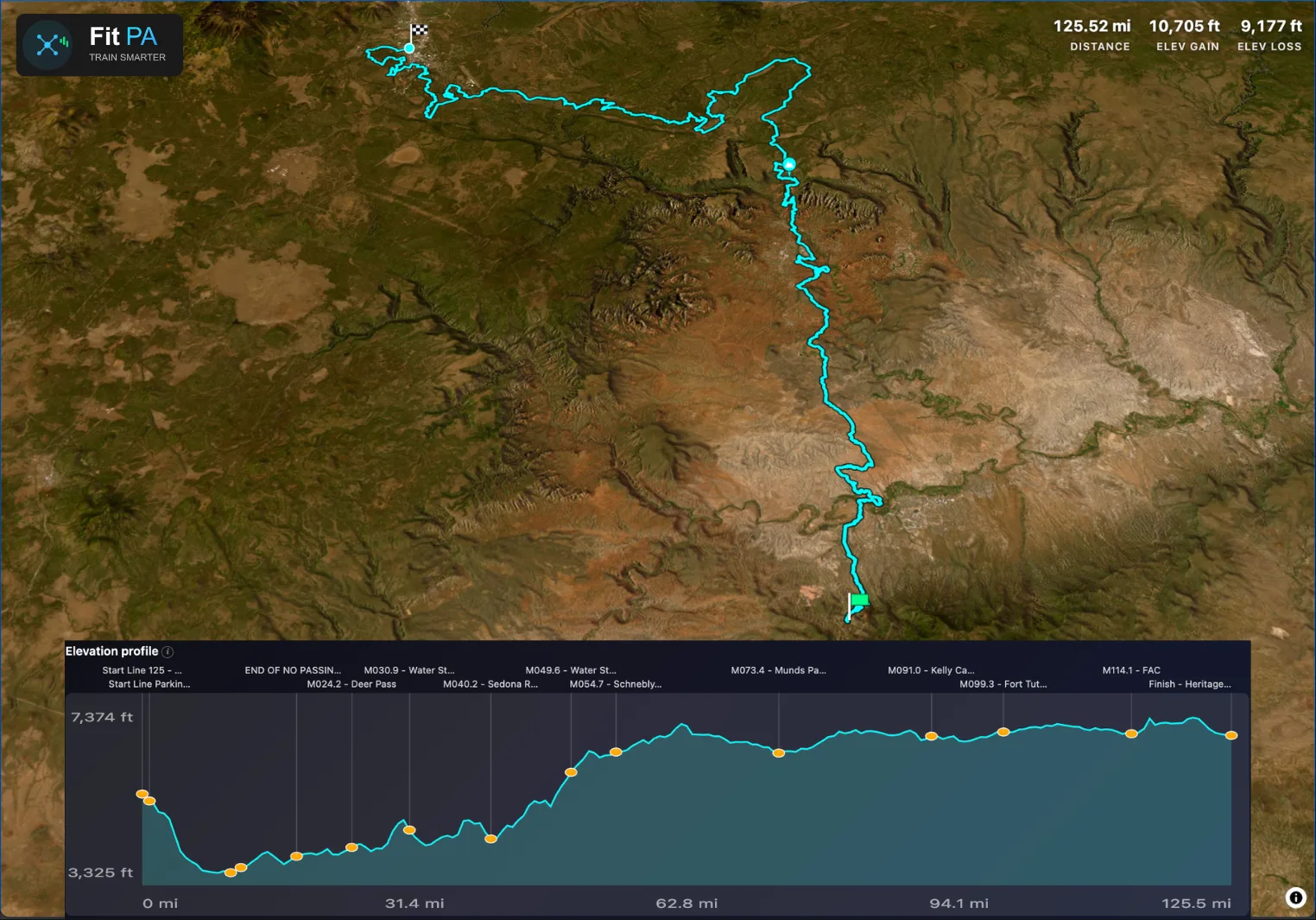
The Sedona Canyons 125 rewards runners who plan the whole route, including the middle sections where weather, logistics and sleep come together. This guide ties the official course description to what finishers reported, then turns each point into something you can train for or pack. The last section shows how to put it into practice with Fit PA. Course details come from the official 2027 section guide, updated 1/10/26. The race says it will not update that document within a month of the event, so confirm any late changes in the runner guide. Reports from earlier years are labeled by year, because the route has changed. Six things runners most often overlook:
- A possible wet-feet start at the Verde River crossing, depending on the year, then sand and dust into Sedona.
- A swing from desert heat to near-freezing wind within hours of leaving Sedona.
- The Hangover Trail, in daylight or in the dark depending on your pace, with no pacers allowed until Munds Park (mile 73.4).
- Lights, batteries and phone cables failing just when navigation gets hardest.
- Leaving the sleep plan to be decided at 2 a.m.
- A fueling plan with no plan B for the hours when your stomach shuts down.
In 2024, 142 of 197 starters finished (72%), so finishing is realistic for a runner who has prepared for the middle of the course as well as the start and finish.
Section by section: what to expect and what to do
Every stage has one job: arrive at the next with enough left to handle what follows. Miles are from the 2027 official section guide. The reports below come from individual runners in 2024 to 2026. Many runners had smooth stretches in these sections, so each entry shows what went well and what some people ran into. Runners also praised the race organization, clear markings and generous cutoffs in 2024.
| Section | What to expect | What runners reported | What to do |
|---|---|---|---|
| Start to Dead Horse (0 to 10.2) | 1.5 miles of streets, then a steep, loose dirt road dropping about 1,000 ft in a mile, several gates to close, and a knee-deep Verde River wade. No crew or drop bags at Dead Horse | Went well: a daylight descent on fresh legs, a cool, refreshing river crossing, and dry socks at Dead Horse that kept blisters away. Challenges: a bunched-up field on the descent, and wet feet followed by sand | Train long, controlled downhills; plan your wet-feet routine; close every gate |
| Dead Horse to Deer Pass (10.2 to 24.2) | A 4 mile no-passing zone through protected plant habitat on chunky baby-head rocks, then a flowy descent and fine dust. Careful turns near mile 21 and a pipe culvert under Hwy 89A | Went well: shaded riverside miles, runnable single-track, a Lime Kiln highlight, and locals cheering (2024). Challenges: sun, deep sand and road in the 80s that slowed pace more than planned (2024 and 2025) | Start easier than feels right. You cannot pass in the zone, so accept the line |
| Deer Pass to Sedona (24.2 to 40.3) | 16.1 miles with about 2,600 ft of gain, many single-track junctions, a water station near mile 31, a very chunky Airport Loop, and brutal heat of the day | Went well: red rock views one runner called the most beautiful stretch, ice in a bandana, a cold bucket and sponge at the water station, and one runner who limited running in the heat and arrived within five minutes of plan. Challenges: cramping at the water-only station in late afternoon (2024) | Carry more fluid than the plan says, ice in a bandana, phone out for navigation, hike early so you arrive with legs. Crews cannot reach you until Sedona |
| Sedona to Schnebly Hill (40.3 to 55.2) | Gear check, then the Huckaby, Munds Wagon and Hangover trails, a Schnebly Hill Road climb with water at mile 49.6, and a long plateau dirt road. A big temperature drop | Went well: sunset views, miles that passed quickly with other runners, and a night on Hangover that one 2025 finisher called memorable, with camaraderie on the plateau climb. Challenges: the official guide flags a drastic temperature swing from daytime in Sedona to nighttime on the plateau, and 2024 reports include a fall on the long dirt road at night and a headlamp dying near freezing | Dry layers ready, two lights, a plan for Hangover (see that section) |
| Schnebly Hill to Munds Park (55.2 to 73.4) | No pacers, to protect nesting owls. Keep headlamps down and noise low. Well-graded dirt roads with vehicle and ATV traffic. The Munds Park sleep station is unheated and nights are in the upper 30s F | Went well: runners who planned a sleep stop at Munds Park described a real reset from a cot and hot food, and others enjoyed the stars and company on the plateau. Challenges: the official guide says some runners have woken up in a ditch not knowing where they were | Plan your nap marker and GPS check before you lie down |
| Munds Park to Kelly Canyon (73.4 to 91.0) | Pacers can join. Gear check for runners and pacers. Barbed-wire gates, four places where the 250 route splits or rejoins, pine needles to chunky volcanic rock. Kelly Canyon aid is barebones | Went well: green evergreen forest, rolling terrain, sunrise lifting spirits, and a pacer's company. Challenges: disorientation in harvested forest and hallucinations (2025), and a bushwhack after a wrong turn (2024) | Backup lights, GPS discipline, follow distance-specific signs, close gates |
| Kelly Canyon to Fort Tuthill (91.0 to 99.3) | A well-graded road, Old Munds Highway, then single-track. Cross traffic on Hwy 89A does not stop. Fort Tuthill has crew, pacers, drop bags and heated cots | Went well: runners praised Fort Tuthill's massage table, cots and dark sleeping room (2024), and one woke from a short truck nap feeling surprisingly fresh. Challenges: chills and a restless hour of rest (2024) | Cross Hwy 89A with full attention even when tired; plan your rest |
| Fort Tuthill to FAC (99.3 to 114.1) | Gear check and mental status evaluation before you leave. The 125, 250 and Flagstaff Crest runners start together, so watch the distance signs. Chunky DeMiguel Connector, then a powerline corridor | Went well: park-like single-track, elk, views of snowy Humphreys Peak, and cheers from shorter-distance runners (2024). Challenges: dead phones and mismatched batteries (2024) | Charge before dark and carry the right cable |
| FAC to finish (114.1 to 125.6) | Route 66 crosses at a signal, about 8 miles of single-track over Mars Hill, then the Rio de Flag into downtown | Went well: real food at the last aid station, company from other runners, sunrise, and a lively finish; one runner finished well inside the 75 hour cutoff. Challenges: unclear markings near the end (2024) | Review the finish route in daylight and keep your phone charged |
Plan your pacing: what a finish time looks like
The goal you pick changes your whole race: which hours you spend in the heat, how many nights you are out, and when you reach the crew points. Fit PA has a Sedona Canyons 125 page that anyone can open.
Choose a finish time from the dropdown (37, 45, 52, 60, 67 or 75 hours) and it lays out every section of the course: length, climb, descent, the mile you reach, elapsed time and clock time, starting from the 2027 start of Tuesday 7:00 am. It also lists the even pace per mile and km for each goal. The table below pulls a few checkpoints from it as an example.
| Finish goal | Even pace | Sedona (mile 40) | Munds Park (mile 73) | Fort Tuthill (mile 99) | Finish |
|---|---|---|---|---|---|
| 37 h | 17:40 /mi | Tue 6:51 pm | Wed 4:37 am | Wed 12:15 pm | Wed 8:00 pm |
| 45 h | 21:29 /mi | Tue 9:24 pm | Wed 9:18 am | Wed 6:35 pm | Thu 4:00 am |
| 52 h | 24:49 /mi | Tue 11:39 pm | Wed 1:23 pm | Thu 12:07 am | Thu 11:00 am |
| 60 h | 28:38 /mi | Wed 2:12 am | Wed 6:04 pm | Thu 6:27 am | Thu 7:00 pm |
| 67 h | 31:59 /mi | Wed 4:27 am (after cutoff) | Wed 10:09 pm | Thu 11:59 am | Fri 2:00 am |
| 75 h (cutoff) | 35:48 /mi | Wed 7:00 am (after cutoff) | Thu 2:50 am (after cutoff) | Thu 6:18 pm (after cutoff) | Fri 10:00 am |
What the table tells you:
- Nights out. A 37 hour finish means one night on the trail. Finishing around 45 to 60 hours means two, with the second night somewhere between Munds Park and the finish. At 67 hours or slower you are moving through a third night, so a sleep plan matters more than any pace target.
- When you hit the heat. Faster goals reach Sedona and the climbs after it in the evening. Slower goals reach them the next morning, which puts the exposed Sedona to Schnebly Hill section in daytime heat, so plan your heat and fluid strategy around the clock times, not only the pace.
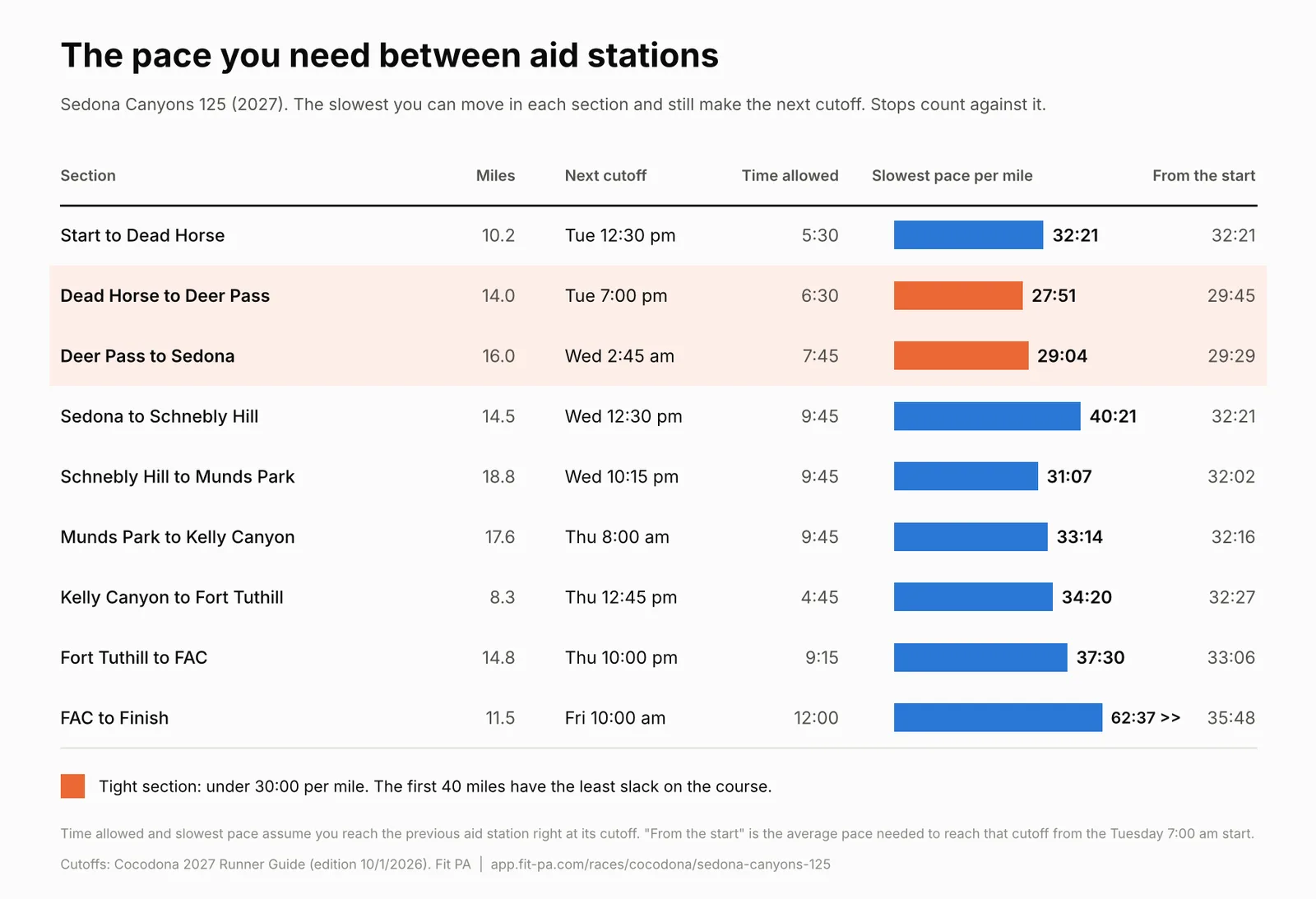
- When you reach crew and the sleep station. Check which aid you arrive at in daylight and which after dark. Munds Park, the sleep station and the start of pacers, falls in the early morning at 37 hours but in the evening at 60 to 67 hours. Plan crew shifts and your own sleep stops around these times. The aid station cutoffs are front-loaded. The tightest limits are in the first 40 miles, and an even split misses them.
| Aid station | 2027 cutoff | Average pace per mile needed to reach it at the cutoff |
|---|---|---|
| Dead Horse | Tue 12:30 pm | 32:21 |
| Deer Pass | Tue 7:00 pm | 29:45 |
| Sedona | Wed 2:45 am | 29:29 |
| Schnebly Hill | Wed 12:30 pm | 32:21 |
| Munds Park | Wed 10:15 pm | 32:02 |
| Kelly Canyon | Thu 8:00 am | 32:16 |
| Fort Tuthill | Thu 12:45 pm | 32:27 |
| FAC | Thu 10:00 pm | 33:06 |
| Finish | Fri 10:00 am | 35:48 |
- Deer Pass and Sedona are the squeeze. Reaching them by the cutoff takes about 29:45 and 29:29 per mile, both faster than the 35:48 headline pace.
- An even 67 hour pace (31:59 per mile) misses both. It reaches Deer Pass at 7:53 pm and Sedona at 4:27 am. The 75 hour line misses them by more.
- A goal near the time limit means moving faster early and slower later than the even split in the table.
- Every minute spent sleeping or sitting at aid comes out of that budget, so keep stops short and deliberate.
The page is arithmetic from the finish time you pick. It does not know your fitness, sleep stops or time at aid stations, so treat it as a planning frame. Fit PA's race time predictor, linked from the same page, estimates a finish from your own training, and your coach can build sleep and aid stops into the plan once you pick a goal. The same page has a Train for this race button. Connect your watch or device and the coach builds your first plan for Sedona Canyons 125 from what you have actually run, working backward from the May 4, 2027 start. The first plan is free and needs no card.
Water crossings and foot care
The Verde River wade just before Dead Horse (mile 10.2) is the crossing to plan for. The 2027 guide calls it knee deep and says there is no keeping your feet dry. Water levels and weather change from year to year, so check recent conditions and be ready for both a wet and a dry day. The official guide highly recommends merino wool socks for the Verde crossing and suggests giving your feet time to dry at Dead Horse. One 2024 finisher noted that stepping out into sand with wet feet is a recipe for blisters if left alone. Another runner, who normally goes a hundred miles without blisters, had five and three sock changes here. Runners are divided on this, and none of these are race rules. The decision is whether to accept wet feet and keep moving, or spend a few minutes caring for your feet to protect the next segment:
| Approach | Why runners choose it | What it costs |
|---|---|---|
| Keep moving with wet feet | Saves time and keeps momentum. One father and son pushed through the current without stopping and finished with only minor blisters | Wet feet plus sand and grit raise blister risk over many miles. One runner who normally goes 100 miles without blisters had five |
| Cross in shoes, then dry and change socks at Dead Horse | A few minutes to dry your feet, change socks and re-lube or tape. One finisher credited dry socks after the river with preventing blisters | Minutes lost at the aid station, and you must carry the supplies because Dead Horse has no crew or drop bags |
| Shoes off or ultralight water shoes | Keeps shoes and socks dry | Bare feet on a river bed risk cuts, sand gets into your shoes when you put them back on, and water shoes add weight to carry until the Deer Pass drop bags (mile 24.2) |
Dead Horse has no drop bags and no crew access for the 125 in the 2027 guide, so carry your spare socks, lube and tape and make your change at the aid station. Deer Pass (mile 24.2) has drop bags but no crew access. Practical tips:
- Carry one spare pair of socks in a zip bag so they stay dry through the crossing.
- If the water looks deeper or faster than the knee-deep crossing the guide describes, do not cross. Ask race staff for direction instead. In normal conditions, unclip your vest's sternum strap (and any hip strap) so you can shed the pack if you fall, and use poles for balance.
- Gaiters keep sand out. One 2024 runner changed socks and gaiters after a crossing, which took time.
- Dust and fine grit continue into Sedona. Lube known hot spots before the sections, not after.
Training: since runners split on this, test both approaches. Do a long run that ends with an hour of wet feet in your exact sock, shoe and lube setup, then try a timed sock change, so you know how your own feet respond and which camp you are in.
Heat training and heat management
Start heat training six to eight weeks before the race, finish with a second block in the final taper, and know that women may need a longer block than men (see the table below). This is general evidence for healthy, trained adults, not medical advice. Check with a doctor first, especially with heart or kidney conditions, a history of heat illness, pregnancy, or medications that affect sweating.
The basic protocol (any sex)
Passive heat options (most popular)
Do one of the following immediately after a run:
- Hot bath: up to 40 minutes, submerged to the neck, at 104°F to 106°F (40°C to 41°C), on 6 to 10 consecutive days.
- Dry sauna: about 30 minutes at 176°F to 212°F (80°C to 100°C), about 3 to 4 times a week for 3 weeks.
Keep a cool drink handy during hot bath and sauna sessions, and get out if you feel dizzy or faint.
Rehearse your heat plan. Heat adaptation lowers your body's heat load, but race day also depends on pacing, cooling and fluids. Practice all of it in training in similar heat: your clothing, your cooling gear (including any ice bandana), your fluid and sodium plan, and your heat-adjusted pacing. See the race day section for how to use them on course.
Sources:
Zurawlew et al. 2019, Frontiers in Physiology Post-exercise hot water immersion study, Scand J Med Sci Sports McIntyre et al. 2021, J Sci Med Sport Runners Connect: heat-acclimating without a hot climate Claude is AI and can make mistakes.
Active heat option
- Heat training: exercise in the heat with your core temperature held above 101.3°F (38.5°C) for about 1 hour, repeated for 10 to 14 consecutive days.
- Two-block schedule: a 6 to 10 day block six to eight weeks out, one or two maintenance sessions a week, then a final 6 to 10 day block in the taper.
- Adaptation fades about 2.5% per day once you stop, so the final block matters.
What differs for men and women
| Men | Women | |
|---|---|---|
| Time to adapt | Most gains in the first 4 to 7 days of heat | Medium-term blocks of 6 to 10 days are needed for performance, core temperature and heart rate gains |
| How to schedule | One block, then maintain | Start earlier, repeat blocks, or add extra exposures |
| Sweat and fluids | Higher sweat rates on average | Lower average sweat rates and fluid needs; individualize from training data |
| Sauna response | Higher forearm blood flow after 3 weeks of post-run sauna | More active sweat glands after the same program |
| Cycle effects | Not applicable | Core temperature runs about 0.5 to 0.9°F (0.3 to 0.5°C) higher in the luteal phase and on higher-hormone contraceptives; learn your own pattern |
| Perception | At the same core temperature, women tend to report feeling hotter |
Humid heat (above about 60% relative humidity, a rule of thumb, not a studied threshold) or sauna sessions can add stimulus for anyone who sweats little in dry heat, which is more common in women. Build aerobic fitness first, because fitter athletes of either sex adapt more readily.
On race day
Heat management on course comes down to three things: pace for the heat, cool yourself repeatedly, and watch for warning signs.
Pace for the heat
- Hike the early climbs, run later in cooler sections, and treat the Deer Pass to Sedona stretch as the place to protect your legs.
- Pace by effort and heart rate, not by how hot you feel. Expect to be slower in the heat and plan for it.
Cool yourself repeatedly
- Carry enough fluid for long gaps. Crews cannot reach you until Sedona (mile 40.3), since Dead Horse and Deer Pass have no crew access.
- Cool from the inside and by evaporation first: drink cold fluids (ice slush if you can get it), and wet your hat, neck, forearms and shirt with cool water at every water source. Ice is optional, not the plan.
- Wear light-colored, breathable clothing, a hat and sunglasses, and reapply sunscreen.
- Consider a lightweight reflective sun umbrella for the exposed daytime stretches. It blocks direct sun, which adds to your heat load, and it weighs about 6 ounces. It works best on open, low-wind sections, and the hands-free clip can slip, so test your setup with poles and a loaded vest in training. When you are not using it, collapse it and stash it in your pole quiver, which most runners already wear. Check the race rules before relying on it.
Ice bandanas: a comfort tool, not a thermometer
An ice bandana makes you feel cooler, but research suggests it may do this mostly by dampening your perception of heat, with little effect on core temperature. In one study, runners with a cooling collar quit at the same perceived effort but at a higher core temperature (103.3°F vs 102.5°F). There is also a physiology debate about ice held directly on the skin: very cold contact can constrict skin blood vessels, which may limit how much heat you lose. The evidence is mixed, so do not rely on it. If you use one, wrap the ice in cloth, do not speed up because you feel cooler, and treat the cold drinks and cool water above as your main tools.
Know the warning signs
- Dizziness, nausea, confusion, stumbling, goosebumps or chills in the heat, or a sudden drop in pace are signals to slow down or stop, get into shade, and cool aggressively, no matter how cool you feel.
Fluids and food
- Drink to thirst and do not force fluids, because overdrinking is the main cause of exercise-associated hyponatremia. The race guide warns that heat, dehydration and hyponatremia can take a huge toll on unprepared runners. Practice your fluid and sodium plan in training so you know your own numbers.
- Spread food across the day. One runner overheated near the marathon mark and found tacos did not sit well in the heat.
Fueling and hydration
Build the plan around real food you have tested, train your gut for it, and write a plan B for the hours when nothing sounds good. The research does not say real food beats gels in ultras, and runners split on it, but it does show that stomach trouble is common and that practice helps.
| Question | What you can do | What the evidence says |
|---|---|---|
| How much carbohydrate per hour? | There is no right number for everyone. Start from what you can already eat comfortably on long runs, and raise it in small steps over several weeks only if your stomach stays calm. Slower, lighter runners often need less than faster, bigger ones, because they burn less per hour | Observational data show most ultrarunners take in less than 60 g an hour. Intakes of 90 g an hour or more come from elite and faster athletes, and from short trials on trained guts. Treat them as a ceiling some people reach, never a target to copy |
| Can I train my gut? | Practice eating at race effort and in heat on long runs, and build gradually. Write down what you ate and how you felt, so you can repeat what works | A 2023 review found gut training may reduce gut discomfort. In a two week trial, runners who practiced a high carbohydrate intake had fewer symptoms than a placebo group. That was in short lab efforts, not multi-day races |
| Real food or gels? | Test both. Choose the mix you can still face at hour 20, and carry a simple backup for when sweet gets hard to swallow | No controlled trial shows one wins in ultras. Coaches disagree: some say gels deliver energy faster, others say real food is easier on the stomach at a slower pace |
| Will my stomach act up? | Expect that it might and plan for it, because it is the rule, not the exception. Heat and hard effort make it worse, so ease off when it starts | A review reports bothersome GI symptoms in about 60 to 96% of ultra athletes in efforts over four hours. In one ultra-trail study, the faster runners had about 2.5 times more symptoms than the slower ones |
| How much should I drink? | Drink to thirst and do not force fluids. Use sodium for taste and cramp comfort, not as protection against low sodium. Practice your plan in training | Wilderness Medical Society guidelines name overdrinking as the main cause of exercise-associated hyponatremia and find no evidence that sodium supplements prevent it |
On this course
- Carry enough to bridge the gaps. Dead Horse has no crew or drop bags, Deer Pass has drop bags but no crew, and Kelly Canyon aid is barebones. Crews reach you at Sedona and Schnebly Hill, so stock real-food backups there.
- Eat early and often. Under-fueling can itself cause nausea, because low blood sugar makes you feel sick.
- Vary flavors and textures. Palate fatigue is a common reason runners stop eating. Runners reported watermelon, ramen, a black bean burger and breakfast burritos at aid stations, and one said cola and ramen fixed lightheadedness after hours without eating.
- Drink to thirst and do not force fluids. Sweat carries sodium, so salty food and electrolytes can replace some of it, but they do not protect you if you overdrink. Bloating, no thirst, weight gain or confusion can signal low blood sodium from overdrinking. These signs overlap with heat illness, so tell the aid station medical team.
Electrolytes and sodium
Sweat carries sodium, so replacing some of it makes sense in a long, hot race. Sodium-rich foods and fluids should be available during long efforts in heat. But they will not prevent exercise-associated hyponatremia (EAH) if you overdrink, so treat sodium as a comfort and replacement tool, not a safeguard.
Ways to get it
- Electrolyte drink mixes. Powder or tablets you add to your own bottle or flask. They are light, you control the strength, and they make plain water easier to drink when it gets old. Carry what you have tested in training.
- Electrolyte capsules or salt tablets. Compact and easy to carry for the long gaps without crew. Some runners find concentrated sodium upsets their stomach, so test them on long runs and take them with fluid.
- Aid station drinks. Aid stations usually offer an electrolyte drink, but check the runner guide for what is stocked and at which stops. Do not count on a specific brand. If your stomach is picky, carry your own mix and ask for water to blend it.
- Salty food. Broth, ramen, salty potatoes and pretzels add sodium and fluid together, and they help when sweet things stop appealing.
Practical rules
- Electrolyte drinks are still fluid. Drinking more because it "has salt in it" can still lead to overdrinking.
- Stacking a mix, capsules and salty food can add up fast. Test your full combination in training, not each piece separately.
- Do not take extra salt to treat symptoms like nausea, headache or bloating. Tell the medical team instead.
- Dead Horse and Deer Pass have no crew access, so carry enough mix or capsules to get you to Sedona (mile 40.3).
How much? There is no number that fits everyone. Sweat sodium varies from about 200 to over 2,300 mg per liter, averaging near 950 mg per liter. That range comes from coaching and calculator sources, not clinical guidelines. White salt streaks on your clothes or skin and strong salt cravings after long runs suggest you lose more than average, but they are rough clues, not measurements. Start from a product you tolerate, adjust by how you feel on long hot training runs, and write your plan down.
If you don't know your sweat rate
You do not need a lab. A simple home test gives you a useful range:
- Use the toilet, then weigh yourself with as little clothing as possible.
- Run 60 to 90 minutes at race effort, ideally in conditions close to race day. Measure everything you drink.
- Towel off and weigh yourself again in the same state.
- Sweat loss in liters per hour is (pre weight minus post weight in kg, plus liters drunk) divided by hours. One kilogram lost is about one liter.
Repeat in cool, warm and hot conditions, because one test only describes that day. Your hot-day rate can be far higher than your cool-day rate.
Use the result to learn how much you typically lose, not to drink it all back. The Wilderness Medical Society finds that replacing fluid based on weight loss does not prevent low sodium, and some weight loss during a long effort is expected. The red flag is gaining weight.
If you can't test, keep it simple:
- Drink to thirst and sip steadily instead of chugging at aid stations.
- Eat salty food when it sounds good.
- In training, note thirst, urine color, salt streaks and how your hands and stomach feel (swollen or sloshy). Your race plan should come from those notes.
Too little fluid or too much?
Signs overlap, so use the table as a guide, not a diagnosis.
| Sign | Too little fluid or heat illness | Too much fluid (low blood sodium) | Could be either |
|---|---|---|---|
| Thirst | Strong thirst | No thirst | |
| Stomach | Bloated, sloshing feeling | Nausea, vomiting | |
| Weight vs. start | Weight loss | Weight gain | |
| Mouth and skin | Dry mouth | Swollen hands or fingers | |
| Standing up | Lightheaded when you stand | Usually normal | Dizziness |
| Body temperature | Elevated | Usually normal | |
| General | Headache, weakness, fatigue, irritability, variable urine output |
When to get help. Tell the aid station medical team early for bloating with no thirst, swelling, headache or nausea that is getting worse, or any dizziness you can't shake. Confusion, memory lapses, stumbling, repeated vomiting, seizure or collapse need medical help right away, and you should not keep going. Symptoms of low blood sodium can appear up to 24 hours after you stop, so keep telling your crew how you feel after you finish.
What not to do. Do not respond to nausea or headache by drinking more, and do not take extra salt tablets to "fix" symptoms without medical advice. The medical team can tell the two problems apart, because treatment is different.
Foods that tend to sit well No study gives a proven list of easy-on-the-stomach foods for ultras, so this is a set of common patterns, not a prescription. The only research hint is simple: in one small study of a 56 km trail race, runners with severe stomach problems had eaten more fat, more sugar alcohols (like sorbitol) and more caffeine than runners who felt fine. That study shows a link, not a cause, so use it as a reason to test in training, not as a rule.
| Type of food | Examples | Why runners reach for it | How solid is the support |
|---|---|---|---|
| Simple, starchy carbs | Boiled or salted potatoes, rice, plain bread, crackers, pretzels, bananas | Low in fat and fiber, so they tend to be gentler on the stomach | Fits the research hint above. Which specific foods work is mostly runner experience |
| Sourdough bread | Traditionally made sourdough (long fermentation, simple ingredients), small slices on their own or with a salty filling | Soft, familiar, easy to carry, and a good base for something salty. Some runners say it sits well, and long fermentation may lower the fructans in wheat that bother some stomachs | Weak. Mostly experience. Lab tests show lower fructans in some loaves, but a small pilot study found no clear symptom benefit over yeast bread, nothing has tested it in ultras, and store-bought loaves vary a lot. Test it in training |
| Salty and warm | Broth, ramen soup, plain noodles | Adds fluid and sodium when sweet things stop appealing. The ISSN ultra guidance notes that savory cravings grow in longer races | Mostly experience |
| Sweet and light | Flat cola, applesauce, watermelon | Easy to sip or eat in small amounts when nothing else sounds good | Experience. Watermelon is high in fermentable sugars and bothers some runners, so test it |
| Aid station meals | Breakfast burritos, a black bean burger, grilled cheese | Real food for long stretches when gels stop working. Some Sedona 125 runners reported these going down well | Experience from this race. Heavier, so save them for aid stations and calmer stretches |
| Test carefully | Sugar-free gels or candy (sorbitol), lots of caffeine, high-fat or high-fiber foods, apples, honey | Linked to more symptoms in some runners | Preliminary. Mostly studied in the day or two before a race, and it varies by person |
Train it before the race Training is the best-supported prevention. Troubleshooting, covered next, is what you do when prevention fails.
- Practice eating on long runs at race effort and in heat, and raise your intake gradually over several weeks.
- Write three plans. Plan A is your normal mix. Plan B is simple foods such as broth, flat cola and boiled potatoes. Plan C is small sips and bites while walking until your stomach settles.
- Rehearse plan B in training, so a food you have never tried at 3 a.m. is not your first test.
If your stomach turns during the race These steps come mostly from runner experience and coaches, not trials, so treat them as things to try, not guarantees.
- Slow down or walk. Heat and effort raise gut distress, and the faster runners in the study had more symptoms.
- Sit for 5 to 10 minutes at an aid station and sip small amounts of cold water or ginger ale. A lab review found cold fluids reduced GI symptoms in the heat.
- Pause solid food for 15 to 30 minutes, then restart with liquids such as broth, flat cola or ramen soup, and small bites.
- Go small and frequent. Even 100 calories an hour beats none, and runners report that this is how they climb out of a low.
- If nothing stays down for hours, see the medical team. Dehydration and low sodium both become risks.
| Symptom | What runners and coaches try | Evidence |
|---|---|---|
| Nausea | Follow the steps above. Ginger ale or ginger chews are a common try | In a Western States study, nausea was the most common symptom and peaked in the hottest stretch. Ginger of at least 1 g reduced nausea after surgery in a meta-analysis, and it has also been studied for pregnancy and motion sickness, but not in ultrarunners. Many ginger ales and chews contain little real ginger, so check the label |
| Bloating, belching, fullness | Stop eating for a while, sip plain water, and slow down. Dilute concentrated drinks | Mostly experience. Overdrinking and very concentrated sugar can both overload the stomach |
| Diarrhea or urgency | Slow down, replace fluids and sodium with a drink or broth, and choose bland, low-fiber foods. Skip caffeine, sugar alcohols and concentrated gels for a while | Mostly experience. Caffeine and sorbitol intake were higher in runners with severe symptoms in one 56 km study |
| Vomiting | Stop solid food, sit down, and take small sips | If it repeats, see the medical team |
Talk to your doctor before the race about anti-diarrheal medicine such as loperamide. It can change how your gut handles fluid and electrolytes, and a 2025 sports dietitian position statement lists drugs among the approaches with negative outcomes. Do not take anti-inflammatory painkillers as prevention without medical advice. Get help from the aid station medical team for severe abdominal pain, dizziness, repeated vomiting, blood in the stool or confusion.
Hot to cold transitions
The danger is not the cold itself but arriving in it soaked with sweat. Runners leave Sedona after a hot day and climb into wind. In 2024, one runner hit near-freezing wind at a water drop on the plateau. Nights at Munds Park and Fort Tuthill sit in the upper 30s F, and the official guide notes a big swing between daytime heat in Sedona and cold nights on the plateau.
- If a cold storm hits. Spring storms can bring rain, wind and sharp temperature drops, and the plateau nights are already in the upper 30s F. Rain on top of sweat is what turns a cold night into a dangerous one, because wet clothing loses its warmth and wind speeds the loss.
- Plan for it before race day: carry a shell you have tested in the rain, a spare insulating layer and gloves kept dry in a waterproof bag along with your phone, and put them on at the first sign of rain, before you are chilled.
- Eat and drink more than usual, because shivering burns energy. Stay with other runners, and go to the next aid station or to the medical team if you cannot get warm.
- Rain can also change the Verde River crossing and washes and make trails slick, so use the water-crossing guidance above and ask race staff when you are unsure. Check what the runner guide says about severe weather, and check the forecast in the last week and the day before the start.
Pack an ultralight dry shirt in addition to the mandatory warm gear. Its job is to give you dry skin, not warmth. Put it in a zip bag or compression sack, rolled tight, so sweat and river water cannot reach it.
| Example shirt | Approximate weight | Note |
|---|---|---|
| Patagonia Capilene Cool Trail Shirt | About 70 g (medium, reviewer measured) | Very light, hot-weather fabric |
| Patagonia Capilene Cool Ultra Shirt | About 74 g (retailer listing) | Lightest in the Cool line; women's version available |
| Patagonia Capilene Cool Lightweight Shirt | About 98 g (Packstack) | Dries quickly but does not work as a warming layer |
| Patagonia Capilene Cool Daily Shirt | About 123 g (retailer listing, medium) | Heavier; a long-sleeve version is about 148 g |
These are examples, not endorsements. Weights vary by size and model year, and other brands make similar shirts. Because these fabrics are built for heat, pair the dry shirt with your insulating layer and shell, or choose a thin long sleeve if you run cold. Practical habits that people do not think of
- Change before the cold arrives, not after. Swap the sweat-soaked shirt at Sedona, before the climb and the wind.
- Start climbs slightly cool and vent early. Sweating hard in an insulating layer is what chills you the moment you stop.
- Add layers as soon as you stop moving. Body temperature drops fast when you stop, especially when you are tired.
- Swap socks along with the shirt if your feet are wet from a crossing.
- Protect hands, head and neck first. A buff, light gloves and ear cover weigh almost nothing.
- Expect the reverse the next day: near freezing at dawn, then mid-70s feeling like the 80s with intense sun. Strip back down, reapply sunscreen three or four times a day, and carry anti-chafe balm.
- Use hot meals at aid stations to restore core warmth before heading out.
- Mandatory gear is checked at Sedona and Munds Park, and again at Fort Tuthill. Runners without required gear cannot continue, so pack it all before you leave the aid station.
Hangover Trail
Hangover is a roughly three-mile section near Sedona that feels airy, not technical for most of its length. The race director says exposure can feel unsettling but is not inherently dangerous, and that the slickrock is very grippy, even when wet.
A slip there would more likely mean a skid and road rash than a fall. Runners describe one move that feels committing, and most find it easier to meet that move in daylight, when the trail's meandering and the small circle of your headlamp are not a factor. Whether you see it in daylight or at night depends on your moving time.
With a 7 a.m. start, only runners well ahead of a 37 hour pace reach Sedona (mile 40.3) by late afternoon and cross it in daylight. The pacing table above puts a 37 hour finish at Sedona around 6:51 pm, so most runners will cross Hangover at dusk or by headlamp. In 2027 it comes early in the climb out of Sedona. After the Tlaquepaque underpass and half a mile of Schnebly Hill Road, the course takes the Huckaby-Schnebly Connector, Huckaby and Munds Wagon, then a hard left onto Hangover, which winds through the Painted Dome, Teapot and Merry Go-Round spires. About another mile of Schnebly Hill Road climbing leads to the water station at mile 49.6. Before race day
- Walk or hike it in daylight if you can. Seeing the actual move turns fear into a known task.
- Study the GPS track and satellite view, and watch trail videos. Review the route with your crew so they know how long to expect you to take.
- Pacers cannot help here. In 2027 pacers start at Munds Park (mile 73.4), and none are allowed from Schnebly Hill to Munds Park, so you will do Hangover alone or with other runners. Your crew can meet you at Sedona (mile 40.3) and Schnebly Hill (mile 55.2).
If you reach it at night
- Follow the GPS track first. The route can wander, and it is easy to lose the line. Look for painted white dots on the rock as a second check, and confirm that marking in the 2027 runner guide.
- No pacer is allowed on this section, so if you are alone and unsure, pair up. Ask a nearby runner if you can stay together through Hangover. Finishers who stuck close to other runners at night credited them for their safety and morale.
- Stash your poles before the crux so both hands are free. It is one move, so take it slowly and use whatever you need: hands, knees, as many points of contact as it takes.
- Focus on the next few feet, not the drop. Breathe out slowly before each move.
- If the dark and the heights feel like too much, check the leave-by times in the runner guide to see whether you can wait for first light. The 2027 runner guide (dated 10/1/2026) lists the Sedona Ranger Station cutoff as Wednesday 2:45 a.m., about 19 hours 45 minutes after the 7 a.m. start. Daylight comes around 5:30 a.m. in early May, so waiting for first light would put you about 2 hours 45 minutes past that cutoff. Only runners who arrive well ahead of it could wait. Cutoffs can change, so recheck the runner guide before race week.
- If you wait, wear your warm gear. Waiting in wind at night is cold.
- If you still doubt you can do it, contact the race director before the event. The organizer says you can contact the race directly, and that fear and danger are not the same thing.
Night navigation and trail naps
At night, a tired brain cannot be trusted with direction, so use the GPS to decide and make a physical marker for every nap. Several runners lost time or the lead to small night mistakes, and one described the stretch to Fort Tuthill as disorienting, with twisting trail through harvested forest where she could not tell whether other lights were ahead or behind. The official guide warns that on the long straight dirt roads of the plateau, some runners have woken up in a ditch not knowing where they were. If that happens, check your map before moving again so you head the right way. Before you lie down for a trail nap
- Pick a spot off the trail, away from cliff edges and summits, that is dry and sheltered. Do not nap on the Hangover Trail.
- Lay your poles on the ground as an arrow pointing the way you need to go. This sounds silly when rested, and it works when you are not.
- Set an alarm. Short naps from a few minutes to about 20 minutes are the usual range.
- Add a layer or an emergency blanket. You cool quickly once you stop.
- Eat something first so you digest while you rest.
- Check the race rules on sleeping in crew vehicles and outside aid stations before you plan around them.
When you wake up
- Do not move yet. Open the GPS and find the blue dot relative to the course line.
- Check which way the next waypoint or aid station lies, and compare it with your pole arrow.
- Walk 100 meters and confirm the distance to the next waypoint is getting smaller, not bigger.
- If it is growing, turn around. Going backward for a mile in the dark is the most common nap mistake.
Other navigation habits
- At every junction in the dark, stop for five seconds and check the GPS before choosing. One runner's watch beeping when off-course was a big help, so turn navigation alerts on.
- Where the 125 and 250 courses split and rejoin, follow the signs for your distance. A 250-mile sign confused one runner about how far he had left.
- Do not trust headlamps ahead of you as a guide. Light you cannot place can be on a different trail.
- Carry two light sources with batteries tested at your real brightness setting. One runner's lamp drained in about three hours instead of five, and another had two lamps using different battery sizes.
- Charge your phone before dark and carry the right cable. One runner missed turns and bushwhacked with a dying phone.
- Stay with other runners, especially at night. Several finishers credited the people who stayed close for their safety and morale.
- Close gates behind you. It is required by the Forest Service permit.
- Between Schnebly Hill and Munds Park, keep your headlamp pointed down and your noise low to protect nesting Mexican Spotted Owls. Vehicles and ATVs have the right of way on the dirt roads in daylight.
Sleep deprivation and hallucinations
Expect your brain to play tricks on the second night, and plan for it before the race. In a survey of 1,154 finishers of the 111 km and 165 km Grand Raid de La Réunion races, 80% reported at least one symptom attributed to sleep deprivation, and hallucinations and falls were among them. Most naps lasted under 30 minutes and happened between midnight and 5 a.m.
What is studied and what is anecdotal The idea that sleep debt behaves like fuel or fluid debt, easy to build and hard to repay, has real lab support. Most of the nap advice runners trade is weaker: it comes from lab studies of rested adults or from what other runners did.
| Question | What you can do | What the evidence says |
|---|---|---|
| How long should a nap be? | Start with 10 to 20 minutes and an alarm. If you sleep past about 30 minutes, expect grogginess, then walk for 10 minutes before you judge how you feel | In a 2006 lab study of 24 young adults, a 10 minute nap helped right away for up to about 155 minutes, while 30 minutes caused grogginess first. A simulated night-shift trial found performance dipped right after 30 minute and 2 hour naps but was normal within 10 minutes. These were rested adults, not runners at mile 90 |
| Should I aim for 90 minutes, a full sleep cycle? | A 60 to 90 minute block at Munds Park is reasonable, but rehearse it in training. Do not set alarms to 90 minute multiples | 90 minutes is the textbook average. Measured cycles vary from roughly 90 to 120 minutes and lengthen through the night, so it is an average, not a schedule. Not proven for ultras |
| Can I bank sleep before the race? | Protect your sleep in the final week, but do not count on it to cover the race. Still choose a sleep plan | In the Réunion survey of ultra finishers, extra sleep before the race did not predict faster finishes, 38% who believed they had banked sleep still showed a deficit, and sleep-related falls were fewer (12.3% vs 17.3%). Observational and suggestive |
| Will I know when I am impaired? | Do not trust how alert you feel late in the race. Use a plan, a reality-check phrase with your crew, and the safety checks at Fort Tuthill | Van Dongen 2003: over 14 nights at 4, 6 or 8 hours in bed, deficits grew daily, 6 hours or less matched up to two nights without sleep, and self-rated sleepiness barely changed. Strong in the lab, not tested in ultrarunners |
| When do runners actually sleep? | Expect to want a nap between midnight and 5 a.m., and decide your second-night plan ahead of time | In the Réunion survey, 82% of naps were under 30 minutes and about 80% fell between midnight and 5 a.m. This describes what runners did, not what works best |
| How long to recover afterward? | Plan about two days of full rest and arrange a ride home | Runners in the Réunion survey took 2.3 days on average to feel fully alert |
What it looks like on this course. Hallucinations vary a lot from person to person, and they are not only visual. Runners on this course reported sticks that seemed to slither, stumps that turned into abandoned machinery, a utility box that looked like a person, and vivid dream imagery while dozing on a shuttle.
Others hear things, like voices, music or even their own voice speaking in a familiar tone. Runners also reported mood swings, neck and back fatigue that made it hard to follow the course, and a sense of déjà vu. Yours may look nothing like these, and that is normal.
Before the race
- Bank sleep, but do not count on it. In the Réunion survey, extra sleep before the race went with fewer sleep-related falls but not faster finishes, and many runners who thought they had banked sleep still showed a deficit in their diaries.
- Choose a sleep plan in advance by goal. Competitive runners may sleep only 30 to 45 minutes across 60 to 70 hours. Runners aiming to finish comfortably usually take longer breaks.
- Practice naps in training. Try different lengths to learn which leaves you refreshed, not groggy.
- Test your caffeine plan on long training runs, and save it for later in the race if you tolerate it well.
- Do at least one overnight long effort so the first night is not new.
During the race
- Treat hallucinations as a signal. If you cannot tell what is real, it is time for a nap. A short dirt nap can temporarily stop them.
- Name it out loud: "that's a sleep monster." Then check the GPS and keep walking. Never follow a hallucination off the trail.
- Agree on a reality-check phrase with a crew member or friend, and tell them in advance that hallucinations are normal.
- A second-night sleep of about 40 to 60 minutes, timed to end near sunrise, fits the body's rhythm for some runners. This is experience, not trial data. Resting flat for 25 to 30 minutes without sleeping still helped one runner.
- Splash cold water on your face, eat, and walk with someone.
- Know the safety checks. Fort Tuthill includes a mental status evaluation before runners continue. If you are confused or cannot trust your judgment on technical terrain, stop and ask for help.
Where you can sleep: Munds Park (mile 73.4) is a sleep station with unheated tents and cots, and nights on the plateau average in the upper 30s F. Fort Tuthill (mile 99.3) has a heated indoor cot area. Sleep aids and other medications are a personal and medical decision, so discuss them with your doctor before the race, not on the trail.
How Fit PA can help you train for this
Everything above is general guidance. The hard part is turning it into weeks you can actually train, because the right plan depends on your fitness, your schedule, your terrain and how your body responds. Fit PA (app.fit-pa.com) is an AI training coach you talk to like a coach. It builds a plan for your actual race, you refine it with the coach in chat until you confirm it, and it keeps adjusting as your training data and your conversations come in.
Every runner's build looks different, so treat what follows as the kind of structure the coach builds, not a plan to copy. For the Sedona Canyons 125 it would be scaled to your own volume, your race date and the time you have.
Periodization: how a build is structured A race-specific plan usually moves through phases like these. Lengths and volumes vary by runner and by how many weeks you have.
| Phase | What changes | Why it matters |
|---|---|---|
| Foundation | Easy aerobic volume, strength work, and a gentle introduction to hills | Builds the base and the tissue tolerance for harder work |
| Aerobic base | Weekly volume and climbing rise gradually, with hilly long runs and the first back-to-back long days | Builds endurance and time on your feet |
| Race-specific | More climbing and descending, longer back-to-backs on tired legs, hill repeats and practiced descents | Matches the demands of the course |
| Sharpening and simulation | Race-pace practice, night running, and fueling and gear rehearsal | Rehearses the whole race system, not just the legs |
| Taper | Volume and climbing come down while some sharpness stays | Gets you to the start line rested |
Three principles in that structure are worth using even if you never open the app:
- Distance and climbing are separate dials. A course with long climbs and descents needs vertical gain trained on purpose, not just mileage. A plan can put the biggest climb on the first day of a back-to-back, while legs are freshest, and a pace-capped descent with trekking poles on the way back.
- Back-to-back days stack up. Long runs on consecutive days give you tired-leg time on feet without the injury risk of one enormous run. Later in a build the block can stretch to three or more days, often ending with a night run. This is coaching practice, not trial-tested.
- Lighter weeks are built in. After several weeks of building, a good plan pulls volume and climbing back. The timing shifts with how you are recovering, which is why a plan that adapts beats a fixed template.
Strength: bombproofing the legs Strength sessions are scheduled as part of the plan, not bolted on. Typically that means short lower-body durability sessions a couple of times a week on non-long days, a quad eccentric focus ahead of the biggest climbing blocks, and brief maintenance sessions in the taper.
A typical session pairs a squat (goblet squat), a hinge (Romanian deadlift), single-leg work (step-ups, reverse lunges, single-leg glute bridge), a loaded carry (farmer's carry) and core stability (side plank, dead bug). Each exercise comes with sets, reps and a starting load, and a how-to you can open from the workout card. The aim is hip stability, quad eccentric control and posterior chain support for the climbing days.
Why this matters on a course like this one: downhill running loads the quads eccentrically, which is a main source of muscle damage in mountain races. One bout of downhill running reduces the damage from the next (the repeated bout effect), and in a 2025 trial ten downhill-biased sessions reduced perceived quad soreness, though they did not change measured neuromuscular fatigue.
A 2023 meta-analysis found that heavy lifting, plyometrics and combined strength methods may improve running economy in middle and long distance runners. None of this was tested in 100 mile racing, and nobody knows the ideal dose, so treat it as a sound principle, not a formula.
Race-specific sessions: practice what the course will ask
| Session in the plan | What it trains | Where it shows up on this course |
|---|---|---|
| Hill repeats and long sustained climbs | Climbing strength and steady effort uphill | The 2,600 ft of gain from Deer Pass to Sedona and the Schnebly Hill Road climb |
| Pace-capped descents with trekking poles | Managing quad eccentric load | The steep, loose first descent to the Verde River and every long drop after it |
| Hill circuits (springing and bounding) and short hill sprints | Power and springy, stable legs | Chunky rock such as the Airport Loop and the baby-head rocks before Deer Pass |
| Back-to-back and night fatigue long runs | Running on tired legs and in the dark, with a headlamp | The second night, Hangover at night, and plateau navigation |
| Pole practice, gear test and fueling rehearsal runs | Rehearsing systems before race day | Mandatory gear checks and the long gaps with no crew access |
Fueling is prescribed per session On long days the workout card includes a fueling plan: a carbohydrate target per hour inside a band, fluid matched to the forecast temperature, a pre-session carb range that is low in fiber and fat, and a list of foods and amounts spaced through the session.
The numbers are individual, so they are set for you and are not a target for anyone else. Foods you have logged as tolerated on earlier long runs are marked, so gut training builds on what already works. That is the plan A and plan B rehearsal this guide recommends, built into your long days. Meals and fluids can be logged by photo, voice, barcode or text, and fluid is tracked as its own target.
What you can ask the coach
| Area | Examples |
|---|---|
| Build and adjust the plan | "I am running the Sedona Canyons 125 on May 4, 2027. Build me a plan with long descents, back-to-back days, a heat block and an overnight run." Or: "I lost a week to a cold. Rework the next two weeks." Plans sync to your calendar and push to Garmin, Suunto and Coros watches, and the coach checks in when a session is missed |
| Train the details this guide covers | "My stomach shut down after four hours. What should I change before my next long run?" "Put a 20 minute nap rehearsal into my overnight run." "My feet blister after wet runs. Help me decide between changing socks and keeping moving." If a hot spot or a sore joint shows up, tell the coach. It records niggles in your health file, keeps them in mind in later chats, and can suggest reduced load, cross training or rehab work |
| Read your data | The analytics page shows fitness and fatigue, and sleep, HRV and resting heart rate trends if your watch records them. Ask "Am I recovering well enough for another vert block?" and the coach answers from your own numbers |
You can also paste a link, such as the official section descriptions or this guide, into the chat and the coach will reason over it with your own history. Longer conversations use more of your monthly coach allowance, and the paid tiers give more room.
What it does not do Fit PA is a coaching and tracking tool, not a medical device, and it does not replace your doctor or a physical therapist. Running form analysis is available, but it covers running only today. The web app works best on a desktop, and a mobile app is available.
Prep checklist and sources
Use this as a final pass in the last two weeks before the race.
- Confirm the 2027 cutoffs, full required gear list, and any late course changes in the runner guide (course details here come from the section descriptions updated 1/10/26)
- Goal finish time picked, with the clock times for Sedona, Munds Park and Fort Tuthill written down for your crew (use the Fit PA Sedona Canyons 125 page for the numbers)
- Heat plan: first block 6 to 8 weeks out, final 6 to 10 day block in the taper
- Weather watched in the final week and again the day before the start: recent storms show conditions can change, so check the forecast for rain, flooding and cold nights, and expect water levels at the Verde River crossings and trail conditions to depend on it. Pack for the worst forecast, not the average
- Rain gear tested before race day: wear your jacket (and pants if you carry them) on a long run in wet weather or under a shower, with your vest loaded, to check that it keeps water out, that you can reach your pockets and food, and that it does not overheat you
- Wet-feet rehearsal: sock, lube and gaiter setup, practiced with a timed change
- Spare socks, lube and tape in your pack (no crew or drop bags at Dead Horse); decide shoes on, shoes off, or carrying water shoes
- Fueling plans A, B and C rehearsed on long runs, with real food packed for the gaps between Dead Horse, Deer Pass and Sedona
- Ultralight dry shirt in a zip bag or compression sack, in addition to the mandatory gear
- Two light sources with tested batteries; phone charged with the right cable
- GPS course downloaded with navigation alerts on
- Hangover Trail reviewed in daylight or on video; plan for both daylight and night, and a backup if you want to wait for light
- Sleep plan chosen: nap lengths, second-night plan, and a reality-check phrase with crew
- Poles ready to use as a direction arrow when you nap
- Sleep protected in the final week (it helps, but do not count on it to cover the race)
Sources Pages opened for this guide:
Aravaipa Sedona Canyons 125 section descriptions, 2025 (older version)
Fit PA, Sedona Canyons 125 race page (finish-time section tables and race coaching)
Cocodona 2027 Runner Guide (aid station cutoffs, edition dated 10/1/2026)
Aravaipa Sedona Canyons 125 section descriptions, 2027 (updated 1/10/26), the main source for course details
Aravaipa 2025 runner guide, used for 2025 leave-by times and gear checks only
Runners Connect, heat protocol and heat acclimation recommendations (PMC)
Nine, but not four, days of heat acclimation in females (PMC) and sex differences in post-exercise sauna adaptation
Sleep strategies in Grand Raid de La Réunion finishers (Sports Medicine Open, 2024)
Van Dongen et al. 2003, chronic sleep restriction (NASA NTRS)
Fueling for an ultra, GI symptom review (Runner's World South Africa)
Carbohydrate and GI symptoms in ultra-trail races (systematic review, PMC)
Joint position statement on exercise-associated GI symptoms (Costa et al., Sports Medicine, 2025)
FODMAP, caffeine and GI symptoms in a 56 km ultramarathon (Deakin)
Endurance athletes' GI management strategies (Frontiers in Nutrition, 2022)
GI distress at the Western States 161 km (Stuempfle and Hoffman, 2015)
How fermentation affects FODMAP content in sourdough bread (FODMAP Everyday)
Glycemic index and endurance performance, review (IJSNEM, 2010)
Shirt weights: Feed the Habit, Le Pape, Packstack, Ultralight Outdoor Gear
Runner accounts are individual experiences from 2024 to 2026, and the course changes each year.