
Most ultrarunners train like running is the only variable that matters. Miles go up, back-to-back long runs get added, vert gets stacked and strength training gets treated as optional, something for people who aren't "real" runners. The research says the opposite: for the distances this sport is actually run at, strength training isn't a supplement to your running. It's part of what makes the running hold up.
Here's what the science actually shows, where it's still uncertain, and how to build it into a real training block without wrecking your running.
The running-economy case: lifting heavy makes you a more efficient runner
The finding that should have ended the "strength training is for gym people" debate came from a Norwegian lab in 2008. Thomas Støren and colleagues at the Norwegian University of Science and Technology took well-trained distance runners, added heavy half-squats. Four sets of four reps, three times a week, on top of their normal running, for eight weeks. No other changes.
The results: one-rep max strength up 33%, rate of force development up 26%, running economy improved 5%, and time to exhaustion at max aerobic speed jumped 21%. VO2max didn't move. Body weight didn't move. The runners didn't get slower-twitch or bulkier. They got more efficient at the pace they already had (Støren et al., Medicine & Science in Sports & Exercise, 2008).
That result has held up. A 2018 systematic review by Blagrove, Howatson, and Hayes in SportsMedicine, and a 2017 study by Beattie and colleagues following runners over 40 weeks, both found the same pattern: heavy, explosive, or plyometric strength training improves running economy and time-trial performance, largely without touching VO2max, lactate thresholds, or body composition. The mechanism isn't bigger muscles. A 40-week intervention that improved race times produced nohypertrophy. It's neuromuscular: better motor-unit recruitment, stiffer tendons that return more elastic energy per stride, less wasted motion.
A 2024 meta-analysis in *Sports Medicine* sharpened the picture further: loads at 80%+ of your one-rep max produce the biggest running-economy gains, especially at faster paces, while plyometric work shows its benefit at paces at or slower than about 12 km/h (7:30/mile or slower). That ceiling matters more for an ultrarunner than it sounds like it should. Not because ultras are run *at* 7:30 pace although in recent years, elite athletes are running 100 milers at an insane 7+ minute/mile pace; but because most ultra running, especially anything with real vert or technical terrain, happens well above this pace. Depending on the race's conditions and terrain, mid-pack ultra pace is anything from 9–15+ minutes per mile, and a 100-miler often includes hours of hiking. That means most of the actual time-on-feet in this sport sits inside the exact pace range where the research shows plyometric training helps. A method usually associated with sprinters, oddly relevant to the slowest end of the sport.
"Durability": the concept that explains why this matters more the longer you go
Here's where it gets specifically relevant to ultra distance, not just running in general.
In 2021, exercise physiologists Ed Maunder, Stephen Seiler, and colleagues published a paper in Sports Medicine proposing that endurance performance has a fourth pillar most testing ignores. The traditional three: VO2max, lactate threshold, running economy, are all measured fresh, in a lab, in the first twenty minutes of exercise. But almost no race is decided in the first twenty minutes. What actually separates finishers from the field at hour 20 of a 100-miler is how well those numbers hold up under accumulated fatigue. Maunder and Seiler call that durability, and it's become an active research thread with multiple follow-up papers through 2025 have tried to measure it directly, using things like heart-rate decoupling as a field proxy for how much your economy is degrading over time.
There isn't yet a study that puts strength training in one arm and measures durability as the outcome. That's a gap in the literature, not a claim we're making. But there's a real, earlier data point pointing the same direction. Esteve-Lanao and colleagues (2008, Journal of Strength and Conditioning Research) put runners through a periodized strength program and measured stride length under intense, fatiguing running. The strength group maintained stride length. The control group lost over 3% of it. That's durability's mechanism showing up nine years before the concept had a name: strength training doesn't just make you faster fresh, it slows the rate your mechanics fall apart late.
For a sport decided almost entirely by what happens after hour six, that's the actual argument for lifting. Not a faster 5K, a less-degraded mile 80.
The ultra-specific case: eccentric load, tendons, and bone
Three things matter for ultrarunners specifically that don't show up in road-marathon strength research:
Downhill running trashes your quads unless you've prepared them. The eccentric, braking forces of descending; especially on technical terrain, cause disproportionate muscle damage compared to flat or uphill running. But the "repeated bout effect" is well established: a single prior bout of eccentric-biased loading, even weeks earlier, measurably blunts the damage and soreness from the next one (Sports Medicine, 2020 review). This is the actual scientific case for doing weighted step-downs, eccentric squats, or deliberate downhill repeats before a mountainous race. You're not building quad size, you're pre-adapting the tissue so it doesn't shred itself at mile 60 of Hardrock.
Tendons store and return energy, and you can train that. Roughly half the metabolic cost of each running stride is offset by elastic energy your tendons store and release. It's why a stiffer Achilles correlates with better economy. Fletcher, Esau & MacIntosh (2010, European Journal of Applied Physiology) had 12 highly trained male distance runners do isometric calf holds with four 20-second contractions at 80% max effort, three times a week for 8 weeks, and measured real gains in triceps surae (calf/Achilles complex) tendon stiffness alongside improved economy. That's a specific, fairly short protocol, not a claim that any heavy lifting will stiffen your tendons in two months. But it's real evidence the timeline can be shorter than people assume, for that specific stimulus.
Bone doesn't adapt to running volume. It adapts to load variety. Bone stress injuries come from workload exceeding what the bone has adapted to handle (Warden, Edwards & Willy, 2021, CurrentOsteoporosis Reports). Running alone is a fairly repetitive, single-plane load. Heavy strength work and multidirectional plyometrics load bone differently, which is the theorized mechanism for why strength training helps. Though the review is honest that direct evidence isolating strength training's effect on bone-stress-injury rates in runners is still thinner than we'd like.
On injury broadly: a large 2014 meta-analysis (Lauersen, Bertelsen & Andersen, British Journal ofSports Medicine, 26,610 athletes) found strength training cut overuse injuries roughly in half. That's sports-wide data, not running-specific. A 2024 review looking specifically at runners found a more mixed picture, with supervised, well-programmed strength work showing a real effect and unsupervised, token strength work showing much less. The honest read: strength training is protective, but "protective" assumes you're actually doing it right, not adding a few random sets after your easy run.
How to actually combine it with running, without blunting either
The fear that strength training "interferes" with endurance adaptation traces back to a single 1980 study (Hickson) that found concurrent training blunted strength gains after about seven weeks. It's real, but it's been overstated for 45 years. Larger, more recent studies show a much smaller effect than the original small sample suggested, and the interference mostly runs one direction (endurance can dull strength gains slightly; strength training essentially doesn't dull endurance gains when programmed sensibly).
Practical guidance that holds up across the research:
- Two to three strength sessions a week is the range nearly every cited study above used, and it's the range the literature treats as the sweet spot with just enough stimulus, not enough to compete meaningfully with your running volume.
- You need less than you think. Štohanzl, Baláš & Draper compared recreational female runners doing no strength work, one weekly ~30-minute session, or two ~30-minute sessions. Even the single weekly session showed a measurable benefit over running alone. More isn't automatically better; consistency at a modest dose beats sporadic heavy sessions.
- Sequencing matters when sessions land the same day. If you're lifting and running on the same day, doing strength first favors the strength adaptation; running first favors the endurance one. If you can't separate them by session order, separate them by time, several hours of recovery gap between a hard run and a hard lift meaningfully reduces the molecular interference.
- Keep lifting through the build, not just in base phase. This is where a lot of runners get it backwards. They lift all winter, then drop it entirely once race-specific running volume ramps up, right when tendon and neuromuscular adaptations most need maintenance to not decay before race day.
Sex differences: real, but less settled than the internet makes it sound
This is a place where the honest answer is "some of this is well established, some of it is a promising hypothesis still being tested," and the difference matters.
Well established: women have real physiological differences relevant to ultra distance. A widely cited 2020 review (Ansdell et al., Sports Medicine) found women show greater fatigue resistance in key muscle groups after ultra-endurance efforts, and rely more on fat oxidation with lower glycogen dependence. Both theoretically advantageous the longer an event runs. It's a plausible part of why the performance gap between men and women narrows at ultra distance compared to shorter races, though it doesn't erase the gap. Offsetting factors such as lower oxygen-carrying capacity, more GI distress, hormonal effects on injury risk, mean this isn't a simple "women have an ultra advantage" story; it's a more interesting, more mixed one.
Well established, and directly relevant to strength training: low energy availability (RED-S) degrades bone density and disrupts the hormonal signaling muscle needs to recover and adapt. Strength training is a genuine countermeasure for bone density, but only if you're actually fueling enough to support it. Loading bone while underfueling doesn't protect it. This is a place where "just add strength training" as generic advice can quietly make things worse if the fueling underneath it isn't right; which is part of why treating strength, fueling, and recovery as one connected system, not three separate decisions, actually matters here.
Promising, not yet settled: the idea of periodizing strength training around the menstrual cycle with heavier work in the follicular phase, lighter in the luteal phase gets a lot of coverage (Stacy Sims' ROAR and Next Level are the most visible popularizers). It's a genuinely interesting hypothesis with some early supportive data, but a 2025 review in the Strength & Conditioning Journal found the existing studies aren't yet methodologically strong enough to call it settled guidance. Worth experimenting with individually; not yet something to market as proven.
What is well supported and often skipped: research and coaching consensus agree that women are, on average, under-dosed on heavy strength training relative to what benefits them. A legacy of outdated advice that lifting heavy "bulks up" female athletes, which the strength research directly contradicts. The clearest evidence is actually a useful cautionary tale, not a clean win: Vikmoen et al. (2016, PLOS ONE) put 19 female endurance athletes through 11 weeks of heavy leg strength work, twice a week. One-rep max jumped 40%, muscle fiber cross-sectional area grew 13–31% depending on fiber type with zero negative effect on running economy, VO2max, or a 40-minute time trial. So the "lifting heavy will make you bulky and slow" fear didn't hold up. But running economy didn't improve either, and the researchers' own explanation is the useful part: patellar tendon stiffness didn't change in this protocol, and without that mechanical adaptation, you shouldn't expect the economy payoff. The lesson isn't "strength training doesn't help female runners." It's that the dose and duration have to be enough to actually stiffen the tendon, not just build strength, before the running-economy benefit shows up.
A periodization structure that actually fits a running build
Sports-science consensus (the framework nearly every cited strength-and-endurance study above sits inside) breaks a strength block into phases that should move with your running periodization, not run on a separate calendar:
- Anatomical adaptation (base period, ~8 weeks). Lighter loads, higher reps, tendon and joint conditioning. This is groundwork, done while running volume is lower.
- Max strength (early-to-mid build). Heavier loads, ≥80% of one-rep max, lower reps. This is the Støren-style phase that drives the biggest running-economy gains.
- Power / plyometric conversion (late build, pre-peak). Converting raw strength into rate of force development: bounds, hops, reactive work; which is where the injury-reduction and economy-at-easy-pace research (the ≤12 km/h plyometric finding) lands.
- In-season / race-specific maintenance. Reduced volume, but not zero. Ultra coach Jason Koop (CTS, author of Training Essentials for Ultrarunning) frames continued strength work through the goal race as "use it or lose it." The adaptations decay if you stop, right when race-specific fatigue is highest and you need them most.
- Taper. Sharp volume cut in the final one to two weeks, keeping some frequency and intensity to avoid detraining without adding fatigue.
The through-line: strength training isn't a separate program bolted onto your running plan. It needs to move through the same build, taper, and race-week logic your running does; which is exactly where most self-coached athletes lose the thread, because they're tracking it in a different app, on a different spreadsheet, with no connection to what their running week actually looks like.
Worth knowing and rarely talked about
A few findings from the research that don't fit neatly above but are genuinely useful:
- Isometric holds calm tendon pain, not just build strength. A small 2015 trial in the BritishJournal of Sports Medicine (Rio et al.) had six volleyball players with patellar tendinopathy do five 45-second isometric holds at 70% max effort. Pain dropped from an average 7/10 to near zero within 45 minutes, an effect an equivalent isotonic (non-isometric) protocol didn't produce. It's a small sample and it's volleyball players, not runners, but the mechanism, a neurological pain-modulation effect, not just a mechanical one, is a genuinely useful thing to know if you're managing early tendon irritation rather than avoiding load entirely.
- Grip and carry strength has a real trail argument, even without a Ramdonised Control Trial (RCT) to back it. Coaches consistently point to loaded carries for trunk stability and posture over multi-hour pole use and long climbs. The mechanism is plausible (poles shift load from legs to arms and shoulders, "preserving strength for later in the race," as Koop puts it) even though nobody's run the controlled study yet. Reasonable to program, honest to call it practical wisdom rather than "proven."
- Plyometrics work at paces you'd never associate with jump training. The research showing plyometric benefit clusters at ≤12 km/h is counterintuitive. That's roughly ultra-pace, not sprint pace; which means the training method most associated with track athletes turns out to be unusually relevant to the slowest end of the sport.
Where Fit PA fits into all of this
None of this research matters if it never makes it onto your calendar next to your actual running week; which is where most runners' strength intentions quietly die. A plan in one app and lifting "whenever" in your head is how the max-strength phase gets skipped the week your long run gets long, and how the in-season maintenance phase disappears the moment race-specific volume peaks, right when you need it most.
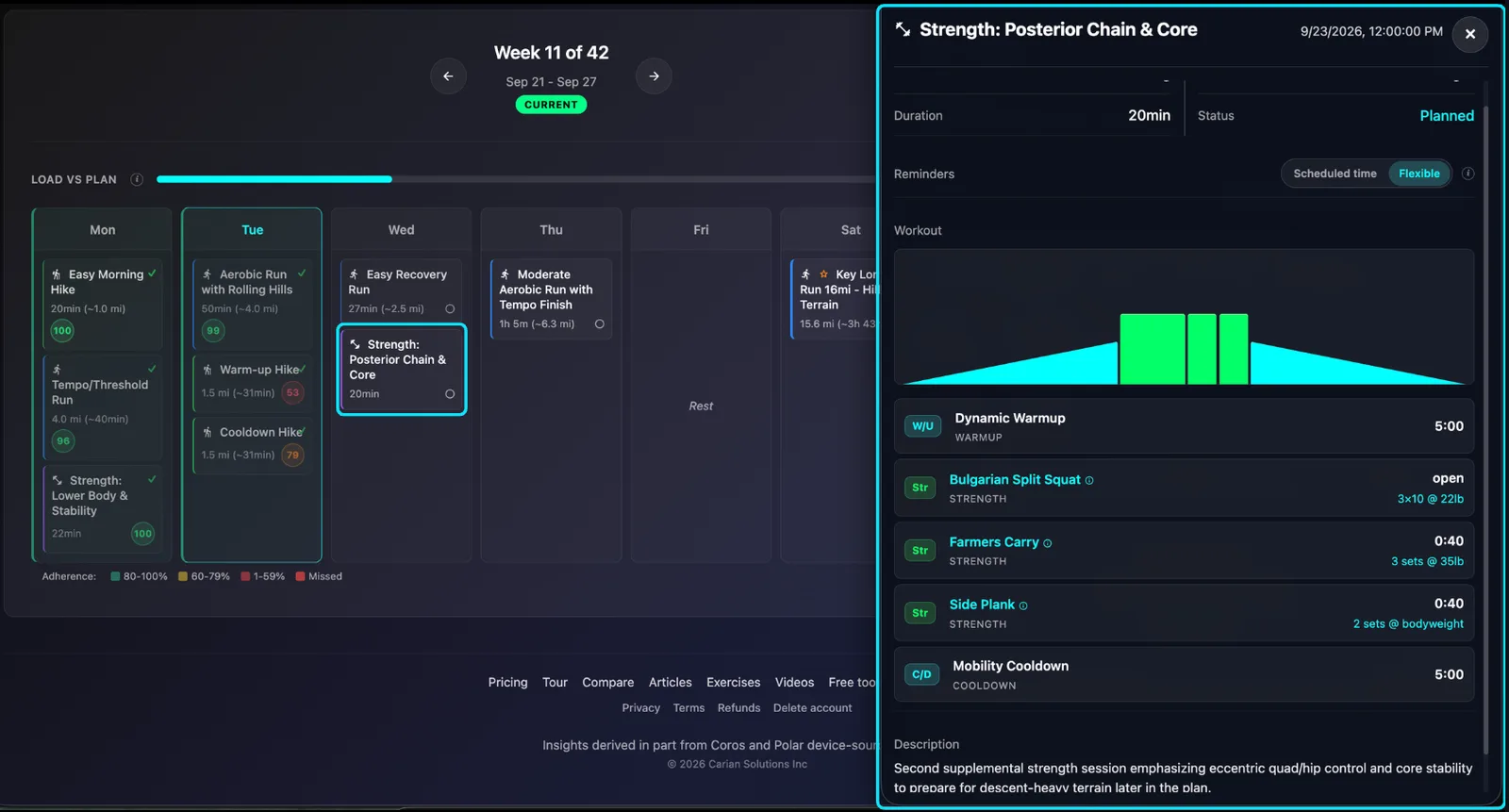
Fit PA's coach builds strength sessions into the same periodized plan as your running, not a separate program to remember, but rather a set of sessions in the same week, sequenced around your key runs the way the concurrent-training research above recommends. Every strength session pushes to your watch as a structured workout with cues, the same way an interval session does. When the plan re-casts around a missed week or a flare-up, your strength sessions re-solve with it instead of being the first thing quietly dropped. And the coach's sex-specific physiology guidance: fueling-adequacy vigilance, iron/ferritin risk flagging, masters-women strength and recovery emphasis, is built into the same coaching that sets your fueling targets, because the RED-S research above is exactly why strength, fueling, and recovery can't be three separate decisions for female athletes especially.
It won't hand you a lifting course to watch. Fit PA isn't a form-demonstration library, and we won't pretend it is. What it does is make sure the strength work the research says matters actually survives contact with a real training block: programmed, sequenced, adapted, and connected to the fueling and recovery it depends on from a coach that costs a fraction of what a human ultra coach runs, and explains every call it makes.
Start free for 14 days. Build your plan with the coach and see the strength sessions land in your week.
Sources
- Støren, T. et al. (2008). Maximal strength training improves running economy in distance runners. Medicine & Science in Sports & Exercise, 40(6), 1087–92.
- Rønnestad, B.R. & Mujika, I. (2014). Optimizing strength training for running and cycling endurance performance. Scandinavian Journal of Medicine & Science in Sports, 24(4), 603–12.
- Vikmoen, O., Raastad, T., Seynnes, O., Bergstrøm, K., Ellefsen, S. & Rønnestad, B.R. (2016). Effects of heavy strength training on running performance and determinants of running performance in female endurance athletes. PLOS ONE, 11(3), e0150799. (Verified directly: found no change in running economy or patellar tendon stiffness — reported in this piece as a dose/duration lesson, not a positive economy finding.)
- Esteve-Lanao, J. et al. (2008). Running-specific, periodized strength training attenuates loss of stride length during intense endurance running. Journal of Strength and Conditioning Research, 22(4), 1176–83.
- Beattie, K. et al. (2017). The effect of strength training on performance indicators in distance runners. Journal of Strength and Conditioning Research, 31(1), 9–23.
- Blagrove, R.C., Howatson, G. & Hayes, P.R. (2018). Effects of strength training on the physiological determinants of middle- and long-distance running performance. Sports Medicine, 48(5), 1117–49.
- Sports Medicine (2024). Effect of strength training programs in middle- and long-distance runners' economy at different running speeds — systematic review with meta-analysis.
- Fletcher, J.R., Esau, S.P. & MacIntosh, B.R. (2010). Changes in tendon stiffness and running economy in highly trained distance runners. European Journal of Applied Physiology, 110, 1037–46. (n=12 male runners; isometric calf/plantarflexion protocol, 8 weeks.)
- Lauersen, J.B., Bertelsen, D.M. & Andersen, L.B. (2014). The effectiveness of exercise interventions to prevent sports injuries. British Journal of Sports Medicine, 48(11), 871–77.
- PMC (2024). Do exercise-based prevention programs reduce injury in endurance runners? Systematic review and meta-analysis.
- Warden, S.J., Edwards, W.B. & Willy, R.W. (2021). Preventing bone stress injuries in runners with optimal workload. Current Osteoporosis Reports, 19(3), 298–307.
- Maunder, E., Seiler, S., Mildenhall, M. et al. (2021). The importance of "durability" in the physiological profiling of endurance athletes. Sports Medicine, 51(8), 1619–28. (Full author list beyond the first three not independently re-confirmed — verify on Springer before print.)
- Sports Medicine review (2020). Downhill running: what are the effects and how can we adapt?
- Hickson, R.C. (1980). Interference of strength development by simultaneously training for strength and endurance. European Journal of Applied Physiology and Occupational Physiology, 45(2–3), 255–63.
- Frontiers in Sports and Active Living (2025). The effects, mechanisms, and influencing factors of concurrent strength and endurance training with different sequences.
- Ansdell, P. et al. (2020). Do sex differences in physiology confer a female advantage in ultra-endurance sport? Sports Medicine.
- Strength & Conditioning Journal (2025). Evidence for periodizing strength and/or endurance training to the menstrual cycle.
- PMC (2024). Female Athlete Triad and Relative Energy Deficiency in Sport (REDs): nutritional management.
- Štohanzl, M., Baláš, J. & Draper, N. Effects of minimal dose of strength training on running performance in female recreational runners. Journal of Sports Medicine and Physical Fitness.
- Rio, E. et al. (2015). Isometric exercise induces analgesia and reduces inhibition in patellar tendinopathy. British Journal of Sports Medicine, 49(19), 1277–83. (Small trial: n=6 volleyball players, not runners — mechanism, not a running-specific result.)
- Sims, S. ROAR (2016, updated 2024) and Next Level (2021) — female-athlete-specific training and physiology.
- Koop, J. — CTS / TrainRight: "Why Strength Training Won't Make You a Faster Ultramarathon Runner" and "How to Implement Heavy Strength Training for Runners."