

Ultra-Trail Cape Town 100 Miles: What the Course Teaches Every Ultrarunner
The 100-mile field of RMB Ultra-Trail Cape Town started at 5:00 pm Cape Town time on Friday, November 20, 2026 (7:00 am Pacific), and runners are out on the mountains right now. Entries are closed, so this guide is for everyone cheering from home and for anyone who wants this race, or one like it, on a future calendar. You do not need to be running UTCT to use this. The course is a textbook of what a mountain 100 asks of you: where the climbing sits, how steep it gets, how tight the cutoffs are and what that means for your training, fueling and pacing. Every lesson below ends with something you can put into practice this week.
In this guide
- Why the first 70 km decide the race, and how to pace for it
- What to do on climbs that average 25% to 28%
- How to train your legs for downhills that can drop 2,470 ft (753 m) in one stretch
- Why average pace is the wrong number for cutoffs, and the one to use instead
- A fueling, strength and night-running checklist you can start now
- How Fit PA turns a race like this into a plan built around your watch data and your calendar
The race at a glance
| Detail | Official figure |
|---|---|
| Distance | 163 km (about 101 miles) |
| Climbing | 7,187 m (23,579 ft) |
| Time limit | 45 hours |
| Aid stations | 14 |
| Start and finish | Gardens Rugby Club, Cape Town |
| Start time | Friday 5:00 pm local time |
| Qualifier | A 50 km or longer trail race finished in the 24 months before race day |
| Pacing | Allowed from Llandudno to Alphen (105.7 km, about 65.7 miles). Up to three pacers, one at a time |
| Honey Badger medal | For finishing in under 30 hours. Only 43 people have earned it, and 5 of them more than once |
Climbing works out to about 44 m per km, or roughly 233 ft per mile, held for up to two days. Several sources list slightly different climbing totals for this race, so this guide uses the official figure on the Fit PA UTCT 100 Miles race page. The GPX file the organizer published measures 161.4 km and 6,834 m of gain, so the course numbers below, which come from that file, are estimates of the shape of the race, not official splits. Want the full course breakdown? The UTCT 100 Miles race page on Fit PA has the elevation profile, 3D flyover, biggest climbs and descents, GPX download, a pacing table for your finish goal and a race time predictor.
A city between mountain and two oceans
UTCT begins at Gardens Rugby Club, beneath Table Mountain, and within minutes runners are climbing toward Kloof Corner on the mountain's north face. From there the course leaves the city behind and works south along the Cape Peninsula. It passes through Silvermine, drops to the False Bay shoreline at Kalk Bay and Simon's Town, then crosses to the Atlantic side at Kommetjie and Noordhoek. Runners see both the Indian and Atlantic coastlines, with fynbos-covered mountain slopes, quiet southern suburbs and long stretches of open trail in between. The last climb goes from the University of Cape Town up to the King's Blockhouse, then a contour path winds back down to Gardens Rugby Club, where a warm welcome waits.
Lesson 1: The first 70 km set up the whole race
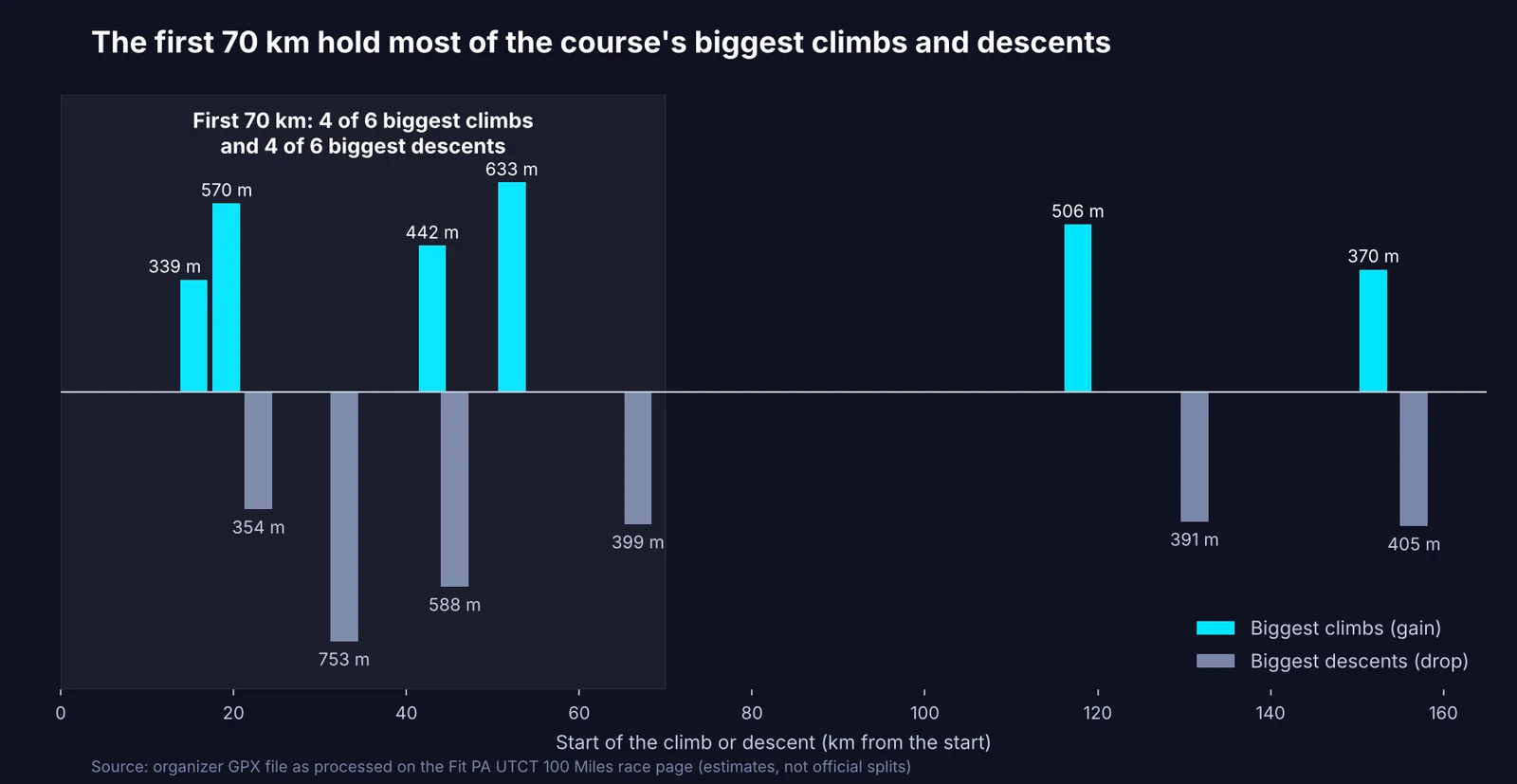
What the course shows. Using the organizer's GPX file, four of the six biggest climbs and four of the six biggest descents start before the 70 km mark. The 570 m climb at 19.2 km averages 28%. The longest descent, 753 m over 5.1 km, begins at 32.8 km. The biggest single climb (633 m over 5.5 km) starts at 52.2 km.
| Biggest climbs | Starts at | Length | Gain | Avg grade |
|---|---|---|---|---|
| 1 | 52.2 km | 5.5 km | 633 m (2,077 ft) | 11.5% |
| 2 | 19.2 km | 2.0 km | 570 m (1,870 ft) | 28% |
| 3 | 117.7 km | 2.0 km | 506 m (1,660 ft) | 25.1% |
| 4 | 43.0 km | 1.7 km | 442 m (1,450 ft) | 26.5% |
| 5 | 151.9 km | 2.3 km | 370 m (1,214 ft) | 16.4% |
| 6 | 15.4 km | 2.3 km | 339 m (1,112 ft) | 15.1% |
What it means for you. The damage in a mountain 100 is often done in the first third, when you feel strongest and the pace feels easy. A second block of hard terrain waits late: a 25% climb at 117.7 km, a 16% climb at 151.9 km, then a 4.5 km descent from 156.6 km. If you spend your legs early, you will meet those late climbs with nothing left. Put it into practice
- Plan your first third by effort, not by pace. Use a heart rate or perceived effort ceiling you could hold for 12 hours, and hike every climb steeper than your plan allows.
- Look at the biggest climbs and descents of any race you enter before you taper, and write the kilometer marks on your pace band or phone notes.
- Train the late-race version of the same terrain: run a hard climb at the end of a long run, not the start.
Lesson 2: When it hits 25%, hike
What the course shows. The steepest grade in the file is 45%. Three of the six biggest climbs average between 25% and 28%.
What the research says. For most people, walking is more efficient than running on slopes steeper than about 15 degrees (roughly a 27% grade). The same group found that on slopes between 20 and 35 degrees, running and walking cost nearly the same energy at the same vertical speed, and that sub-elite athletes can climb very steep slopes faster by walking. On a 30 degree incline, walking cost less than running at slow speeds.
What it means for you. On a 25% climb you are not choosing between fast and slow. You are choosing between spending more energy to go the same speed and saving it. Power hiking is a skill, and the runners who are good at it save legs for the descents and the second night.
Put it into practice
- Once a week, find a climb that averages 20% to 30% and hike it with intent: short, quick steps, hands on thighs or poles if the race allows them, steady breathing.
- Use your watch's grade field to learn what 15%, 25% and 35% feel like.
- Practice the handoff: hike the steep section, then start running again the moment the grade eases.
Lesson 3: Downhills are where legs are lost
What the course shows. The biggest descent drops 753 m (2,470 ft) over 5.1 km, and another drops 588 m (1,929 ft) a few kilometers later. Both are finished before the 51 km mark. The last descent, 405 m over 4.5 km, comes after more than 150 km on your legs.
What the research says. Downhill running is eccentric work, and a 2020 narrative review in Sports Medicine found it causes lower-limb muscle damage that can affect running performance for several days. A 2026 study of trail runners describes that muscle damage as a main performance-limiting factor in mountain running, and notes that prior exposure to downhill running reduces markers of muscle damage and strength loss. A University of Cape Town study had runners do nine 40-minute runs at a 10% downhill grade: muscle pain and a muscle damage marker rose after the first run and did not increase further. One caution from the research: a repeated-bout effect reduced damage and strength loss in a 2022 study, but it did not clearly lower the energy cost of running. Downhill training protects your legs. It does not make descending free.
What it means for you. You cannot build downhill durability the week before the race. Eccentric load has to be added gradually, early, and then backed off before the taper. Put it into practice
- Start with one short, controlled downhill block each week (for example, 3 to 5 repeats of 5 minutes) on a grade you can handle with good form, and add repeats before you add steepness.
- Run downhill on trails, not only road, so your feet and ankles learn to adjust.
- Back off downhill volume in the final 2 to 3 weeks so you arrive fresh, not sore.
Lesson 4: Average pace is the wrong number for cutoffs
What the course shows. Fit PA's race page calculates that finishing in the full 45 hours means an average pace of 16:34 per km (26:39 per mile). That sounds generous. But the tightest checkpoint is Kloof Nek, 16.1 km from the start, where runners must leave by 8:30 pm on Day 1, a required pace of 13:00 per km (20:56 per mile) through the first big climb. The tightest leg is Simon's Town to Noordhoek: 25.4 km in 4 hours 45 minutes, or 11:14 per km (18:05 per mile).
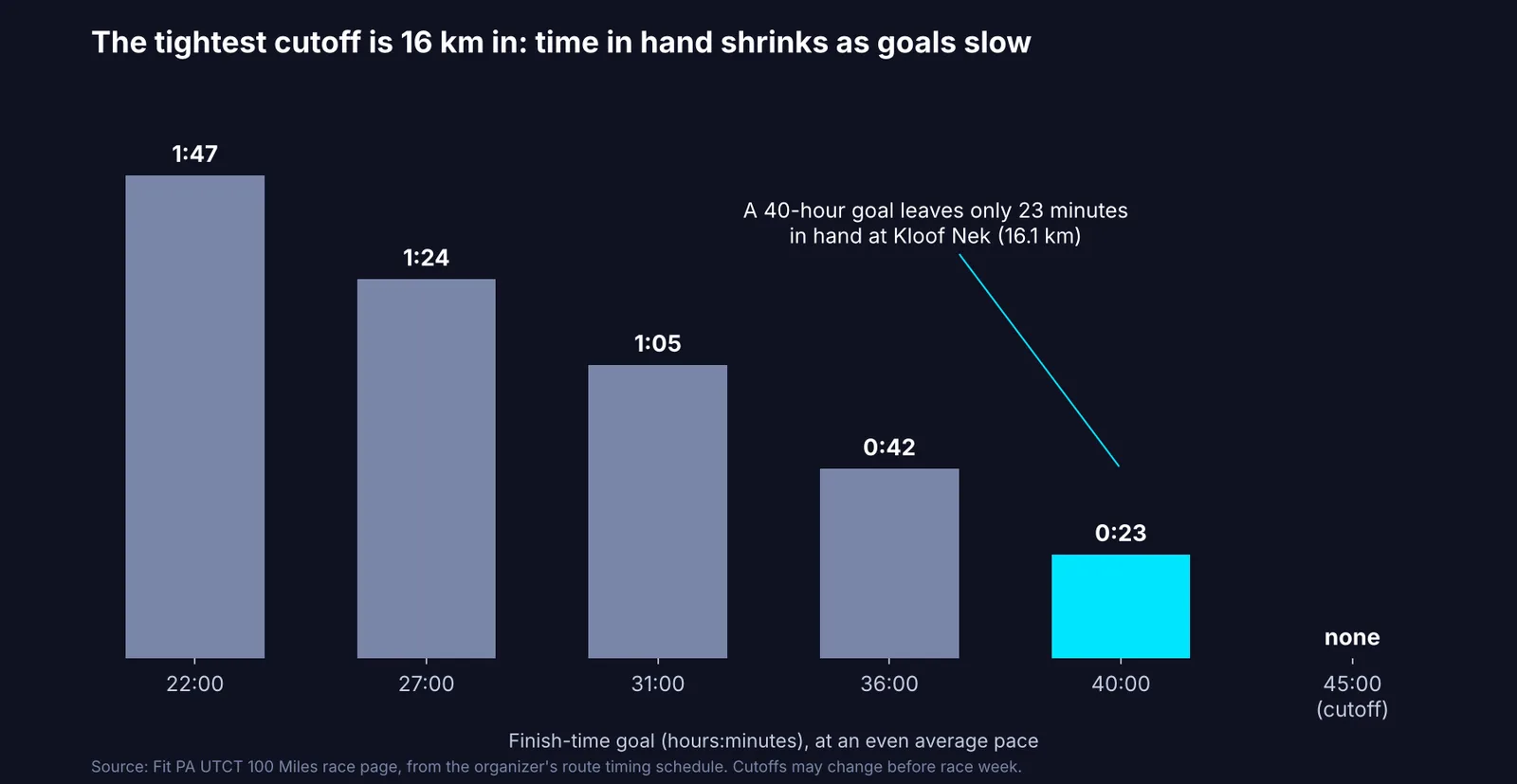
| Finish goal | Average pace | Time in hand at the tightest checkpoint |
|---|---|---|
| 22:00 | 8:06 /km (13:02 /mi) | 1:47 |
| 27:00 | 9:56 /km (16:00 /mi) | 1:24 |
| 31:00 | 11:25 /km (18:22 /mi) | 1:05 |
| 36:00 | 13:15 /km (21:20 /mi) | 0:42 |
| 40:00 | 14:43 /km (23:42 /mi) | 0:23 |
| 45:00 (cutoff) | 16:34 /km (26:39 /mi) | none |
Figures are Fit PA's calculations from the organizer's route timing schedule at an even average pace. Checkpoint cutoffs may change before race week.
What it means for you. Someone aiming for a 40-hour finish has only 23 minutes in hand at the tightest checkpoint if they run an even average pace. The risk is not the clock at the end. It is the clock at the start, when the course is steep, it is getting dark, and there is little room to start slowly.
Put it into practice
- Write your cutoff times for the first three checkpoints on your pace band, not just your goal finish time.
- Test your power hiking pace on steep terrain so you know what your real speed is on a 25% grade, not what you hope it is.
- Use a finish-time scenario table, like the one on the race page, to see how much buffer each goal gives you at the hardest point.
Lesson 5: Fuel is a training adaptation too
What the research says. Carbohydrate recommendations for ultra-endurance events lasting more than about 3 hours go up to 90 g per hour of multiple transportable carbohydrates. A study of amateur ultra-distance runners found they averaged only about 33 g per hour during the event, well under that target. Research suggests the gut can be trained: in one study, practicing 90 g per hour daily for two weeks reduced stomach discomfort. Tolerance varies, and intake should be tailored to the individual runner. What it means for you. A 24 to 40 hour race is too long to "wing" fueling. If your stomach has never handled 60 to 90 g of carbohydrate per hour, race day is the wrong time to find out. Put it into practice
- Make every long run a fueling rehearsal: same products, same timing, same bottles.
- Build up gradually. If you manage 40 g per hour now, move to 50, then 60, before going higher.
- Track what you ate and how you felt, so you can spot patterns. If stomach problems persist, talk to a sports dietitian or doctor.
Lesson 6: Strength work makes every step cheaper
What the research says. A 2024 meta-analysis of 31 studies in 652 middle- and long-distance runners found heavy-load and combined strength training improved running economy, with plyometric training helping at speeds up to about 7.5 mph (12 km/h). The authors rated the certainty of the evidence as moderate to low, so treat it as a strong signal, not a guarantee. Put it into practice
- Two short sessions a week: single-leg squats or step-ups, calf raises, glute bridges or hip thrusts, and core work.
- Add a lighter plyometric block (skips, low box jumps) once your base strength is built.
- Keep strength in during the build phase. Drop volume, not the habit, in the final 2 weeks.
Lesson 7: Plan for the dark
A 5:00 pm start puts every runner into the night within hours, and a 45-hour limit means slower runners will see a second one. Navigation, temperature and sleep all change after dark. Put it into practice
- Do at least a few long sessions in the dark with your race headlamp and a backup light.
- Practice your night kit: a warm layer you can put on while moving, a wind shell, and gloves.
- Read our guide to night navigation, trail naps and hallucinations from another desert 125, and rehearse your sleep plan at home.
Lesson 8: Make the pacer part of the plan
Pacing is allowed from Llandudno to Alphen, a 105.7 km (65.7 mile) stretch. Runners may use up to three pacers in total, one at a time. Put it into practice
- Pick your pacers early and run with them in training so they know your pace, your food and your low moments.
- Give each pacer a one-page brief: your fueling schedule, your warning signs, and what you want them to do (and not do) when you are struggling.
- Agree on a plan for the hand-off points so nobody waits in the dark.
Wind and weather
November in Cape Town averages a high near 75°F (24°C) and a low near 59°F (15°C) (Beach-weather.com). The prevailing summer wind is the southeaster, and a hot berg wind from the interior can push temperatures toward 104°F (40°C) (Cape Town Tourism). Gusts around 39 mph (63 km/h) were forecast in late November 2025 (EWN). Carry a wind layer even on a warm day, and train in wind if you can.
A 28-week training shape
This is a common ultra coaching structure, not a prescription. Adjust it to your history, and check with a qualified professional before changing your training if you are managing an injury or health condition.
- Weeks 1 to 8, base. Build easy aerobic volume and consistency. Add two strength sessions a week and start regular hill walking.
- Weeks 9 to 20, build. Lengthen the weekend long run, add back-to-back long days, and raise weekly climbing step by step. Add the weekly steep hike and controlled downhill block. Race a 50 km or longer trail event as a tune-up. It also satisfies the qualifier if you still need one.
- Weeks 21 to 25, specific peak. Do your biggest training weekends, rehearse race-day fueling and kit, and run at night.
- Weeks 26 to 28, taper. Cut volume while keeping some short, sharper efforts, reduce downhill load, and prioritize sleep.
Your prep checklist
- Know your cutoffs for the first three checkpoints, not only your finish goal
- Hike a 20% to 30% climb every week
- Add a controlled downhill block weekly, then back off before the taper
- Practice your race fueling on every long run
- Two strength sessions a week through the build
- Several long runs in the dark with your race lights and layers
- Brief your pacers, and run with them at least once
- Pack a wind layer, and test it in wind
How Fit PA helps you train for a race like this
A generic 100-mile plan cannot know where your race is hardest. Fit PA builds your plan around the actual race, and your actual training.
- A race page with the numbers that matter. The UTCT 100 Miles page shows the elevation profile and 3D flyover, the biggest climbs and descents, the checkpoint pacing and finish-time scenarios from this guide, the GPX file and a race time predictor.
- "Train for this race" in one tap. Open the race page and tap the button to load the event into your coach. The coach uses your goal, your watch data and your available hours, plus the race's elevation gain and technicality, then refines the plan with you in conversation until you agree.
- Hard and easy built in. The coach spaces hard sessions and builds in strength, mobility or cross-training where your plan needs them.
- A plan that adapts. Your plan changes as your training does, based on your activities and biometrics, and you can ask the coach questions any time. If you report a niggle, it goes in your health file and stays in view in future chats.
- Fueling practice in one place. Nutrition tracking includes fluid intake and timing-aware fueling around big efforts, which helps with back-to-back long days.
- Works with your watch. Fit PA connects with Garmin, Coros, Suunto, Polar, Apple Watch and Health Connect, and pushes workouts back to supported devices.
- Start free. Your first plan is free, with no card required to get started.
Open the UTCT 100 Miles race page or start at app.fit-pa.com. Fit PA is a fitness coaching tool, not a medical device, and does not provide medical advice. If you are managing an injury or health condition, check with a qualified professional before changing your training.
Sources
- Fit PA UTCT 100 Miles race page: official distance, climbing, cutoff, GPX-derived climbs, descents and pacing figures
- UTCT 100 miles official page: route, qualifier, pacing, Honey Badger medal
- ITRA race listing, UTCT 100 Mile 2026: event details
- Rio Times UTCT 2026 guide: festival dates and format
- Outside: uphill trail running research, CU Boulder: optimal inclines, CU Boulder: walking vs running steep slopes, Metabolic costs at 30 degrees (PubMed)
- Downhill running review, Sports Medicine 2020, Downhill-induced muscle damage in trail runners, 2026, UCT repeated downhill training study, Repeated bouts of downhill running, 2022
- Ultra runner carbohydrate study, Stirling, Amateur ultra-runner intake, Frontiers in Physiology 2021, Gut-training study summary, Ultra-runner nutrition, PMC
- Strength training and running economy meta-analysis, 2024
- Beach-weather.com Cape Town November averages, Cape Town Tourism summer tips, EWN weather report, November 26, 2025
Course climb, descent and pacing figures come from the organizer's published GPX file and route timing schedule as processed by Fit PA, and are estimates. Training guidance is general ultra coaching practice informed by the research above, not medical advice.