
More than 50 million Americans ran or jogged in 2024, up 5.7% year over year and breaking 50 million for the first time since 2020. Half marathon finishers grew 20.9% that year, the fastest-growing distance of the decade, and Gen Z is leading it: 69% competed in a running event in 2025, 76% plan to again in 2026. Most of this growth is beginners; races of 5K or shorter make up 54% of all events. And 40-44% of runners get hurt every year, almost entirely from overuse injuries, patellofemoral pain, medial tibial stress syndrome, Achilles tendinopathy, plantar fasciitis, caused by doing too much, continuously, before the body is ready. The fix for this isn't new, and it isn't a secret. Jeff Galloway's Run-Walk-Run method has been mainstream for decades, endorsed by physical therapists, licensed by Garmin, and used by hundreds of thousands of runners. What's strange is that the technology built to support it never fully caught up to what the method actually requires.
The Method, and the Man Behind It
Jeff Galloway, a 1972 US Olympian, developed Run-Walk-Run in 1974 while coaching beginners at Florida State. He noticed people who mixed short jogs with planned walk breaks, taken before fatigue set in rather than after, held together better than people trying to run every step. He proved it on himself at the 1980 Houston Marathon: at 35, he walked through every water stop and finished in 2:16:35, faster than his all-out win at Honolulu six years earlier, where he never walked at all. Over 500,000 runners have used the method through his direct coaching, with a 98%+ marathon completion rate. Galloway passed away on February 25, 2026, at 80, after a hemorrhagic stroke. He'd run more than 230 marathons across eight decades and was weeks from attempting to become the first person to complete a marathon in eight consecutive decades of life.
It's Not Just a Beginner's Tool. Elite Ultrarunners Use It Deliberately.
Nearly every non-elite runner finishing a 50 or 100-mile ultra uses some form of run-walk. Even elite trail runners walk the steep climbs, not out of necessity but because it's genuinely faster, walking is more energy-efficient than running at slower speeds, with running only becoming the more economical choice above roughly a 12-minute-mile pace. Ultra racers call this "power hiking": brisk, purposeful walking with active arm drive, typically at 130-160 steps per minute, a distinct cadence from both easy running and a casual stroll. The math behind it is stark: in a 100-mile race, improving walking pace from 20 minutes per mile to 15 saves more total time than improving running pace from 9 minutes per mile to 8. One widely cited calculation shows a runner covering the first 50 miles in 11 hours at a 20-min/mile shuffle for the back half finishes in 27.5 hours, but the same runner power-hiking at a 16-min/mile pace instead finishes in 26.5 hours, a full hour saved purely from optimizing the walk. That means an ultra athlete's watch has to make sense of three different cadences in a single activity, running, power-hiking, and standard walking, not two. A blended average doesn't just blur run from walk; at ultra distance it collapses three distinct efforts into one meaningless number.
The Research
Hottenrott et al. (2016), published in the Journal of Science and Medicine in Sport, randomly assigned 42 non-elite marathon runners to a run-walk strategy or continuous running. Finish times were statistically identical (4:14:25 vs. 4:07:40), but the run-walk group reported significantly less muscle pain afterward, with equivalent cardiac stress between the two groups. A separate 2023 study by Relph et al. followed 110 UK Couch-to-5K participants and found 19% sustained a musculoskeletal injury during the 9-week program, with a prior injury raising that risk more than sevenfold, a reminder of how concentrated injury risk is in exactly the population run-walk programs are built for.
Getting Started, and Why the Walk Breaks Actually Help
If you're new to running, start with 30 seconds of running to 30 seconds of walking, and don't worry about pace yet, worry about effort: you should be able to speak in full sentences during the run portion. Take the walk before you feel like you need it, not after. Stay at that ratio for 2-3 weeks before touching it. The mechanism isn't as simple as "walking is gentler." Research comparing injured and healthy runners has found impact-related loading rates 15-20% higher in injured runners overall, and specifically elevated in patellofemoral pain and plantar fasciitis, two of the most common running injuries (Davis et al.). But a 2023 review in the Journal of Biomechanics found the broader link between impact forces and running injury in general is only weakly to moderately supported, so impact reduction alone doesn't fully explain why the method works.
The stronger explanation is fatigue management. Walk breaks keep your effort below the point where your running form starts to break down, and that breakdown, not the walking itself, is where injury risk actually concentrates. This is the same reasoning behind why cadence fading late in a run segment is a meaningful early warning sign: fatigue changes form before it causes pain, and a structured walk break is what interrupts that process before it compounds.
How the Progression Actually Works
This is where most people, and most apps, get vague. Rather than a fixed pace-to-ratio formula, Galloway's own method starts with a "Magic Mile" time trial to establish current fitness, then applies a starting ratio, commonly 30 seconds run/30 seconds walk for newer runners, scaling up toward 4:1 or 8:1 for faster, more experienced ones, tested and adjusted on long runs rather than locked in from a chart.
Advancing the ratio follows a specific rule, not a fixed schedule: increase the run segment by about 30 seconds every 2 to 3 weeks, never advancing the ratio and total distance at once. Readiness to progress is judged by three things, in order of reliability: better heart rate recovery between intervals, a faster easy-pace run without more perceived effort, and lower effort at a pace that used to feel harder. If pace regresses or pain shows up, the rule is to drop back to the previous ratio, not push through.
Clinically, this same walk-run logic is the standard path back from injury. A widely used graded return-to-run protocol for bone stress injuries (Warden et al., 2016) prescribes a specific sequence: walk 9 minutes/jog 1 minute (x3), then walk 8/jog 2, then walk 7/jog 3, and so on, advancing only if the runner is symptom-free during the session, after it, and the following day, and regressing a full stage if symptoms return. This isn't a beginner's crutch; it's the same graded walk-run logic sports medicine uses to bring injured competitive athletes back.
Garmin Licensed the Method. Users Say It Doesn't Fully Run It.
Garmin has offered official Run-Walk-Run plans authored by Jeff Galloway himself since 2018. In practice, actual users report a gap between the plan and the execution:
- A runner 10 weeks into a Garmin half-marathon Galloway plan: "I am getting bored... is this correct? I thought I'd be doing different types of runs by now."
- A confirmed bug prescribing 30+ km long runs on a half-marathon plan, distances appropriate for full marathon prep.
- Most directly, a forum thread titled "Garmin Coach has a Run Walk Run training plan (author: Coach Jeff) but doesn't implement the Run/Walk intervals in the Run Walk Run workouts even though that's the core part of the whole training approach," where users describe manually timing their own walk breaks with a stopwatch.
The Cadence Gap Nobody Fixed
Average recreational running cadence sits around 150-170 steps per minute at easy effort. Walking cadence runs meaningfully lower, and as shown above, power-hiking sits somewhere in between. Blend all of that into one "average cadence" and the number reported tells you almost nothing about what you actually did. A Garmin forum user, training with Galloway's method, described this exact problem more than a decade ago:
"my average Cadence on a recent run was 159; however, that is distorted by the slow cadence that I have during my walk breaks... It seems that Connect could upload the run/walk alert data and use that to compile this more accurate information."
Garmin's reply: "This may not be a satisfying answer, but I count my steps." The feature was never built.
Why This Actually Matters
Progression, by the framework above, is judged by comparing your run segments to your run segments over time. A blended cadence number moves whenever your ratio changes, for reasons that have nothing to do with whether your running actually improved. And cadence fading within a run segment as fatigue sets in is an earlier warning sign of gait breakdown than stride length, a signal that disappears entirely once it's averaged with walk-pace data.
How This Actually Works in Fit PA
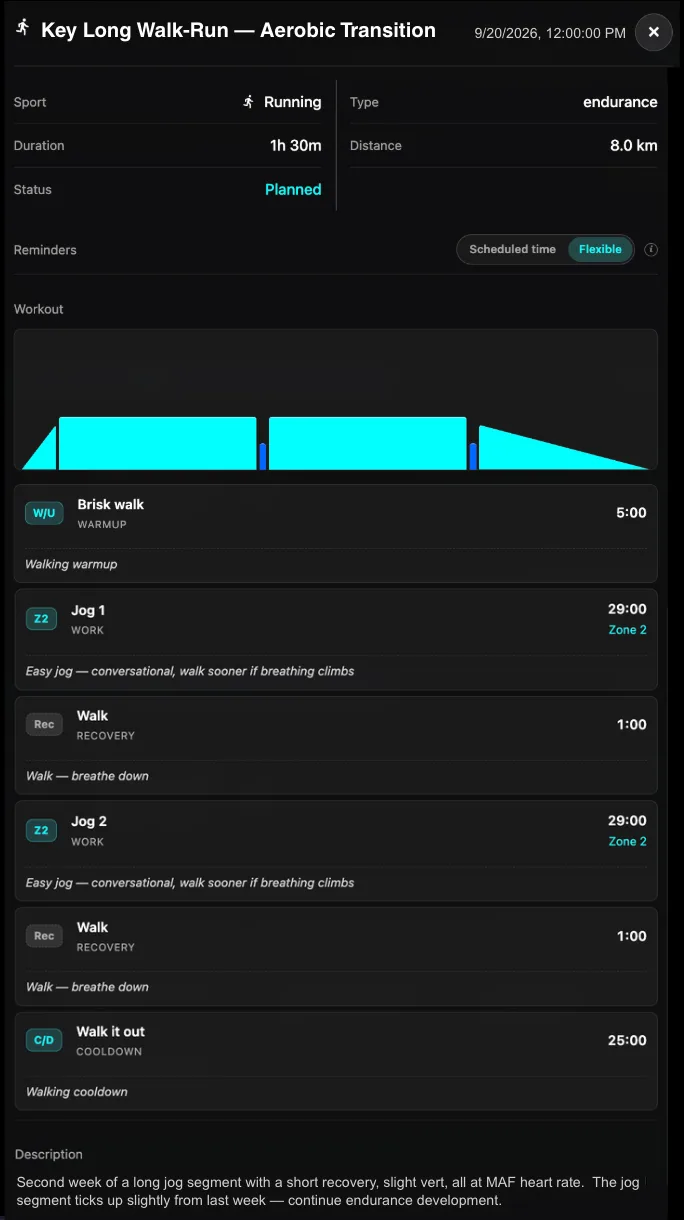
You don't need to know any of the terminology above to start. You tell the coach your goal, distance and timeframe, and whether you're starting from zero, coming back from an injury, or training for an ultra where walking is part of the strategy, and it builds a run/walk structure around that conversation rather than handing you a fixed template off a shelf.
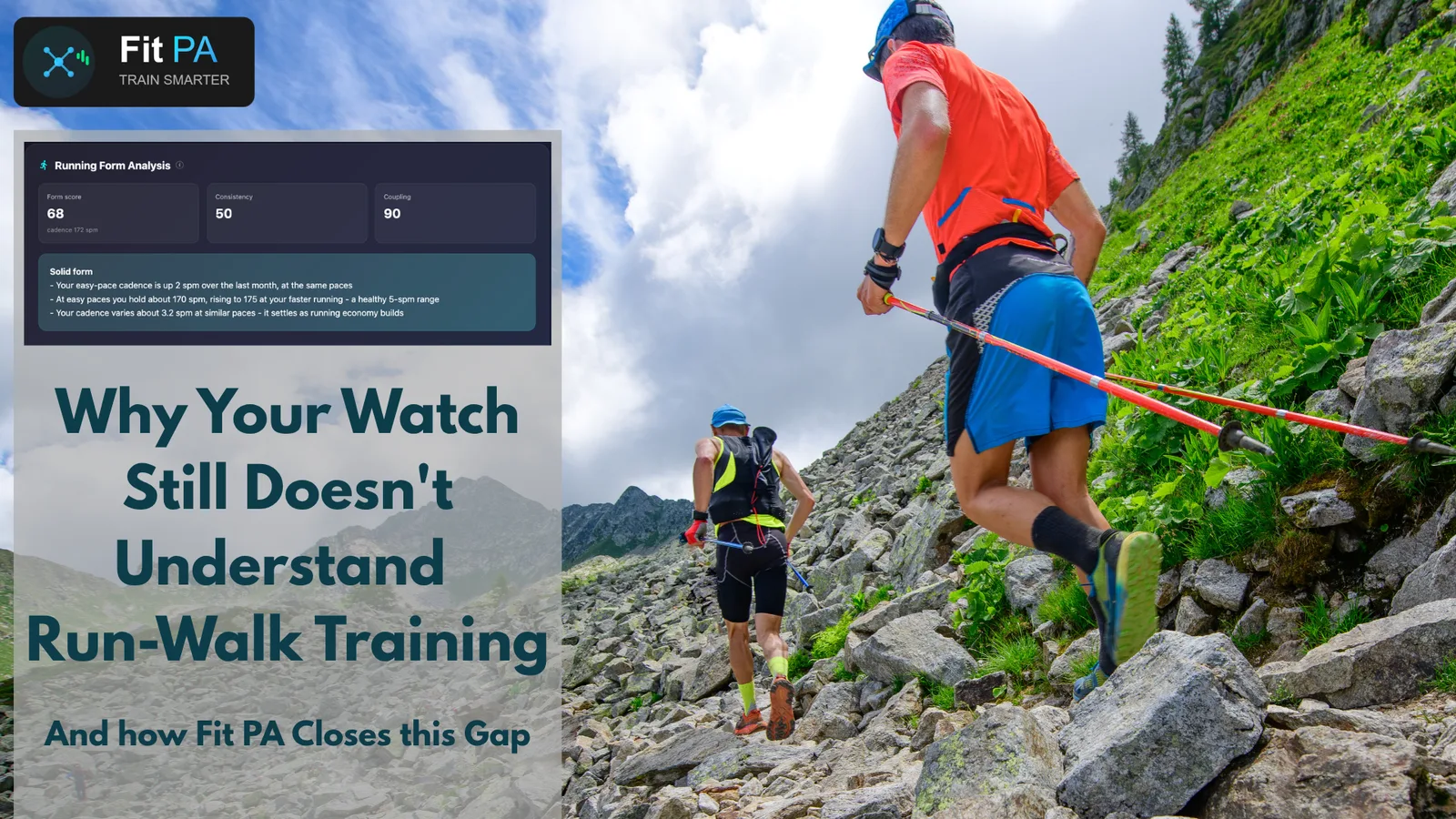
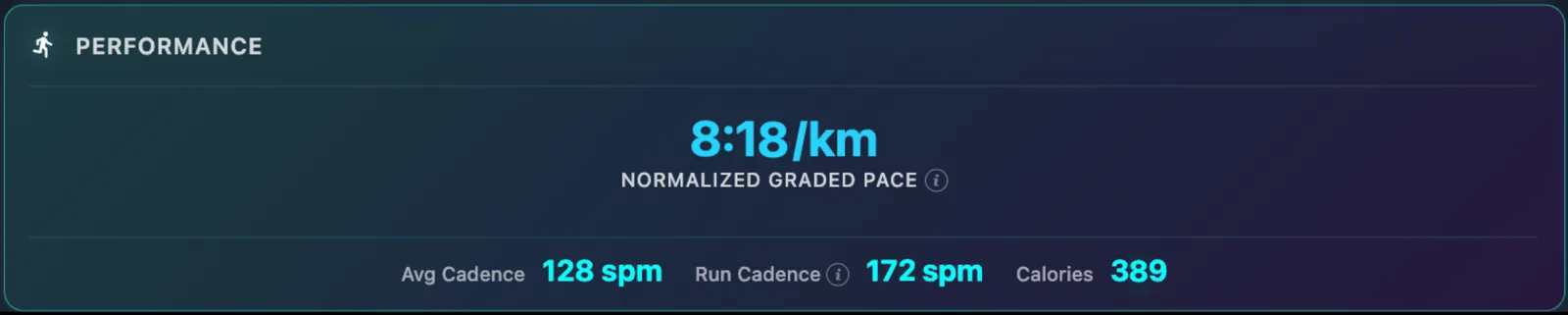
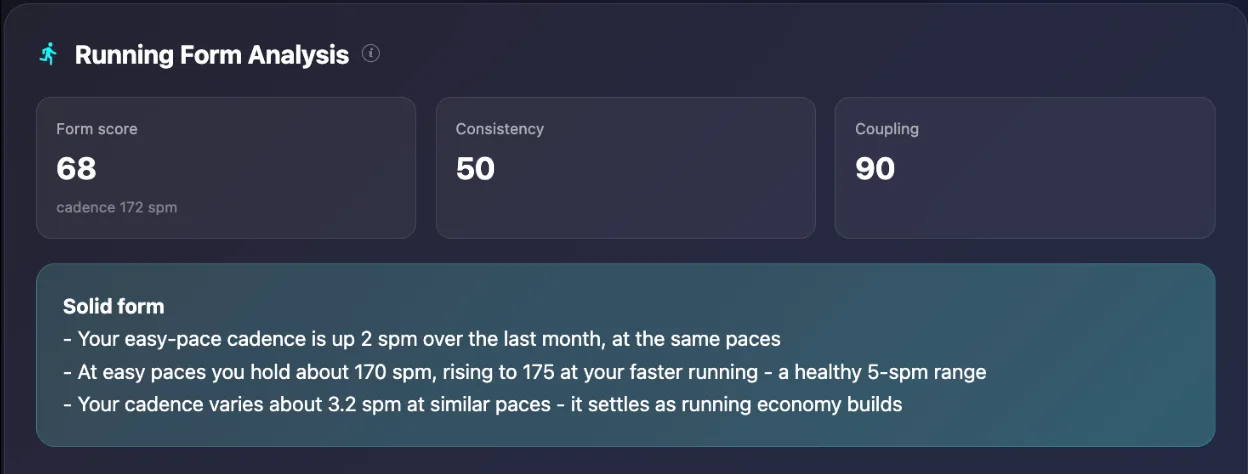
From there, the coach tracks the same readiness signals the research above points to. Take a real 8km walk/run session: the activity's blended average cadence reads 128 spm, but the isolated run-only figure is 177 spm, a 49-step gap a merged number would have hidden entirely. Fit PA's Form Analysis goes further than isolating that number: it scores Coupling (how cadence responds to your own pace changes), Consistency (how tightly cadence holds at a given pace), and cadence drift, all measured against your own running specifically, walk breaks excluded, rather than a one-size-fits-all target. The output reads like a coach's note, not a dashboard: "your easy-pace cadence is up 2 spm over the last month, at the same paces... it settles as running economy builds." That's the exact "compare your run segments to your run segments over time" logic the progression research above depends on, shown as a real, working feature.
For someone training for an ultra, the same tracking distinguishes power-hiking from casual walking and from running, so the plan and the data both reflect what an ultra actually demands, not a road-race template stretched to fit. The method has been proven for fifty years. The tracking behind it is what's new. See how Fit PA reads the whole picture, run, walk, and everything in between, at app.fit-pa.com.