

How Much Downhill Is Too Much? What the Research Says About Training Vert
Training Science: Climbing, Descending and Recovery for Mountain Ultras
If you are building toward a mountain race, you have probably asked it: how much climbing and descending can I stack before it stops helping? We dug through the research to find out. The honest answer is that no study has found the exact line. But the studies that exist add up to a practical way to train, and a simple check that tells you when you are pushing too far.
The quick take
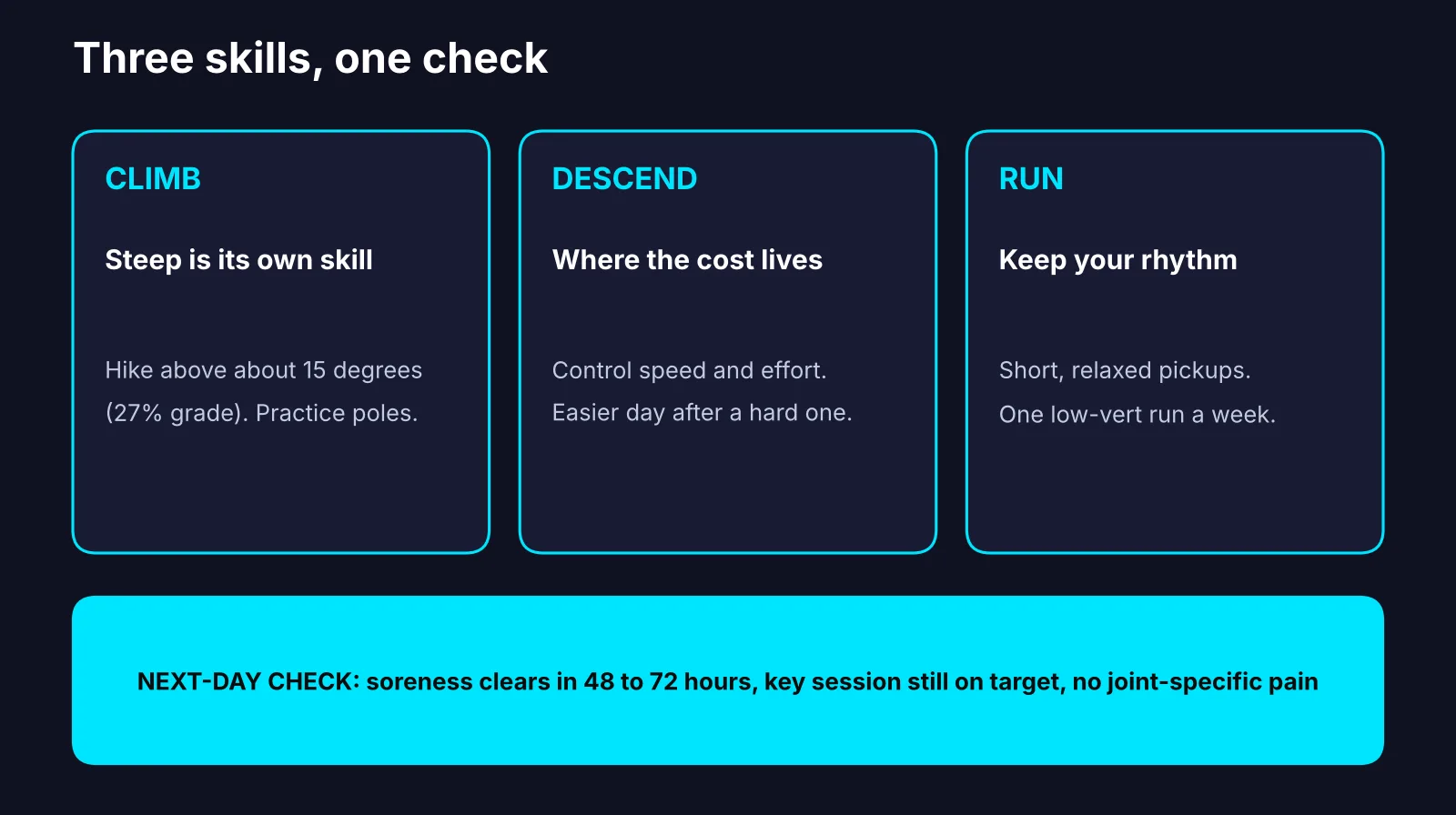
- Total vert is a blunt number. Climbing, descending and flat running load your body in different ways, so track all three, not just one weekly total.
- Steep climbing is its own skill. For most people, walking beats running on very steep grades. Hike them, and practice with poles.
- The recovery cost lives in the downhills. Soreness adapts after a few exposures. Strength loss and fatigue do not fully go away, so feeling fine is not the same as being recovered.
- Keep some flat running in the mix. It is the least-studied piece, but it keeps your rhythm from fading.
- Use the next-day check. If soreness clears in two to three days and your next key session still hits its targets, your mix is working.
Why this matters for big mountain races
Take Cocodona 250 as an example. The 2027 course is 253.5 miles (408 km) with 38,943 ft (11,870 m) of climbing and 34,039 ft (10,375 m) of descending over a 125-hour limit, using the official figures on the Fit PA race page. That works out to about 154 ft of climbing per mile (29 m per km) and 134 ft of descending per mile (25 m per km), on average, with a steepest grade of 31 percent. The biggest single descent comes late: 2,310 ft (704 m) over 2.5 miles (4 km) at an average 17.7 percent grade, starting around mile 245. Two things follow from those numbers. First, descending is almost as big a part of the race as climbing. Second, on an out-and-back training route you cannot climb without descending, so every foot you gain you also give back. Whatever your race, the question is the same: how do you build the legs for both without breaking them down?
Lesson 1: Total vert is a blunt number
Weekly vertical gain is the number most trail runners track. It is also the number with the least research behind it. Here is what we found:
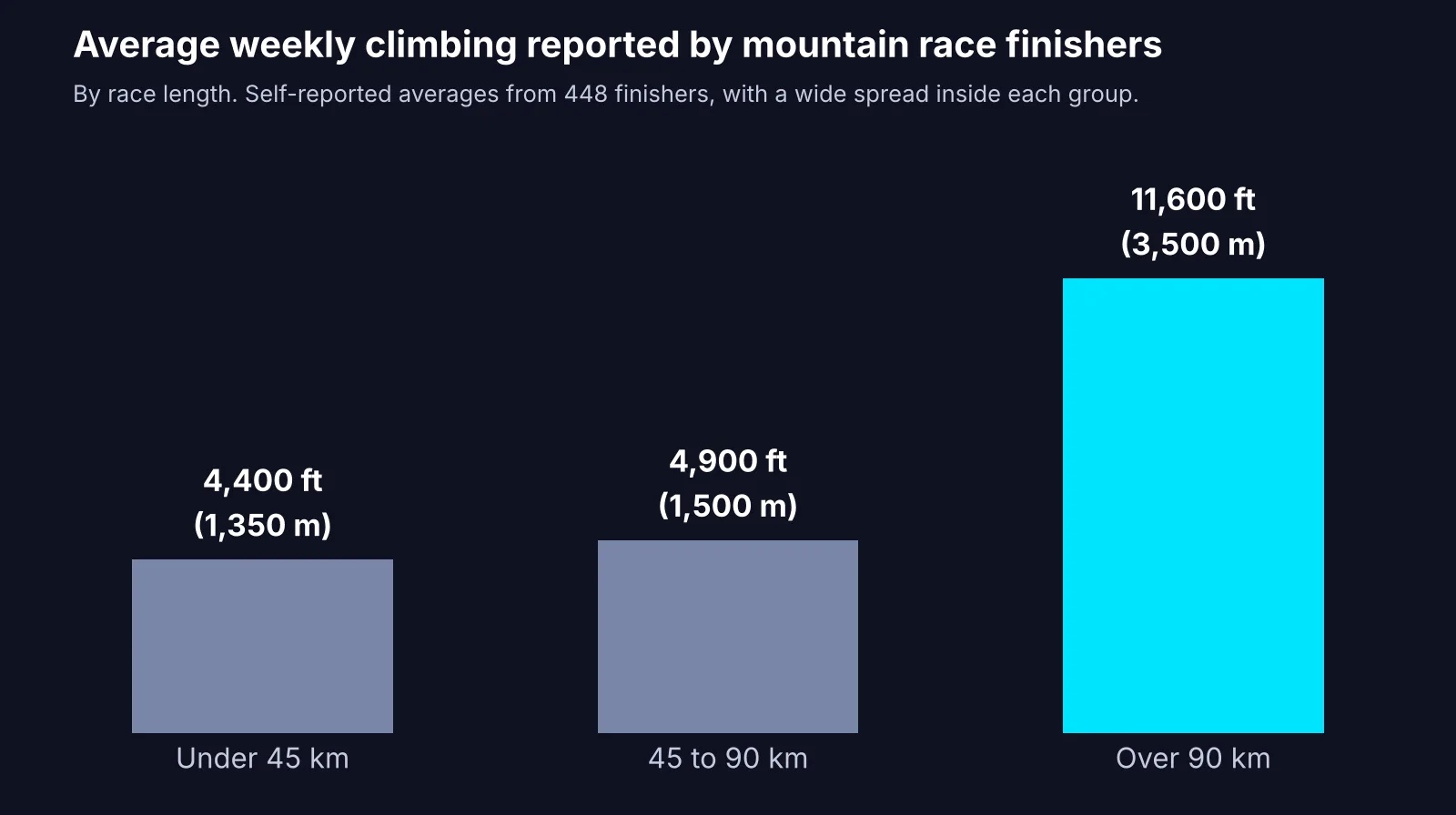
- A survey of 448 mountain race finishers found that those training for races over 90 km (56 miles) reported about 3,500 m (11,600 ft) of weekly climbing on average, compared with roughly 1,350 m (4,400 ft) and 1,500 m (4,900 ft) for the shorter groups. The spread was wide, the data were self-reported, and weekly climbing did not clearly separate faster from slower finishers within a group.
- In a cohort of 697 trail runners, injury risk was higher with lower weekly training volume and lower yearly elevation gain. In other words, more vert went with fewer injuries. The authors note that a harmful threshold may exist and should be studied. These are observational data, and experienced runners may simply train more and handle it better.
- Trail runners with high weekly climbing (a median of about 2,500 m, or 8,200 ft) had thicker Achilles tendons than road runners, but no difference in the patellar tendon. That suggests adaptation to uphill load, not a limit. The study did not analyze downhill running.
- Sudden jumps matter. In a cohort of runners, overuse injuries rose when a single session was more than 10% longer than the longest run of the previous 30 days. That study measured distance, not vert, but the lesson carries over.
Put it into practice
- Track climb per distance, not only total vert. Divide your weekly climbing by your weekly distance, in feet per mile or meters per km. Compare it with your race's average. For a 250-miler like Cocodona that is about 154 ft per mile (29 m per km).
- Treat spikes as spikes. If one session has far more vert than anything you have done in the last month, plan the next day easier.
- Build vert and miles on different weeks. Raising both at once makes it hard to tell what is causing fatigue.
Lesson 2: Steep climbing is its own skill
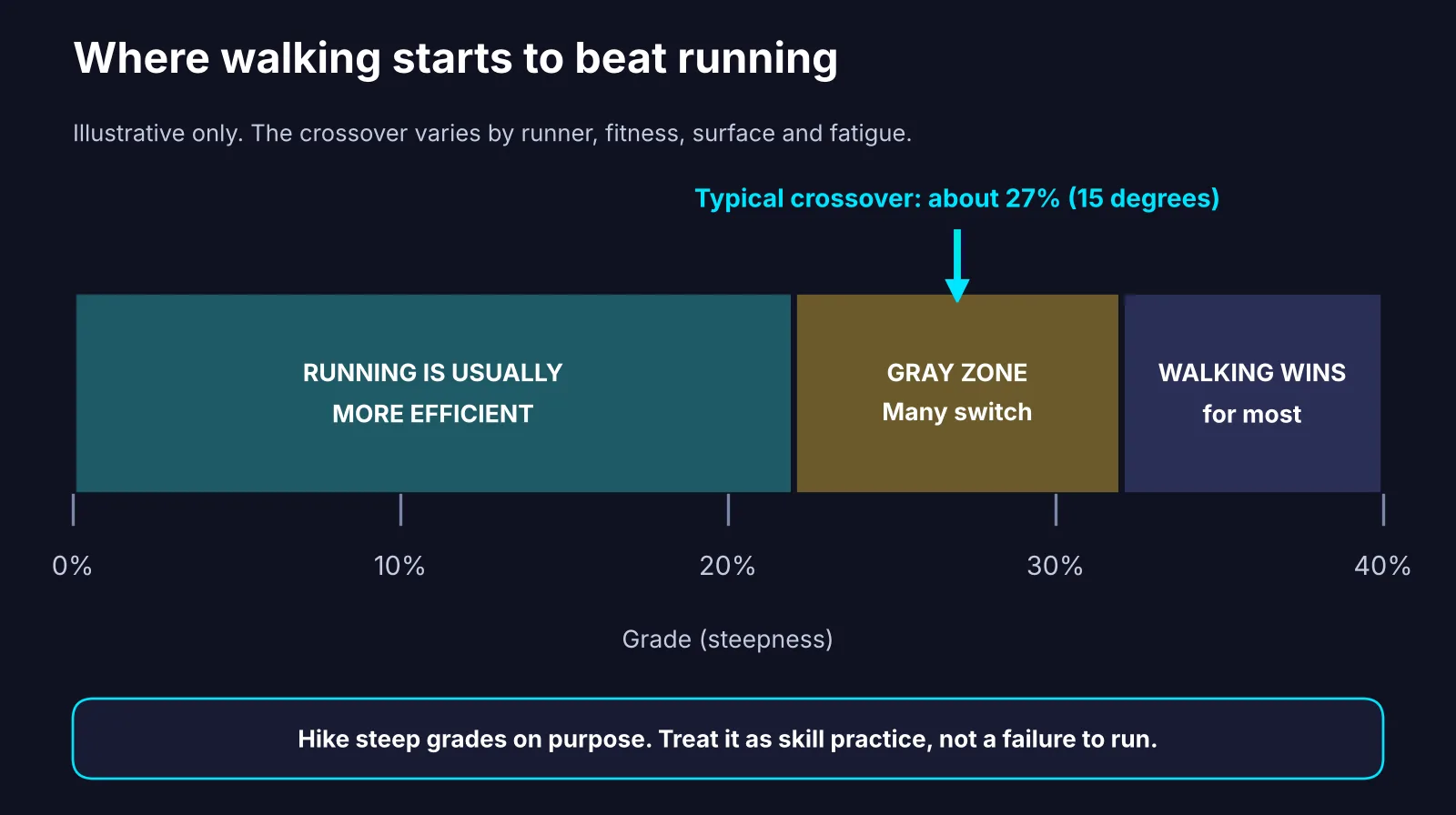
On steep grades, running and hiking become different movements. For most people, walking is more efficient than running above roughly 15 degrees, which is about a 27 percent grade. Elite runners can run somewhat steeper, but everyone eventually reaches a point where walking wins.
Two other findings matter for training:
- Running economy on steep slopes (around 20 percent) is not well predicted by running economy on level or shallow ground. Steep climbing behaves like a separate skill that needs its own practice.
- Incline treadmill training improved parts of running economy in well-trained runners, but it was not enough on its own as strength training.
Poles are worth practicing early. In one study of 15 trail runners, poles reduced the force through the feet on steep uphill walking without changing the metabolic cost. Another found that after a simulated trail race, walking without poles cost about 2.5 percent more energy than walking with them. The savings are small, but the idea is that they spare your legs.
There is also encouraging news for fatigue. After a 330 km (205 mile) race with about 24,000 m (78,700 ft) of climbing, runners' uphill walking energy cost was lower, not higher. Uphill gait seems to hold up well even on tired legs.
Put it into practice
- Find your hiking point. On your steep climbs, test where walking feels easier and faster than running. For many people it is somewhere between 20 and 30 percent.
- Hike steep grades on purpose, every week. Treat it as skill practice, not a failure to run.
- Learn poles before you need them. Practice setup, rhythm and transitions in training, including on long descents.
- Do not expect steep climbing to build running economy. It builds capacity for steep terrain. Keep some runnable work too (see Lesson 4).
Lesson 3: The recovery cost lives in the downhills
Downhill running is eccentric work: your muscles lengthen while they brake your body. That is what makes it harder on your muscles than climbing. A major review concluded that downhill running causes muscle damage that shows up as changes in muscle structure and function for up to several days. The good news is the repeated bout effect. After a first dose of damaging eccentric work, your muscles become more resistant to the next one:
- In an early study, 16 men did nine 40-minute runs at a 10 percent downhill grade over five weeks. Soreness and a muscle damage marker (creatine kinase) jumped after the first run and did not rise further. In a 30 km (18.6 mile) time trial afterward, the level-running group showed more heart rate drift and effort creep late in the run and was sore for five days. The downhill group had no added soreness. It was a small study of men on a treadmill, and the author warned that downhill training raises injury risk and that the best dose is unknown.
- A single 30-minute downhill bout reduced fatigue from a hard run 14 days later in another study.
- Protection has been seen at 3 and 6 weeks after a downhill bout. How long it lasts exactly is still being studied.
- Among 36 experienced trail runners, those who did downhill intervals regularly had lower muscle damage markers and kept more squat strength after a 5 km (3.1 mile) downhill run. That one is exploratory and observational.
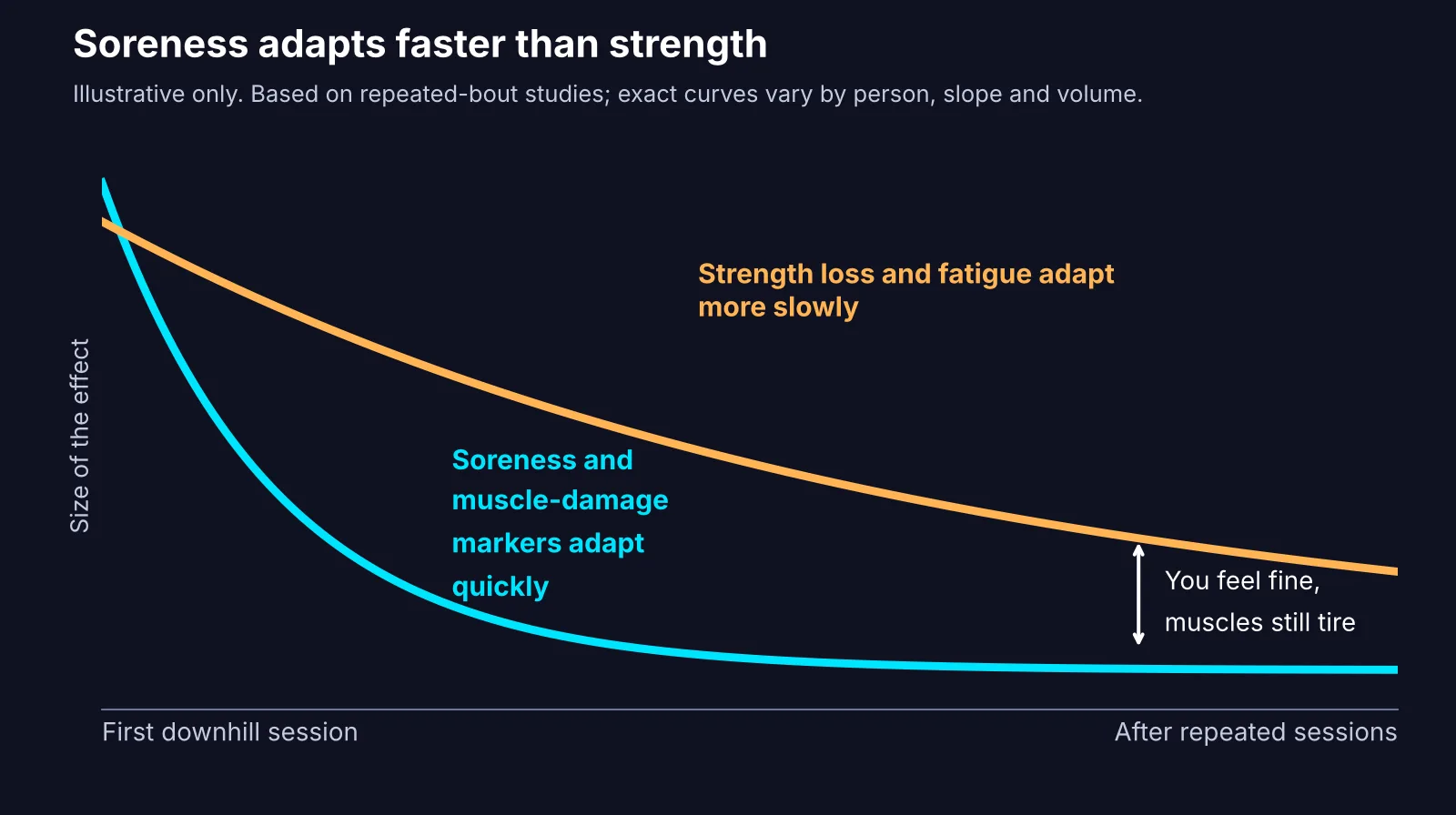
But there is a catch. In a study of 12 untrained adults, 10 downhill sessions lowered quad soreness, yet neither 5 nor 10 sessions reduced the loss of strength and neuromuscular fatigue after a standard downhill bout. Soreness adapts faster than strength loss. You may feel fine while your muscles still tire the same way.
Volume matters too. In a lab study of the knee extensors, damage and recovery depended on how many eccentric contractions people did. Seventy-five contractions did not reduce strength, while 150 and 300 did, similarly, in the first 48 hours. That is an isolated-muscle model, so it shows the principle, not a running number.
What do real races show? In a 166 km (103 mile) race with 9,500 m (31,200 ft) of climbing, knee extensor strength dropped about 35 percent at the finish and most of it recovered within 9 days, with full recovery of neuromuscular function by day 16. In the 330 km (205 mile) race, damage was lower than in shorter races, which the authors credited to cautious pacing and slowing from sleep loss, which reduced the braking load. And in a study of ultramarathons, runners slowed more on downhills than uphills late in the race, while the better finishers kept their downhill speed from dropping as much. Downhill durability is a real performance factor, not just an injury concern.
Put it into practice
- Introduce downhill work early and keep it regular. Repeated exposure keeps the protective effect fresh. Do not wait for the last few weeks.
- Control the descents. Slope, speed and duration all change how much damage you take. Run most descents at a controlled effort with short, quick steps. Save fast descents for a session where nothing important follows.
- Plan the day after a hard-descent day. Make it easier, flatter or shorter.
- Support it with strength. Step-downs, split squats and other eccentric lifts build the capacity that descending uses.
Lesson 4: Keep a little flat running in the mix
This is the least-studied part, so we will be upfront: the research here is thin, and what follows is practical judgment, not a study result. One thing we do know: a supplementary eight-week program of downhill running at a 5 percent grade, twice a week, did not improve running economy in well-trained runners. Downhill work builds durability. It does not make you faster on the flat. Many runners who train on very steep terrain notice that their flat pace slows if they stop practicing it. That matches the idea that you get good at what you practice. For a 250-miler, the aim is not speed. It is keeping a smooth, efficient rhythm on the runnable sections between big climbs.
Put it into practice
- Add short, relaxed pickups to easy runs. A few strides once or twice a week keeps your turnover from fading without adding much fatigue.
- Keep one low-vert run in the week. It gives your legs a break from braking and steep loading.
- Do not turn it into a second hard session. The goal is rhythm, not stress.
Lesson 5: The next-day check is your line
If no study can tell you the limit, what can? Your own response. After a big vert day, ask three questions:
- Did soreness and heavy legs clear within 48 to 72 hours? After eccentric-heavy bouts, strength loss and soreness typically peak in the first day or two. Clearing on that timeline is normal.
- Can you hit your next key session at the effort you planned, at a normal heart rate? If your pace or heart rate is off for several days, you are carrying too much.
- Is anything specific lingering? Soreness is expected. A sharp or joint-specific pain in the knee, shin or Achilles is not.
If the answer to any of these is no, adjust in this order: first the descent effort and speed, then the terrain steepness, then the volume. Cut the descent effort before you cut your climbing. Seek medical care if you have unusual swelling, severe pain, or very dark urine after an extreme day. Serious muscle breakdown is rare but real in ultras.
A weekly checklist
- I know my climb per mile (or per km) for this week and for my race.
- No single session was a big spike compared with the last month.
- I hiked my steep climbs on purpose and practiced with poles.
- I kept most descents controlled and kept one session where I could push them.
- I had an easier day after my hardest descent day.
- I did a few relaxed pickups or kept one low-vert run.
- I did eccentric strength work (step-downs, split squats).
- After big days, soreness cleared in 48 to 72 hours.
How Fit PA can help
The hard part of all this is seeing the whole picture at once. Fit PA builds a training plan around your goal race and shows how each week is going, whether you are preparing for a 50K or a 250-miler:
- Weekly climb and descent against plan. See planned and logged feet each week, along with time, miles and load.
- Load vs plan and adherence. Check how much training stress you actually carried, session by session.
- Recovery signals in view. Your recovery score, heart rate variability and resting heart rate sit next to your training.
- A coach to adjust with. If a big week leaves you flat, you can talk it through and change the next sessions.
- Plans built from your watch. Fit PA coaching builds a training plan from your connected Garmin, Coros, Suunto or Wahoo watch.
Training for Cocodona 250? The Cocodona 250 race page has the course profile and GPX file, a 3D flyover, a race-day climate chart, a goal pace table with a section planner, and a finish time predictor. Build a plan for your own race at app.fit-pa.com.
What we still do not know
Be wary of anyone who gives you a precise weekly limit. The studies we found tested single downhill bouts or short blocks, often in lab settings and often in untrained people. Nobody has tested a months-long build of steep, back-to-back vert days in the way ultrarunners train. The one large injury cohort points toward more training being protective, not harmful, but it cannot prove cause and effect. Until better studies come along, the next-day check, steady progression and honest tracking are the best tools you have. This article is for general education and is not medical advice. If you have pain that does not settle, or a medical condition, talk to a qualified professional.
Sources
- Fit PA, Cocodona 250 race page (official 2027 course figures): https://app.fit-pa.com/races/cocodona/cocodona-250
- Belinchon-deMiguel et al., Predictors of Athlete's Performance in Ultra-Endurance Mountain Races (2021): https://mdpi.com/1660-4601/18/3/956
- Analysis of factors influencing injuries and performance in trail running (Injury, 2025): https://pubmed.ncbi.nlm.nih.gov/41108796/
- The Trail Runners' Tendon: how weekly mileage and elevation gain affect Achilles and patellar tendon morphology (2024): https://pmc.ncbi.nlm.nih.gov/articles/PMC11755538
- Running-related overuse injury and spikes in single-session distance (cohort study): https://pmc.ncbi.nlm.nih.gov/articles/PMC12421110
- Outside Run, summary of uphill trail running research (walk-run transition, Kram): https://run.outsideonline.com/trail/uphill-trail-running-research-2022
- Level, uphill and downhill running economy values are correlated except on steep slopes (2021): https://pmc.ncbi.nlm.nih.gov/articles/PMC8281813
- Effects of incline and level-grade interval treadmill training on running economy and muscle power (2014): https://openprairie.sdstate.edu/hns\_pubs/7
- Giovanelli et al., Do poles save energy during steep uphill walking? (2019): https://pubmed.ncbi.nlm.nih.gov/31020400/
- Do poles really "save the legs" during uphill pole walking at different intensities? (2023): https://link.springer.com/article/10.1007/s00421-023-05254-9
- Impact of pole use on vertical cost of transport after a simulated trail running competition (2025): https://air.uniud.it/handle/11390/1309867
- Vernillo et al., An extreme mountain ultra-marathon decreases the cost of uphill walking and running (2016): https://pmc.ncbi.nlm.nih.gov/articles/PMC5100553
- Downhill running: what are the effects and how can we adapt? A narrative review (Sports Medicine, 2020): https://pmc.ncbi.nlm.nih.gov/articles/PMC7674385
- Schutte, The effect of repeated bouts of downhill training on running performance and recovery after a 30-km time trial (MSc thesis, University of Cape Town): https://open.uct.ac.za/bitstreams/ce71e001-483b-4b20-bded-58f2ca20972a/download
- A single bout of downhill running attenuates subsequent level running-induced fatigue (Scientific Reports, 2020): https://pmc.ncbi.nlm.nih.gov/articles/PMC7606541
- The duration of the repeated-bout effect after eccentric exercise (2026): https://pmc.ncbi.nlm.nih.gov/articles/PMC13674372
- Downhill running-induced muscle damage in trail runners (Sports, 2026): https://pmc.ncbi.nlm.nih.gov/articles/PMC12846201
- Muscle soreness but not neuromuscular fatigue responses following downhill running differ according to the number of exercise bouts (2024): https://researchonline.ljmu.ac.uk/24976/1/Bontemps\_Fatigue\_Accepted\_EJSS\_2024.pdf
- Recovery kinetics following eccentric exercise is volume-dependent (Journal of Sports Sciences, 2023): https://www.tandfonline.com/doi/full/10.1080/02640414.2023.2272101
- Millet et al., Neuromuscular consequences of an extreme mountain ultra-marathon (2011): https://pmc.ncbi.nlm.nih.gov/articles/PMC3043077
- Saugy et al., Alterations of neuromuscular function after the world's most challenging mountain ultra-marathon (2013): https://journals.plos.org/plosone/article?id=10.1371/journal.pone.0065596
- Genitrini et al., Downhill sections are crucial for performance in trail running ultramarathons (2022): https://pmc.ncbi.nlm.nih.gov/articles/PMC9680470
- Shaw et al., The efficacy of downhill running as a method to enhance running economy in trained distance runners (2018): https://pubmed.ncbi.nlm.nih.gov/29561245/