

Run It or Hike It? What the Research Says About Training for the Climbs
Training Science: Uphill Training for Mountain Ultras In [part 1 of this series] How Much Downhill is too much? we looked at the recovery cost and fine line between benefits vs drawbacks. This time we flip it and look at the climbs. Every big mountain race is a long negotiation with gravity, and the questions are practical. When should you run and when should you hike? How hard should you go? And what kind of training actually makes you a better climber? We went through the research on uphill running and hiking. Two things up front. Most of the studies use short tests and small groups, and none follows a runner through a full ultra build. But several findings are consistent enough to act on, and together they give you a clear way to train the climbs.
The quick take
- Flat fitness tells you little about climbing. Uphill running cost behaves differently from level running cost, so practice the climbs themselves.
- Hike the steep parts on purpose. Past roughly 15 degrees, walking costs less energy than running at the same climbing speed. Between about 20 and 35 degrees, the cost of climbing at a given vertical speed barely changes.
- Pace by effort, not by vertical speed. A climbing-speed number means different things on different grades. Heart rate and effort travel better.
- Uphill intervals move the needle. Hard uphill efforts improved performance in the trials we found. Strength work alone did not clearly do the same.
- Climbing holds up when you are tired. It is also gentler on your muscles than descending, which makes it a good place to spend your hard work.
Why this matters for big mountain races
Take Cocodona 250 again. The official 2027 course has 38,943 ft (11,870 m) of climbing over 253.5 miles (408 km), or about 154 ft per mile (29 m per km). The biggest single climb is 1,893 ft (577 m), and it arrives at about mile 14 (22.5 km). That is early, when you feel fresh and it is easiest to overcook it. Whatever your race, the same questions apply. Are you running this climb or hiking it? How hard is too hard on the first big hill? And what should your training look like so that the climbs feel like work you have already done?
Lesson 1: Climbing is mostly lifting, so flat fitness tells you little
Here is what we found:
- In a classic treadmill study, 10 runners walked and ran on slopes from -45 to +45 percent. The energy cost of running one meter was 3.40 joules per kilogram of body mass on the level and rose to 18.93 at a 45 percent grade, more than five times higher. Above about a 15 percent grade, the efficiency of walking and running matched that of a muscle shortening. In plain terms, the cost of steep climbing is mostly the cost of lifting your body.
- In a group of elite endurance mountain runners, the energy cost of uphill running was not associated with the cost of level running. The authors recommended a standardized uphill test to judge a mountain runner's potential.
- A study across several slopes found that level and uphill running costs were correlated across most slopes, but not between level running and the steepest uphill (20 percent). (We covered this in [part 1]([DOWNHILL ARTICLE LINK]).)
What it means for you Your flat pace is a poor guide to how you will climb. Someone who runs a fast flat 10K can still struggle on a long climb, and the reverse is also true. Climbing is its own skill, built by climbing. Put it into practice
- Judge your climbing by climbing. Use climb sessions, not flat paces, to track how your climbing fitness is changing.
- Train on grades like your race. Know the typical grades of your course, then match them in training where you can.
- Do not predict climb pace from road pace. Set your race plan from what you actually do on climbs of similar length and steepness.
Lesson 2: Hike the steep parts on purpose, and know why
You may remember from part 1 that walking beats running above roughly 15 degrees (about a 27 percent grade). The research on very steep climbing adds a useful detail. Here is what we found:
- In a University of Colorado Boulder study, 15 competitive mountain runners climbed at seven angles from 9 to 39 degrees, at a steady climbing speed of just over 1 ft per second (about 3,600 ft per hour, or 1,100 m per hour). At every angle except 9.4 degrees, walking cost less than running, by about 8 to 9 percent.
- Between 20 and 35 degrees (roughly a 36 to 70 percent grade), the energy needed to climb at a given vertical speed was nearly the same whether the slope was steeper or not. The researchers described it as a plateau, so the exact steepness mattered less than how fast you were gaining height.
- A follow-up study at 30 degrees found that walking used less metabolic power than running at slow speeds (up to about 0.7 m per second, or 1.6 mph along the slope). The two were equal at 0.8 m per second, and running likely costs less at faster speeds. The authors concluded that most vertical kilometer racers should walk.
Poles can help a little here. As we covered in part 1, the energy savings are small, but the idea is that they spare your legs. What it means for you On steep ground, the enemy is not the steepness itself. It is how fast you try to gain height. Cocodona's steepest grade is 31 percent, about 17 degrees, which is just past the point where walking starts to win. So only the steepest pitches clearly favor hiking. On most climbs, either gait can work, and the real question is which one you can sustain. Put it into practice
- Use the sustain test. On moderate climbs, choose the gait that holds your target effort without creeping up (see Lesson 3).
- Hike the steepest pitches without guilt. It is the efficient choice, not a failure to run.
- Practice the transitions. Switching smoothly between running, hiking and poles saves energy when you are tired.

Lesson 3: Pace the climbs by effort, not by vertical speed
Many runners like to target a vertical speed, such as a number of feet or meters climbed per hour. The research suggests that number is slippery. Here is what we found:
- In a French study, 10 runners did three incremental tests, on 1, 10 and 25 percent slopes. At the same increase in vertical speed per minute, the 25 percent test reached a much higher maximum vertical speed than the 10 percent test (1,760 vs 1,330 m per hour, or about 5,800 vs 4,400 ft per hour). Power tracked metabolic demand across slopes better than vertical speed did, and the authors concluded power is the better parameter for prescribing training intensity.
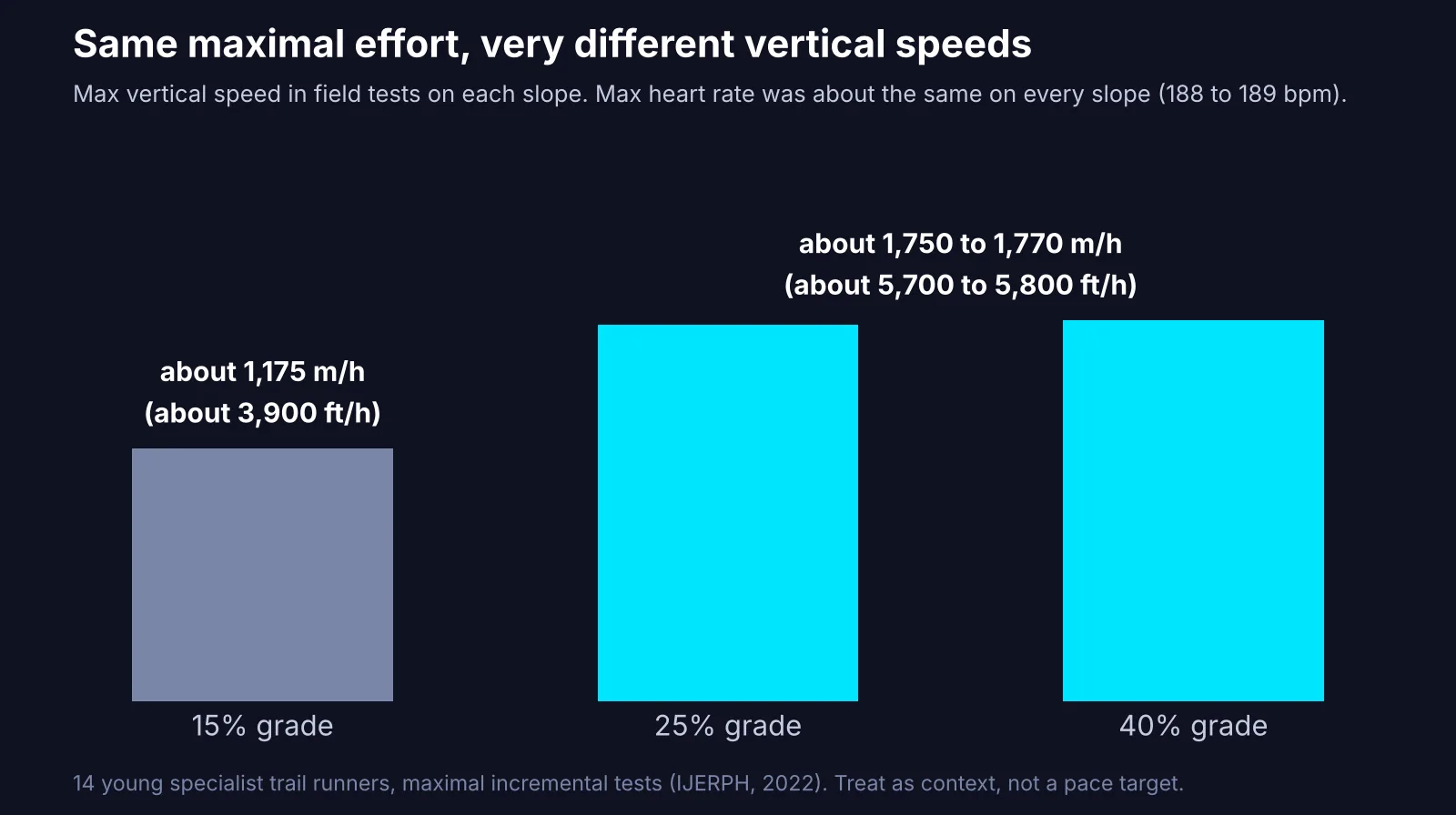
- In another study, 14 young specialist trail runners did maximal field tests at 0, 15, 25 and 40 percent. Their maximal heart rate was about the same on every slope (188 to 189 beats per minute). Their maximal vertical speed was not: about 1,175 m per hour (3,900 ft per hour) at 15 percent, and 1,750 to 1,770 m per hour (about 5,700 to 5,800 ft per hour) at 25 to 40 percent. The authors suggested heart rate can set intensity across different slopes.
What it means for you A vertical speed that feels easy on a 10 percent hill can be maximal on a steeper one. Heart rate, perceived effort and power carry across grades. A vertical speed number does not. Put it into practice
- Set climb targets by heart rate zone or effort. Pick a sustainable range for your race and hold it on every grade.
- Check heart rate against feel. Heart rate can drift upward in long efforts or in the heat, so compare it with how hard the effort feels.
- Start the first big climb conservatively. Early climbs are where most people spend effort they need later.
Lesson 4: Climbing fitness is aerobic, and uphill intervals move it
If climbing is mostly lifting, what limits how well you can do it? The best evidence we found points to aerobic capacity measured uphill. Here is what we found:
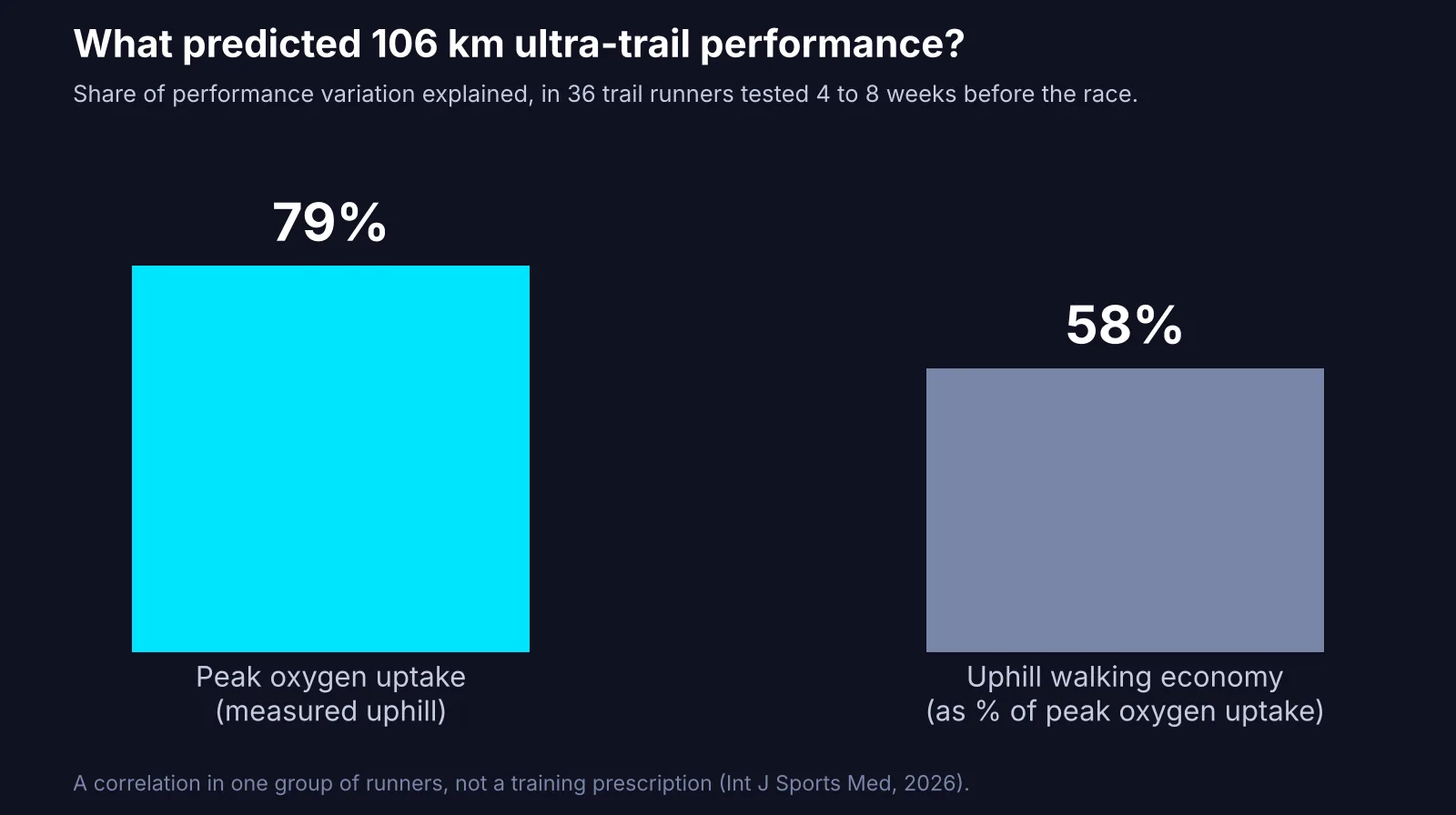
- Researchers tested 36 trail runners 4 to 8 weeks before a 106 km (66 mile) ultra-trail race. Peak oxygen uptake measured in an uphill test alone predicted 79 percent of the variation in race performance. Uphill walking economy, expressed as a share of peak oxygen uptake, explained 58 percent. Longer step length and greater breathing volume were linked with a lower energy cost of uphill walking. This is a correlation in one group of runners.
- In a 6-week trial, 20 well-trained runners were randomly assigned to one of five uphill interval programs. On average, 5 km (3.1 mile) time trial performance improved 2.0 percent. There was no clear best program, and the authors concluded that any form of high-intensity uphill interval training seems to help.
- In a 2026 trial of 40 masters trail runners aged 35 to 55, three groups trained for 12 weeks: circuit weight training, uphill high-intensity intervals, or both. Mountain trail performance and running economy improved in the uphill and combined groups. Circuit training built strength and lean mass, but on its own it did not clearly improve trail performance. We could read only summaries of this paper, so treat the details as preliminary.
- One doctoral study put runners through 8 weeks of heavy resistance training. Strength improved, but uphill running economy did not change significantly.
What it means for you Strength work is valuable, and part 1 recommended it for the downhills. But for climbing, the evidence we found says it does not replace climbing itself. Hard uphill efforts build the aerobic capacity that predicts climbing performance, and the benefits showed up with several different formats. Put it into practice These are our suggestions based on the findings, not protocols from the studies.
- Add one uphill interval session on a steady climb every week or two in build phases. For example, repeat hard efforts of a few minutes with easy recovery, and pick a format you can repeat consistently.
- Walk the recovery downhill. It keeps the braking load, and the next-day cost, down (see part 1).
- Include long, steady climbs. The ultramarathon research below suggests long uphill training could be useful for mountain ultras.
- Keep strength work in the plan, but treat it as support for climbing, not a replacement.
Lesson 5: Climbing holds up when you are tired, and it is easier on your muscles
Here is what we found:
- After a 330 km (205 mile) mountain ultra with about 24,000 m (78,700 ft) of climbing, 19 male ultra runners (average age 43) were retested on a treadmill. Their energy cost of uphill walking and running was lower, not higher: about 11.5 percent lower for walking and 7 percent lower for running. The study had no control group, and eating after the race may have affected the measurements. The authors suggested that long uphill training could help mountain ultra runners.
- In another study, researchers measured the cost of running at 0 and 15 percent incline before and after trail races of 40 to 170 km (25 to 106 miles). Running cost rose after races shorter than 100 km (62 miles), but not after longer ones, whatever the incline.
- In a 173 km (107 mile) mountain ultra, runners slowed on all gradients, but most of the slowing on level ground came earlier than on climbs and descents. Another analysis found that later in ultras, runners slowed more on downhills than on uphills (see part 1).
- Studies describe uphill running as muscle-shortening work and downhill running as muscle-lengthening work. They report that muscle damage mostly comes from the downhills, and that strength loss after hard downhill running is much larger than after uphill running at similar effort.
What it means for you Climbing efficiency seems durable. If your race falls apart late, the research points more to your flat rhythm or your downhills than to your climbing economy. Climbing is also a more forgiving place to do hard work, because it is gentler on your muscles than descending. Put it into practice
- Do your quality work uphill. Hard climbing efforts cost less recovery than hard descents.
- Control the descents. Save fast descents for a session where nothing important follows.
- Keep one low-vert run in the week. It protects your flat rhythm.
- Still use the next-day check from part 1. Soreness should clear in 48 to 72 hours, your next key session should hit its target, and nothing should be sharp or joint-specific.
A weekly checklist
- I tracked my climbing by climbing, not by flat pace.
- I hiked the steepest pitches on purpose and practiced with poles.
- I paced my climbs by heart rate or effort, not by vertical speed.
- I did one hard uphill session and walked the recovery downhill.
- I did one long, steady climb if my plan called for it.
- I kept strength work in the week.
- I kept one low-vert run for rhythm.
- After big days, soreness cleared in 48 to 72 hours.
How Fit PA can help
Good climbing training depends on matching your plan to your course and then watching how your body responds. Fit PA builds a plan around your goal race, whether you are preparing for a 50K or a 250-miler:
- Plans built around your course. The coach researches race-specific demands, including elevation gain and terrain, and builds your plan around them.
- Weekly climb against plan. See planned and logged climbing each week, along with time, miles and load.
- Effort by heart rate zone. Activity pages color each split by relative heart rate or pace zone and show an effort score, so you can see whether your climbs landed where you meant them to.
- Recovery signals in view. Your recovery score, heart rate variability and resting heart rate sit next to your training.
- A coach to adjust with. If a big climbing week leaves you flat, talk it through and change the next sessions.
- Ask the coach about this article. Paste this article's link into your Fit PA coach chat and ask how it applies to your plan. The coach reads the page and answers using your training history, biometrics and conversation. Longer conversations use more of your monthly coach allowance, and higher tiers give you more room.
Training for Cocodona 250? The Cocodona 250 race page has the course profile and GPX file, a 3D flyover, a race-day climate chart, a goal pace table with a section planner, a finish time predictor, and a button that loads the race into your coach so you can start planning. Build a plan for your own race at app.fit-pa.com.
What we still do not know
Be wary of anyone who gives you a precise climbing prescription. Most of the training trials we found ran 6 to 12 weeks, measured performance over 5 to 20 km rather than ultras, and used small groups. The studies on what predicts climbing performance are correlations, and the studies on fatigue and climbing economy had no control groups. Nobody has followed runners through a months-long build of steep climbing and compared it with other approaches. What the evidence does support is a practical approach: hike the steep parts, pace by effort, add hard uphill work, and use the next-day check to keep it sustainable. This is part 2 of our three-part series on training vert. In part 3, we put climbing and descending together. This article is for general education and is not medical advice. If you have pain that does not settle, or a medical condition, talk to a qualified professional.
Sources
- Fit PA, Cocodona 250 race page (official 2027 course figures): https://app.fit-pa.com/races/cocodona/cocodona-250
- Fit PA, How Much Downhill Is Too Much? (part 1): [DOWNHILL ARTICLE LINK]
- Minetti et al., Energy cost of walking and running at extreme uphill and downhill slopes (Journal of Applied Physiology, 2002): https://journals.physiology.org/doi/full/10.1152/japplphysiol.01177.2001
- Balducci et al., Comparison of level and graded treadmill tests to evaluate endurance mountain runners (Journal of Sports Science and Medicine, 2016): https://pmc.ncbi.nlm.nih.gov/articles/PMC4879436
- Lemire et al., Level, uphill, and downhill running economy values are correlated except on steep slopes (2021): https://pmc.ncbi.nlm.nih.gov/articles/PMC8281813
- Giovanelli et al., Energetics of vertical kilometer foot races; is steeper cheaper? (Journal of Applied Physiology, 2016), with the University of Colorado Boulder summary: https://www.colorado.edu/today/node/456
- Ortiz et al., The metabolic costs of walking and running up a 30-degree incline (European Journal of Applied Physiology, 2017): https://pubmed.ncbi.nlm.nih.gov/28695271/
- Giovanelli et al., Do poles save energy during steep uphill walking? (2019): https://pubmed.ncbi.nlm.nih.gov/31020400/
- Hingrand et al., Power is more relevant than ascensional speed to determine metabolic demand at different gradient slopes during running (Journal of Strength and Conditioning Research, 2023): https://www.pubmed.gov/37883404/
- Physiological implication of slope gradient during incremental running test (International Journal of Environmental Research and Public Health, 2022): https://pmc.ncbi.nlm.nih.gov/articles/PMC9566275
- Martinez-Navarro et al., Uphill walking economy and maximal oxygen consumption in trail runners: relationship with ultra-trail performance (International Journal of Sports Medicine, 2026): https://www.thieme-connect.de/products/ejournals/abstract/10.1055/a-2813-3109
- Effects of different uphill interval-training programs on running economy and performance (International Journal of Sports Physiology and Performance, 2013): https://pubmed.ncbi.nlm.nih.gov/23538293/
- Panthong et al., Comparative effects of circuit training, high-intensity interval training, and combined training on performance and neuromuscular function in masters trail runners (Journal of Strength and Conditioning Research, 2026; summary only reviewed): https://doi.org/10.1519/JSC.0000000000005622 and https://marathonhandbook.com/the-best-training-mix-for-masters-trail-runners/
- Robinson, Biomechanical considerations for uphill running performance (doctoral dissertation, University of Oregon): https://scholarsbank.uoregon.edu//bitstreams/65ab1221-2402-4a01-a92f-efadbe73bc69/download
- Vernillo et al., An extreme mountain ultra-marathon decreases the cost of uphill walking and running (2016): https://pmc.ncbi.nlm.nih.gov/articles/PMC5100553
- Degradation of energy cost with fatigue induced by trail running: effect of distance (European Journal of Applied Physiology, 2021): https://pubmed.ncbi.nlm.nih.gov/33666727/
- Pacing during an ultramarathon running event in hilly terrain (PeerJ, 2016): https://peerj.com/articles/2591
- Genitrini et al., Downhill sections are crucial for performance in trail running ultramarathons (2022): https://pmc.ncbi.nlm.nih.gov/articles/PMC9680470
- Localization of damage within the knee extensors and plantar flexors induced by downhill running (Scientific Reports, 2017): https://pmc.ncbi.nlm.nih.gov/articles/PMC5515850
- Downhill running-induced muscle damage in trail runners (Sports, 2026): https://pmc.ncbi.nlm.nih.gov/articles/PMC12846201