
If you're 25, this is the year your body quietly starts keeping score. If you're 45, you've probably already felt it. And if you're deep into your 60s or 70s and still setting ambitious goals, you might be wondering whether the science is on your side or working against you.
Here's the honest answer: decline starts earlier than you'd probably guess, but you have more control over it than you'd probably guess too. How much you decline, and how fast, turns out to be far more within your control than the number on your birth certificate.
This isn't a motivational pep talk. It's what a handful of genuinely remarkable studies, some tracking the same people for nearly 50 years, some examining world-record-setting athletes in their 70s and 80s, actually found. Along the way, we'll also cover what the science says about fueling and protecting the muscle you're working to keep, what else besides strength and aerobic training is worth doing, and how to ramp up training volume safely at any age.
A note on how this article is organized: most of the science here applies to everyone. Two sections are specific to women's physiology (clearly marked below) — men and anyone not affected can skip straight past them without missing anything general.
The Starting Line Everyone Shares: Decline Begins at 35
In one of the longest-running fitness studies ever conducted, researchers at Sweden's Karolinska Institutet tracked 427 people for 47 years, testing the same individuals repeatedly from age 16 to 63. It's part of the Swedish Physical Activity and Fitness study (SPAF), and it's rare precisely because almost no study follows the same people this long.
The finding: physical capacity, aerobic fitness, strength, and muscle endurance, begins declining around age 35. That's not a typo, and it's not just for people who let themselves go. Separate research on elite athletes shows the same pattern: even competitors who train continuously tend to hit peak physical performance around 35, suggesting the underlying biological process starts well before it becomes noticeable.
The encouraging half of the finding matters just as much: starting to exercise later in life still produces meaningful, measurable improvements. Decline isn't optional. But how much of it you experience, and from what baseline, absolutely is.
What Actually Controls the Rate of Decline
This is the part that should change how you think about aging and training, because it turns out age is not the main variable.
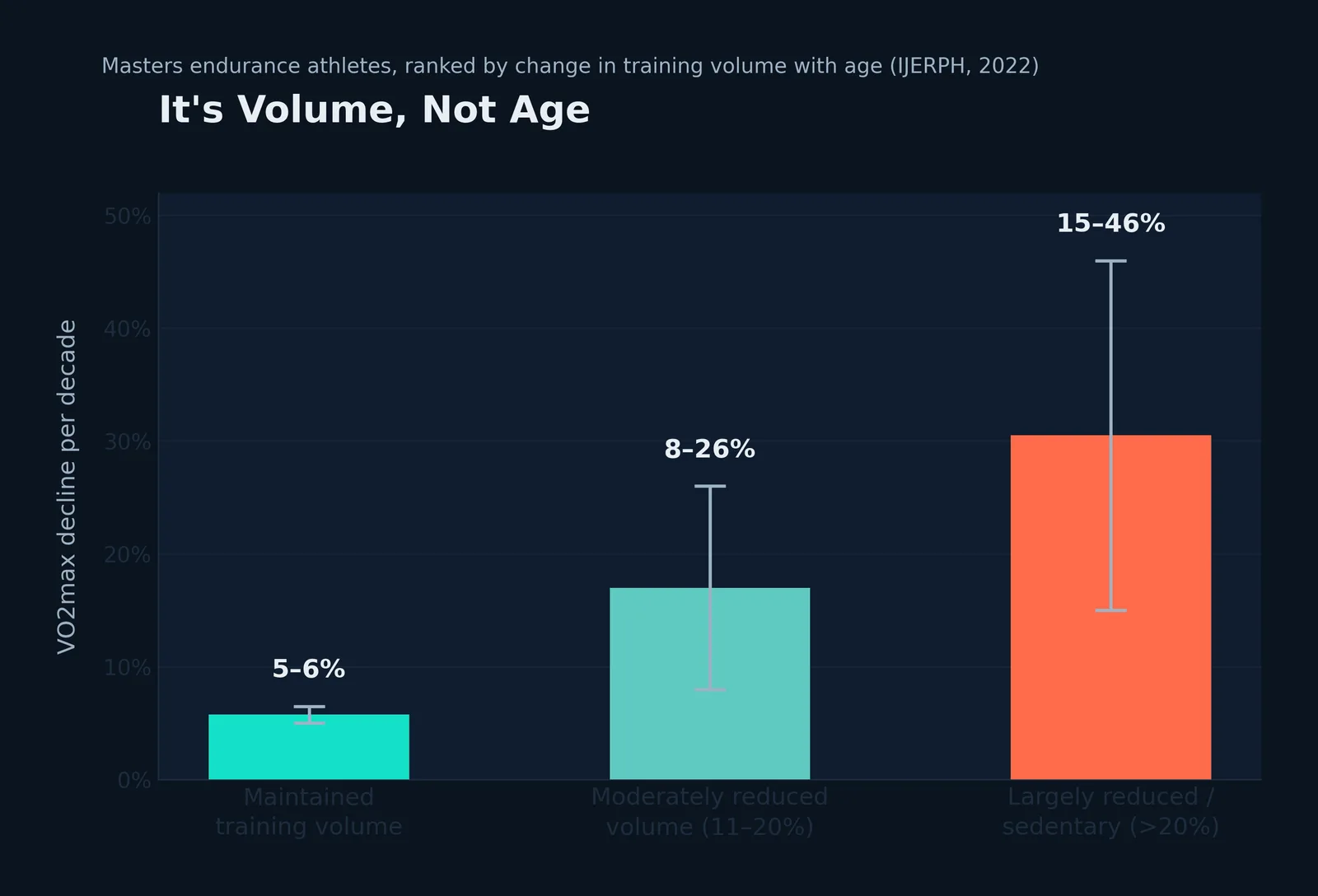
A review of masters endurance athletes found that the widely-cited "decline" isn't really a fixed biological clock. VO2max (short for maximal oxygen uptake, the standard lab measure of aerobic fitness) decline per decade ranged enormously across athletes studied, from as little as 5% to as much as 46%. When researchers ran the numbers, changes in training volume explained 54% of that variance in men and 39% in women. In plain terms: more than half of how fast someone's fitness dropped off was explained not by how old they were, but by how much they kept training.
Athletes who maintained their training volume, keeping it within about 10% of their peak or holding it steady, saw VO2max decline of only 5-6.5% per decade. That's a fraction of what's often assumed to be "normal" aging.
The practical translation: the biggest threat to your fitness as you age isn't your age. It's whether you keep showing up.
The Strength Training Sweet Spot (And Why More Isn't Better)
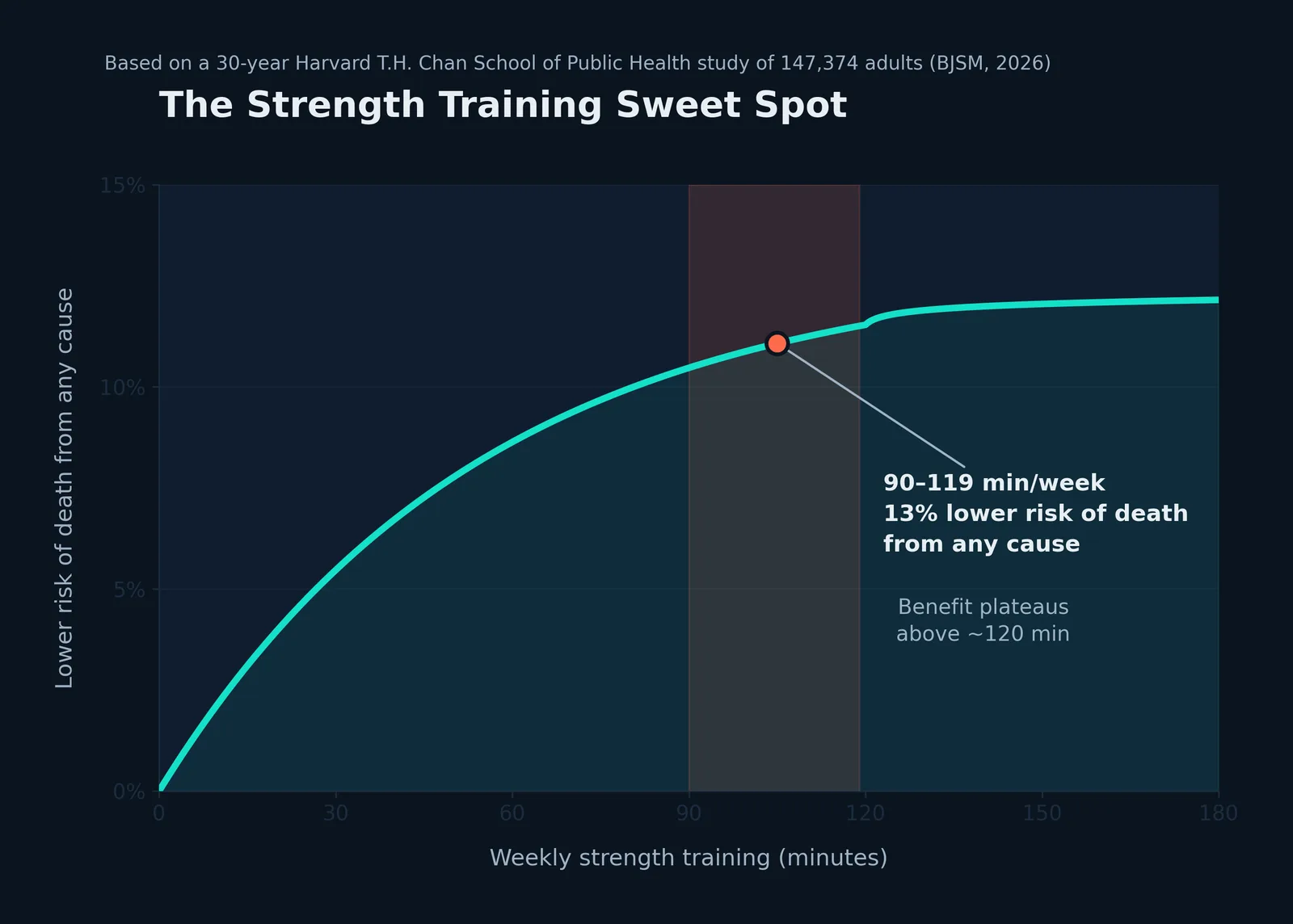
For the baseline, "how much do I actually need to do" question, a Harvard T.H. Chan School of Public Health study gives one of the clearest answers science has produced. Researchers followed 147,374 adults for up to 30 years, drawing on three long-running cohort studies, and asked participants every two years how much time they spent on strength training and aerobic exercise.
The results, published in June 2026 in the British Journal of Sports Medicine:
- 90 to 119 minutes of strength training per week was associated with a 13% lower risk of death from any cause, a 19% lower risk of cardiovascular death, and a 27% lower risk of death from neurological disease (including Alzheimer's and Parkinson's), compared to no strength training at all.
- Benefits plateaued above 120 minutes per week. More strength training didn't hurt, but it didn't add extra protection either.
- Combining strength training with aerobic exercise produced the strongest outcomes of all, better than either alone.
- No gym or equipment is required. Bodyweight exercises (push-ups, squats, lunges), resistance bands, and basic free weights all count.
For a walker or someone just getting into structured fitness, this is genuinely great news: roughly two 45-minute sessions or three 30-minute sessions a week captures nearly all of the measurable longevity benefit. You don't need to live in the weight room.
For more experienced or high-volume athletes, this study isn't the ceiling on what's possible, it's a floor. It answers "what's the minimum effective dose for a long, healthy life," not "what's possible if I keep training seriously for decades." That's where the next section comes in.
What Happens When You Keep Going: The 70s, 80s, and Beyond
This is where the story gets genuinely remarkable, and it should matter a lot to anyone who assumes 70 is a wall.
In 2022, a 71-year-old Dutch runner broke the marathon world record for the men's 70-74 age category by four seconds. Researchers tested him and found a VO2max of 46.6 ml/kg/min, a body fat percentage of 13.5%, and a running economy that held up remarkably well against much younger competitive runners. His fractional utilization of VO2max, essentially, how much of his aerobic ceiling he could sustain for hours, was in the 91-94% range, on par with elite runners decades younger. He didn't start running until age 36, after a doctor advised him to lower his cholesterol.
A separate six-year follow-up study, on the previous record holder in that same age category (tested at 70, shortly before his 2018 record, and retested at 76 in 2024), tells an important complementary story: his marathon times did slow meaningfully over those six years, driven mainly by a real decline in VO2max. But one thing stayed remarkably steady across that span: his running economy, essentially how efficiently his body used oxygen at a given pace, was nearly identical at 76 to what it was at 70. The honest takeaway isn't that decline stops if you train hard enough; it doesn't. It's that some of what makes an efficient athlete, technique and economy, can be preserved through consistent training even as raw aerobic capacity declines with age.
Then there's Juan López García, who took up running at 66 after retiring, and who initially struggled to complete even a single mile. By his early 80s, he'd become the world marathon champion for his age category and set a world record in the 50km ultramarathon for the 80-84 age group. His VO2max was measured at 52.8 ml/kg/min, the highest ever recorded for someone in their 80s, and comparable to a healthy adult in their 20s or 30s.
None of these are freak genetic outliers untouched by aging. They're proof of the pattern from the section above: consistent training volume, not age, is doing most of the work. Several of them didn't even start serious training until well into adulthood.
For anyone in their 60s or 70s still chasing a big goal: the literature doesn't just permit that ambition, it actively documents people building world-class endurance capacity well past 65. The relevant variable isn't the number of candles on the cake. It's whether the training has been consistent.
What Else Belongs in the Plan: Beyond Aerobic and Strength Work
Aerobic exercise and strength training are the two biggest levers, but they aren't the whole picture, especially past 60. Two other categories have real evidence behind them.
Balance and power training meaningfully cut fall risk, separately from general strength. A large body of trial evidence shows structured exercise programs combining strength, balance, and functional movement reduce fall rates by roughly 25% in older adults when done consistently (three or more sessions a week for at least 12 weeks). Reactive or "perturbation-based" balance training, which deliberately practices recovering from an unexpected trip or slip in a safe setting, is a newer, promising approach; early trials suggest it may cut falls by as much as 50%, though researchers studying it are clear that more evidence is still needed to confirm that figure. Separately, power training, moving lighter loads quickly rather than just lifting heavy slowly, is gaining evidence as particularly valuable for older adults, since power (strength combined with speed) tends to decline faster with age than raw strength alone, and it's power, not just strength, that determines whether someone catches themselves during a stumble. Core training has also shown measurable balance benefits in systematic reviews. The practical version of this: even a committed strength and aerobic routine benefits from adding a few minutes of balance work (single-leg stands, controlled directional stepping, or a class like Tai Chi) a few times a week, particularly from your 50s onward.
A few supplements have genuine evidence, though the research is more nuanced than the marketing.
- Creatine monohydrate, when combined with resistance training, has one of the stronger evidence bases of any supplement for older adults. Multiple 2025-2026 systematic reviews and meta-analyses found creatine plus resistance training produced significantly greater improvements in muscle strength and lean mass than resistance training alone, along with some evidence for bone-related benefits and modest cognitive gains. That said, the picture isn't unanimous: one meta-analysis found clear strength benefits in younger adults but did not find a statistically significant additional effect specifically in older adults, and one of the longest individual trials (12 months, ages 49-69) found no added benefit on bone, muscle, or strength beyond resistance training alone. The fair summary: creatine combined with resistance training is well-supported and low-risk for most healthy adults, but it isn't a guaranteed strength boost for everyone, and it does not work as a substitute for training.
- Collagen peptides, taken around the time of training and paired with resistance or plyometric exercise, have decent evidence specifically for tendon health. A 2026 systematic review of controlled trials found strong evidence (the highest evidence grade used in that review) that collagen supplementation increases tendon cross-sectional area and stiffness, particularly at higher doses (15-30 g/day, generally paired with vitamin C) combined with higher-intensity resistance training. Importantly, the same review found no evidence that collagen adds anything to muscle strength itself. In plain terms: collagen looks like a legitimate connective-tissue tool, useful alongside training for tendon resilience, but it is not a muscle-building or strength supplement, and the benefit shows up on a slower timeline than most marketing suggests.
Neither of these supplements is a substitute for training, protein intake, or the load-management principles in this article. They're additive tools with real, if measured, evidence behind them, and anyone considering them, especially alongside existing medications or health conditions, should check with a healthcare provider first.
The Sex Differences Worth Knowing (Women-Specific Science — Skip Ahead if Not Applicable)
Most large longevity and aging studies, including the Harvard strength training research, include large numbers of women (in fact, the Harvard cohort was majority female), but a few sex-specific findings are worth calling out directly for female athletes. This section and the next one are specific to women's physiology; men and anyone this doesn't apply to can jump ahead to "Fueling the Muscle You're Trying to Keep."
Menopause changes the felt experience of training, even in highly fit women. A 2026 survey-based study published in PLOS One (a peer-reviewed journal from the Public Library of Science) found that menopausal symptoms are common even among highly active endurance athletes, and being fit doesn't make them disappear. The four biggest disruptors athletes linked to their training were sleep problems, physical and mental exhaustion, joint and muscle discomfort, and weight changes. This matters because it's easy for a fit, disciplined athlete to assume something is wrong with her training when the real driver is a hormonal transition that fitness alone doesn't override. Naming it can be the difference between someone adjusting her plan and someone quietly burning out or blaming herself.
Recovery differences between men and women are real but still being mapped. Some studies find women recover faster from certain types of fatigue (particularly sustained, lower-intensity efforts), while others find no meaningful difference, or a male advantage in specific contexts like resistance training recovery. A 2026 study looking specifically at sex differences in resistance training fatigue and recovery noted that this remains an open question, one with real implications for how training volume should be prescribed, but not yet a settled one. The honest takeaway for now: don't assume you need to train identically to training partners of a different sex, but also don't assume there's a universal "women need X% less/more" rule. Individual response still matters more than any group average.
What Actually Shifts About Strength Training During Menopause (Women-Specific Science)
This is worth its own section, because the "how" of strength training changes here, not just the "how it feels."
The most comprehensive current synthesis, the American College of Sports Medicine's (ACSM) 2026 Position Stand, reviewed 137 systematic reviews covering more than 30,000 participants and concluded that resistance training is a safe, effective, and evidence-supported cornerstone strategy for countering menopause-related declines in muscle strength, lean mass, and functional performance. A separate 2026 narrative review of resistance training interventions in peri- and postmenopausal women found the strongest strength gains came from programs using progressive overload at moderate-to-high intensity, though lower-intensity and low-impact programs still produced real benefits, especially for women newer to training.
A few specific shifts matter here:
- Heavier, progressive loading is well supported, not something to shy away from. Multiple reviews found heavy resistance training is specifically well-supported for preserving bone density and strength during and after the menopause transition, when bone loss accelerates. For women who want to lift heavy and have no contraindication, the current guidance actively endorses it rather than defaulting to light weights.
- Training to failure isn't necessary. The ACSM's 2026 synthesis found that training to or near muscular failure did not consistently improve outcomes for healthy adults compared to stopping a rep or two short of failure. Separate menopause-focused guidance goes further, specifically flagging extra caution around training to failure past 50 given cardiovascular and recovery load. Either way, this isn't about lifting light, it's about not needing to grind every set to its absolute limit to get the benefit.
- Set structure can be adjusted to manage cardiovascular strain without sacrificing load. A completed randomized crossover trial in postmenopausal women (the CARE project) found that breaking a set into more, smaller clusters of reps with brief rest between them measurably lowered peak and average heart rate during the session compared to fewer, larger sets at the same total volume and load. This is a useful tool, not a requirement, but it's worth knowing it exists if heavy continuous sets feel unusually taxing.
- Individualization matters more than any single protocol. Across the current evidence, no single method (heavy barbell lifting, bands, bodyweight, machines) outperforms the others across the board. The consistent finding is that the best program is the one a woman can access, sustain, and progressively build on over time.
The practical bottom line: menopause is not a signal to back off strength training or shift permanently to light weights. It's a signal to keep progressive resistance training central to the plan, lean into heavier loads if that's accessible and desired, skip grinding to failure, and adjust set structure if cardiovascular strain becomes a limiting factor.
Fueling the Muscle You're Trying to Keep
None of the training guidance above works in a vacuum. Muscle preservation, especially past 60, depends heavily on protein intake, and the research here is specific enough to be genuinely useful. This section applies to everyone.
Standard adult protein recommendations (around 0.8 g/kg of body weight per day) were established decades ago and are now understood to be too low for older adults trying to preserve muscle. A 2025 study using indicator amino acid oxidation, a precise method for measuring actual protein requirements, found that older adults with sarcopenia needed an estimated average requirement of about 1.2 g/kg/day, with a recommended intake closer to 1.5 g/kg/day, notably higher than general adult guidelines.
This lines up with broader nutrition research: reviews of dietary protein and muscle health in older adults consistently point to a target range of roughly 1.0-1.5 g/kg/day, with about half of that from high-quality protein sources, as meaningfully better for preserving muscle mass and strength than standard intake levels. A randomized controlled trial (RCT) in postmenopausal women with sarcopenia found that moderately higher protein intake (1.2 g/kg/day versus 0.8 g/kg/day) over 12 weeks produced measurable improvements in muscle mass composition.
Two caveats worth knowing:
- Protein alone isn't enough. Nearly all of the strongest results come from studies pairing higher protein intake with resistance training, not diet changes alone. A large randomized trial currently underway (the TEAMS study) is specifically testing this combination in frail older adults, because the research base agrees resistance training and protein work together, not as substitutes for each other.
- Quality and distribution likely matter, though this is less settled. Some research points toward high-quality animal protein sources having a modest edge for muscle maintenance, though findings across studies are inconsistent. What's more consistent: getting adequate protein spread across meals throughout the day, rather than concentrated in one, appears to support muscle protein synthesis better than the same total eaten in one sitting.
The takeaway: strength training is the stimulus, but protein is the raw material. Someone doing everything right in the gym while eating like they did at 30 is likely leaving real muscle-preservation benefit on the table, particularly past 60.
Training Volume, Injury Risk, and Ramping Up Safely at Any Age
If you're building toward a big volume goal, whether that's your first race or an ambitious new personal challenge, the research on injury risk deserves real attention, not to discourage the goal, but to protect it.
The clearest, most consistent finding across running injury research is that roughly 80% of running-related injuries come from overload, and tendons and ligaments are the tissues most at risk because they adapt to training stress far more slowly than muscle does. This isn't age-specific; it's true at any age. But it matters more the higher the volume goal and the less margin there is to recover from a setback.
The most practical, well-supported tool for managing this is the acute-to-chronic workload ratio (ACWR), essentially comparing a runner's most recent week of training load to their rolling average over the past month. Research consistently finds that when recent training load spikes to more than roughly 1.5 times the chronic average, soft tissue injury risk, including tendinopathy, rises significantly. The safer range sits closer to 0.8-1.3, meaning training builds gradually rather than jumping sharply. One frequently cited threshold: limiting weekly training load increases to under 10% meaningfully reduces this risk, while increases above 15% have been associated with injury risk climbing as high as 49% in some athlete populations.
Interestingly, in ultramarathon-specific research, being under-trained heading into a big effort was a stronger injury predictor than sudden load spikes; runners with lower training distance in the 12 weeks before a race had a higher injury risk than those who built a solid base. The message isn't "go slow forever," it's "build the base before the goal."
Nothing in the case studies of elite 70-plus and 80-plus athletes suggests age itself raises injury risk in a way that overrides these same load-management principles. Both the marathon record holders and López García built their capacity through years of steady, disciplined training, not dramatic jumps in volume. That consistency, not caution born from age, is what the evidence actually supports.
Practical Takeaways
For everyone:
- Physical decline begins around age 35 for everyone, trained or not, but how fast it progresses depends far more on consistent training volume than on age itself.
- Aim for roughly 90-120 minutes of strength training per week as a baseline; benefits plateau above that, so more isn't automatically better.
- Combining strength training with regular aerobic exercise outperforms either alone.
- Add balance and power-focused work (quick, lighter-load movements and single-leg or directional balance drills) a few times a week, particularly from your 50s onward, since these protect against falls in ways general strength training doesn't fully cover.
- If ramping up training volume for a goal, cap weekly increases at roughly 10%, build a solid base well ahead of time, and treat consistency, not intensity spikes, as your main injury-prevention tool.
- If considering creatine or collagen supplementation, know the evidence: creatine paired with resistance training has solid (though not unanimous) evidence for strength and lean mass; collagen paired with resistance training has good evidence for tendon stiffness specifically, but not for muscle strength. Neither replaces training or protein intake, and either is worth discussing with a healthcare provider first.
Specific to older adults (60+):
- Standard adult protein guidelines are likely too low for you. Aim for roughly 1.0-1.5 g/kg of body weight per day, spread across meals, paired with resistance training rather than diet changes alone.
- Multiple documented cases of elite 70s-80s endurance performance show that starting or significantly ramping up training later in life can still build genuinely elite-level fitness. Age is not disqualifying; inconsistency is the bigger risk.
- Fall-prevention-specific training (balance, reactive stepping practice, power work) has strong evidence for reducing fall risk and is worth adding deliberately, not just assuming general fitness covers it.
Specific to women:
- Menopausal symptoms (sleep disruption, exhaustion, joint discomfort, weight changes) are common even in highly fit, highly active women, and are not a sign that training is failing.
- Heavier, progressive resistance training is well-supported during and after menopause, particularly for bone density; it's not something to back away from.
- Training to failure isn't necessary; stopping a rep or two short of failure captures essentially the same benefit with less strain, and this matters even more past 50.
- If heavy continuous sets feel unusually taxing, cluster-style rest breaks within a set (moderate-to-heavy load, short pauses between small groups of reps) are a legitimate way to keep the load without the same cardiovascular spike.
Specific to men:
- Much of the existing sex-difference research in resistance training recovery and fatigue has historically been conducted primarily on male athletes, so general strength and volume guidelines are typically well-calibrated to male physiology already.
- Don't assume a training partner of a different sex should be following an identical program. Individual recovery response varies more than any broad sex-based rule.
How Fit PA can help you put this into practice:
- Your AI coach builds and continuously adjusts your training plan around your actual biometrics, activity history, and goals, so the 90-120 minute strength floor, gradual volume increases, and recovery needs described above aren't guesswork; they're built into your plan and adjusted as you go.
- Fit PA's training load modeling (tracking fitness, fatigue, and form over time) gives you visibility into whether your training volume is climbing too fast or holding steady, the same principle behind the ACWR research above.
- The coach maintains a persistent health and injury record, so if joint discomfort, fatigue, or a symptom pattern shows up, it's tracked over time rather than forgotten between check-ins.
- Whether you're syncing your first walks or logging years of ultra training, the same coach adapts to where you are, from someone hitting the strength-training floor to someone chasing a goal that feels almost too big.
The Bottom Line
Decline starts earlier than most people think, around 35, for everyone, athlete or not. But the rate of that decline is mostly a story about consistency, not chronology. The people in the research who preserved the most function into their 70s and 80s weren't genetic anomalies. Several of them started serious training in their 60s. The single strongest lever, across every study here, is the same one: keep showing up, keep the volume relatively steady, and don't let big swings become the norm.
Whether you're taking your first 20-minute walk this week or chasing a goal that feels almost too big, the science says the same thing: age isn't the wall. Inconsistency is.
Sources: Karolinska Institutet SPAF study (Journal of Cachexia, Sarcopenia and Muscle, 2025); Harvard T.H. Chan School of Public Health strength training study (British Journal of Sports Medicine, June 2026); masters endurance athlete VO2max review (International Journal of Environmental Research and Public Health); 71-year-old marathon world record case report (Frontiers in Physiology, 2023) and separate six-year follow-up of the previous record holder (Journal of Applied Physiology, 2024); world record 50km case study, age 80+ category (Frontiers in Physiology, 2025); menopause and endurance performance survey (Hamilton et al., PLOS One, 2025); sex differences in resistance training recovery (PeerJ, 2026); ACSM 2026 Position Stand on resistance training (Currier et al., Medicine & Science in Sports & Exercise, April 2026; 137 systematic reviews, 30,000+ participants); menopause-specific resistance training guidance (WHEN position statement; Research in Strength and Performance narrative review, 2026); cluster-set cardiovascular response trial in postmenopausal women (CARE project, Scientific Reports, 2025); dietary protein requirements in older adults with sarcopenia via indicator amino acid oxidation (Frontiers in Nutrition, 2025); protein intake and muscle composition RCT in postmenopausal women with sarcopenia (Frontiers in Nutrition, 2025); running injury and training load research (PMC, 2025); acute-to-chronic workload ratio and tendon injury risk research (Gabbett, British Journal of Sports Medicine, 2016; subsequent applied reviews); multicomponent and perturbation-based balance training reviews for fall prevention (Life, 2026; systematic reviews and meta-analyses, 2025-2026); creatine supplementation in older adults meta-analyses (Nutrients, 2025; European Review of Aging and Physical Activity, 2025); creatine and healthy aging review (2026); collagen supplementation and tendon structural outcomes systematic review (2026).